

The Sinking of the Lisbon Maru, a feature-length documentary about a Japanese warship and the British prisoners of war it carried during World War II, premiered in China in September 2024 to a lukewarm holiday weekend before gaining steam through over 20 Chinese film awards, favorable local press coverage, and good word of mouth. According to Maoyan Box Office, the Chinese real-time box office tracking and industry data platform, the film grossed US$6.7 million globally, with most of the revenue from mainland China. It became the highest-grossing mainland Chinese documentary of the previous five years, the second highest-grossing 2024 documentary worldwide behind Taylor Swift: The Eras Tour, and one of the most highly rated Chinese documentaries of the past decade on Douban.
Despite these impressive numbers, the film lost money. The total budget was US$11 million, almost all of which came from director and producer Fang Li’s personal funds, according to correspondence with the film team. When speaking publicly about the film to media, Fang Li—one of mainland China’s most influential film producers—repeatedly said that he had anticipated the loss when he decided to make The Sinking; to him money is a resource to be expended on worthy projects, and his hope was for the story to be told and the film to be seen.
The film’s paradoxical success exemplifies a consequential shift in China’s documentary landscape, where economic independence from the state no longer equates creative or ideological independence. On many levels, The Sinking’s alignment with longstanding, state-sanctioned archetypes reveals how official ideology can infiltrate stories serving China’s global image without explicit directives through state funding.
As a first-time director with no experience in documentary filmmaking, Fang described the process of making The Sinking with the Chinese idiom “crossing the river by feeling the stone.” Production included trying and testing different animation styles, building and abandoning expensive models, which cost over US$2.8 million. At one point during the production, when cash flow was tight, he sold three homes—two in Beijing, one in Chengdu—to continue funding the film. Despite the superficial similarity between Fang and previous generations of Chinese independent documentary filmmakers in their willingness to lose millions for the sake of passion, Fang distinguished himself with his unconventional professional background. His directorial debut represents a new model of Chinese independent documentary that emerged after the 2010s state crackdown on independent film scenes.
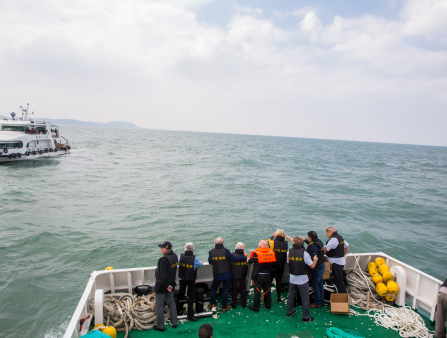
Descendants of POW sail to the Lisbon Maru wreck site.
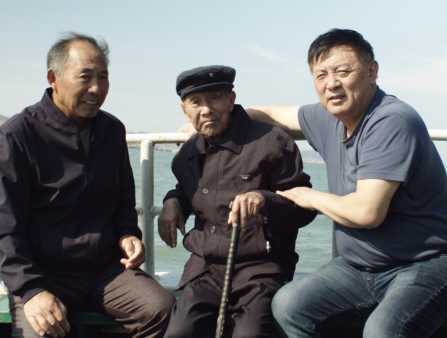
Producer-director Fang Li (R) with fisherman Lin Agen (M).
From the New Documentary Movement to “Main Melody”
To assess what The Sinking reveals about contemporary Chinese documentary requires an understanding of Chinese documentary history. Prior to 2010, most documentaries were produced by the national television broadcaster China Central Television (CCTV) or local satellite stations and distributed through official channels. Documentary films released in theaters were rare. What is now remembered as the golden age of Chinese independent documentaries from the 1990s to 2000s, associated with the New Documentary Movement, was marked by cultural resistance to marketization.
Prominent Chinese independent documentary filmmakers from this period—such as Wu Wenguang, Duan Jinchuan, Li Hong, Yang Lina, and Wang Bing—rebelled against the aesthetics of zhuantipian (“special topic program”), the traditional state-sponsored television propaganda program. Instead, they experimented with cheap, lightweight production methods and equipment; pooled production money from personal pockets; and focused on stories of people living on society’s margins and documenting the painful, less glamorous realities of the country’s social and economic changes.
Many of these indie docs did not seek the Dragon Seal—the release permit issued by the China Film Administration, which oversees film censorship in China and operates under the Propaganda Department of the Chinese Communist Party. Instead, their filmmakers sought audience and community through alternative distribution and exhibition, including DVD sales, grassroots events, independent film exhibition networks, and foreign film festivals.
Fang Li did not come from this tradition. When the New Documentary Movement filmmakers were leaving their state TV station jobs to film in factories, streets, and slums in the late 1980s and 1990s, Fang was earning his degrees: a bachelor’s in applied geophysics from East China Institute of Technology in 1982 and an MBA from Wake Forest University in 1989. In 1992, he founded the geoscience and ocean technology company Laurel Industrial in Silicon Valley, and soon opened offices in Beijing, Shanghai, Chengdu, and Hong Kong. From then to its dissolution in 2018, the company developed high-tech systems and machines for geophysical and deep-sea explorations for both export and China’s domestic industries and national research projects. As a private company with government support and contracts, Laurel Industrial provided Fang his primary source of wealth, which served him well after he founded Laurel Films in Beijing in 2000.
Of the first six movies Laurel Films produced, three were banned, and another had a canceled release. This record earned Fang the nickname “the godfather of underground movies” among his peers in Chinese-language media. He rejected the title, unlike many independent Chinese filmmakers who often wore an oppositional stance as a source of pride. But like the others, Fang saw film as an artistic medium for authentic self-expression and invested in films he personally believed in, without calculating profits. “I am spending money on making films, not investing,” Fang told business magazine Multinationals in China.
Coupled with new rules on broader censorship throughout the 2010s, independent documentary filmmakers now have both greater market opportunities and stricter ideological constraints.
Almost a decade into his producing career, Fang released his first commercially successful project, Buddha Mountain (2010), for which he also shared the script-writing credit with its director and longtime collaborator, Li Yu. That same year also saw a turning point for Chinese documentary. In 2010, a document titled Several Opinions on Speeding up the Development of the Documentary Industry was released by the State Administration for Radio, Film, and Television (SARFT). It marked the beginning of the state’s attempt to industrialize independent documentaries and rein in the booming underground.
New state-led investments and programs emerged, followed by the crackdown on alternative exhibition networks, including YunFest in 2013, Beijing Independent Film Festival in 2014, and China Independent Film Festival in 2020. In this new climate, the Chinese independent documentary many had come to know was all but crushed. Coupled with new rules on broader censorship throughout the 2010s, independent documentary filmmakers now have both greater market opportunities and stricter ideological constraints. Balancing commercial interest with the “main melody” (zhu xuanlv, a term frequently used in Chinese Communist Party discourse to describe cultural activities adhering to its main political lines), documentaries in Chinese theaters during this period often include themes of patriotism, revolutionary history, national development, and zheng nengliang (“positive energy”).
Main melody documentaries, such as Beijing 2022 (2023), The People (2023), Changing China: Life is Marvelous Because of You (2019), and Masters in the Forbidden City (2016), now overwhelm the market. They not only receive state funding but may also receive additional marketing support. For example, Amazing China (2018), a CCTV and China Film Group coproduction depicting various advances in China’s technology, industry, and social life under Xi Jinping’s leadership, reportedly benefited from organized trips to see the film by schools, corporate groups, and government bodies. It remains the highest-grossing Chinese documentary of all time with a box office of US$72.5 million.
Occasionally, a more recognizably independent documentary tops the chart. Recent examples include Four Springs (2019), a tender film that presents the director’s family’s daily life in a remote town in southwest China, and Twenty Two (2017), a solemn documentary that records the stories and present-day lives of the last surviving “comfort women” in China. These independently produced documentaries originated from the filmmakers and were released in other territories, testifying to the lasting appeal of original, rigorous storytelling in China despite its tightly controlled documentary film market. Though not singing the main melody, these independent successes, focused on familial intimacy and historical trauma, do not contradict state narratives.
“There are still audiences who really like documentaries,” says Zhang Laodong, a documentary filmmaker and founder of the Chinese documentary platform Aotu Doc, which educates and promotes the documentary form in China through publishing, media sponsorship, and events. Zhang notes that many Chinese audiences associate documentaries with CCTV broadcasts, and they “don’t have the habit of going into a theater to watch a documentary.” Despite the official marketization of documentaries that also made independent docs available in theaters, independent docs have to rely on word of mouth and grassroots boosts to have a chance at the box office.
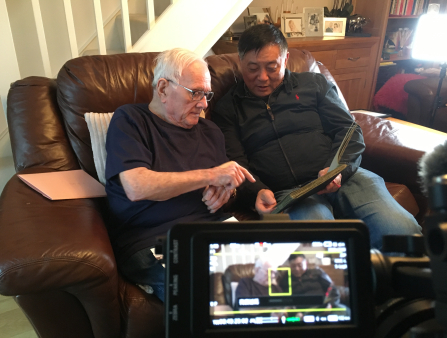
Producer-director Fang Li (R) with the late POW Dennis Morley (L), the last living survivor of the Lisbon Maru.

Producer-director Fang Li (R) interviews the late Ron Brooks, son of POW Charles Brooks.
The Personal Mode as Ideology in The Sinking of the Lisbon Maru
The idea of making a documentary didn’t come to Fang until he was already deep into The Sinking project. Previously, his producing background was entirely in narrative fiction. During a 2014 voyage filming The Continent with director Han Han near Dongji Island, Fang first heard about the Lisbon Maru from a local fisherman.
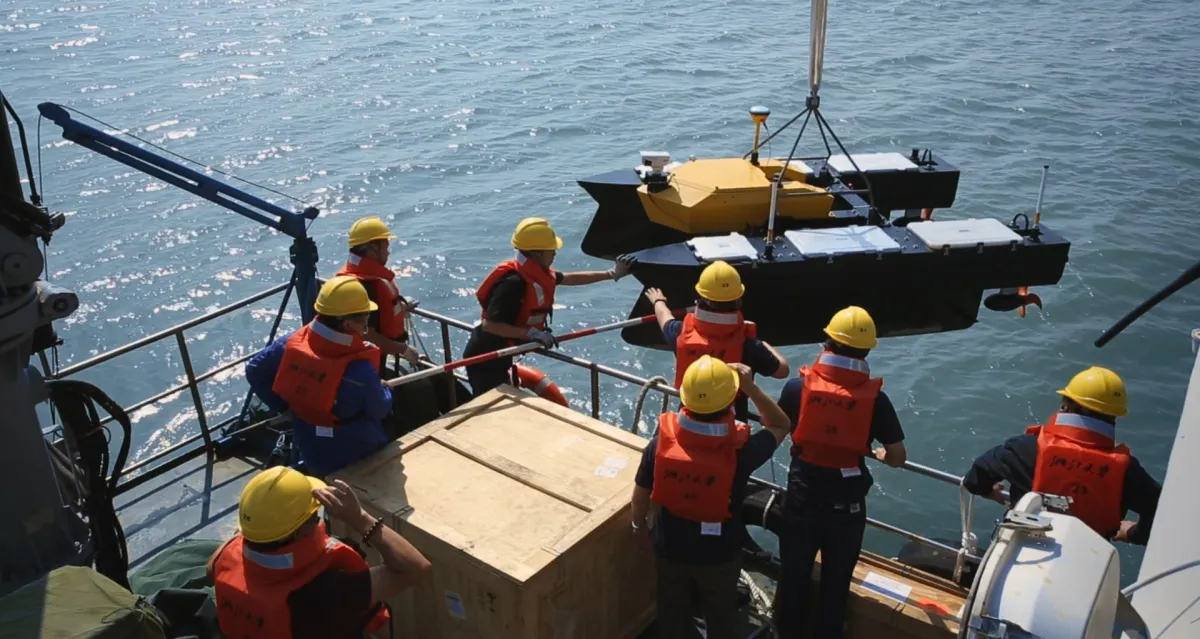
In October 1942, the U.S. Navy torpedoed the ship, a Japanese freighter, as it sailed through the East China Sea, not knowing it also carried approximately 2,000 British prisoners of war. The Japanese troops took back a few hundred POWs, and a few hundred more were saved by local Chinese fishermen, but most died, their bodies and the wreckage remaining buried at the bottom of the sea. Fang, as a geophysicist and marine scientist, led a team back to the East China Sea in 2016, corrected existing records of the shipwreck’s coordinates, and found the ship. Like James Cameron, who famously half-joked that he made Titanic so that he could dive and explore the deep sea, Fang repeatedly said to Chinese media, including Xinhua News, “At the time, I was just looking for a ship; I never thought about making a movie.”
The Sinking of the Lisbon Maru is set mostly in the present, chronicling Fang and his team’s journey of uncovering the history and present-day stories of the British soldiers and their surviving families. Opening with the successful search for the ship, the film follows Fang as he travels to the UK, Japan, and Canada to track down and interview the last few survivors of the sinking, their families, the children of the ship’s lieutenant and captain, and the only surviving Chinese fisherman who participated in the rescue, Lin Agen, who died in 2020.
Reenactment of events during the sinking and the subsequent rescue by Chinese fishermen are presented in woodprint-style, stop-motion animation in the film’s middle section. In a grand finale, Fang invites and personally pays for dozens of family members of the British soldiers to travel to China. As they are brought onto a cruise ship and sail the East China Sea to where the ship sank, they pay tribute to their late loved ones, holding their photographs, throwing flowers into the waves, and embracing Lin Agen—the man who rescued their relatives—and Fang’s own film crew.
In comparison to the independent Chinese documentaries of the 1990s and 2000s, which often employed a detached vérité mode, The Sinking foregrounds Fang’s own expositions, reflections, and reactions. Compared to the disembodied voiceover narrations that dominate state-funded documentaries, Fang’s narration feels situated and duly intimate. From scientific deep-sea explorations, to participatory interviews, to historical narratives, Fang’s presence offers the emotional throughline tying the film’s disparate strands and registers together.
In one scene, during a sit-down interview between Fang and a family member of a soldier who died in the sinking, the family member shows a letter the soldier left for his younger brother, then five years old. Fang quickly excuses himself as he breaks down in sobs. The camera follows him outside, showing him lighting a cigarette to calm himself and explaining to the camera, “I understand how it feels, because I have a younger brother, too.”
Kiki Tianqi Yu, a London-based filmmaker and scholar specializing in Chinese nonfiction and personal filmmaking, found Fang’s use of the personal mode moving. “He’s coming from that generation who usually hides their own perspective,” Yu says. “I think that was really a brave thing to do—a very meaningful thing to do, as well.”
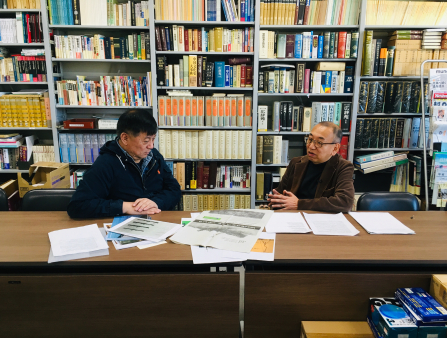
Producer-director Fang Li (L) with Professor Kurosawa (R).

Producer-director Fang Li with descendants of Lisbon Maru survivor Robert Bilinghan.
The Sinking departs from typical Chinese-produced history documentaries that often center on China’s own victimization or revolutionary triumphs. Yet despite shifting its focus to another nation’s historical traumas, Aotu Doc’s Zhang Laodong notes that The Sinking still sings the main melody as a fundamentally archetypal story about the “Good Man of China”—one that casts Chinese people as essentially good through stories of ordinary citizens’ heroic, self-sacrificial deeds. “From the production standpoint, he [Fang] didn’t receive much governmental funding and produced it independently, which makes it an independent film, theoretically, from the American or European criteria,” says Zhang.
“But from an ideological and creative standpoint, that’s another matter,” Zhang continues. Zhang refers to the “science educational nature” of The Sinking, using the term ke jiao pian, a longstanding genre of Chinese documentaries disseminating practical knowledge and ideological enlightenment to a mass audience. In fact, The Sinking received Best Documentary/Science and Educational Film at the 2024 Golden Rooster Awards in mainland China. This positions the film less as an artistic project or political critique and more as educational content serving social good, which allows it to align with state interests.
Nonetheless, Chinese audiences responded audibly. Historian Tony Banham remembered the powerful emotions he witnessed after attending a preview screening in 2023, exclusively for the crew, a few survivors, and hundreds of their family members: “Literally, everyone’s crying.”
Banham is a Hong Kong–based British historian and author of The Sinking of the Lisbon Maru: Britain’s Forgotten Wartime Tragedy, on which Fang’s research primarily relies and from which the film takes its title. The book has gained renewed interest since the film was released. Originally published in 2006, Banham’s book was republished in 2024 with a new cover. The traditional Chinese translation was published by Chung Hwa Book Co. (Hong Kong) Ltd. this August, and a simplified Chinese version is forthcoming.
Banham wanted a film to be made out of the story. When he was connected to Fang, he was so impressed that he authorized Fang’s adaptation without charging a fee for the rights. Fang credits Banham as the historical consultant in the film.
At the Shanghai International Film Festival, Zhang Laodong first watched the film and decided with his Aotu Doc team to help promote it by organizing screenings, such as two sold-out screenings of The Sinking in Beijing around its mainland theatrical premiere. Across the country, the film partnered with universities and local organizations, and Fang made appearances at postscreening discussions to meet audiences.
Hiu Man Chan, a senior lecturer in creative and cultural industries at De Montfort University in Leicester and founder of UK-China Film Collab, also saw the film at Shanghai and acquired distribution rights in the UK and Ireland. She was so moved by the film that she reached out to the team almost immediately after the screening, and after a protracted negotiation lasting six months, closed the deal with a deposit initially saved up for purchasing her own home. “It’s a very personal thing,” Chan jokes. “Don’t tell my mother.”
A few international distributors have also acquired the film, which officially opened in Macau and the UK last March, and in Hong Kong last July. Release plans are in negotiation with distributors in New Zealand, Australia, and North America. The Sinking was submitted for both Best Documentary Feature and Best International Feature Film for the 2025 Academy Awards, although it was disqualified for the latter due to its extensive use of English and was not nominated for Best Documentary Feature.
This exhibition network distinguishes the film from earlier Chinese independent documentaries that circulated through international festival networks. Rather than as an aesthetic or political statement, The Sinking is most useful internationally as cultural diplomacy.
Who Is Listening?
The film’s cultural specificity became evident in international release. What made The Sinking work so well in mainland China did not translate abroad. Unlike the indie gems many early Chinese independent films and Fang’s own portfolio items have become among cinephiles globally, The Sinking is conspicuously absent from international festivals despite domestic acclaim. It has screened at just a handful: the Asian World Film Festival in Los Angeles in November 2024, the New Zealand Asia Pacific Film Festival in November 2025, one festival in Singapore, and another in Russia.
Though rejected by film festivals, international screenings of The Sinking in a dozen countries across Europe, Africa, and Oceania were hosted mostly through Chinese embassy-organized community events. This exhibition network distinguishes the film from earlier Chinese independent documentaries that circulated through international festival networks. Rather than as an aesthetic or political statement, The Sinking is most useful internationally as cultural diplomacy.
Even in the UK, despite Hiu Man Chan’s acquisition and the film’s theatrical release there in March 2025, the results were disappointing. “The film is, economically, a failed project,” Chan says, though she declines to share box office figures, which are not publicly available.
According to Chan, the main theatrical run lasted two weeks in a dozen cities across the country. Since the summer, Chan has done pop-up screenings around special commemorations, including Victory in Europe Day, Victory over Japan Day, and the anniversary of the sinking. On V-J Day, Chan made the film available to stream on UK-China Film Collab’s film festival platform, Odyssey. Chan says the purpose of this was to make the film available to those living far from movie theaters, without paying fees to streamers like YouTube or Amazon.
The disappointing festival circuit and UK theatrical runs hint that the film’s ke jiao pian approach doesn’t work in the same way abroad. International festival programmers may expect either aesthetic experimentation or political critique from Chinese documentaries. UK audiences, even family members of the soldiers, couldn’t fully embrace a film that centers Chinese heroism over British sacrifice.
It is not really a top-down propaganda film, but it does show Chinese ambition or its international care. It’s really where the personal film meets the governmental propagandist function.
—Scholar Kiki Tianqi Yu
Fang’s tears, his scientific curiosity, his willingness to spend his fortune—these sincere gestures don’t contradict the film’s propaganda function but may fulfill it more effectively than state voiceover ever could. The documentary’s glaring lack of acknowledgment of Hong Kong’s colonial history—the reason the ship’s British soldiers were in Hong Kong before being captured by Japanese troops—is also notable. The film’s anodyne emphasis on humanistic love and pacifism is so all-encompassing that it erases finer narratives about colonialism and historical accountability. The documentary embraces the main melody framing, which requires broad slogans and moral clarity—such as Good Chinese Men rescuing suffering foreigners, advocating for peace and love—rather than offering any sense of historical complexity. To acknowledge British colonialism would complicate the virtue narrative implicit in the film’s ideological construct.
As modern Marxist philosophers put it, ideology functions best when it is not seen as ideological. In this sense, perhaps the most effective propaganda consists of objects or activities that are not branded as such, when the ideological functions are transmitted through diversified channels, and the message feels more earned than assigned.
If The Sinking has any propagandist tendencies, scholar Kiki Tianqi Yu says, its delivery through a personal lens tones them down without losing the film’s Chinese core. “It is not really a top-down propaganda film, but it does show Chinese ambition or its international care,” Yu says. “It’s really where the personal film meets the governmental propagandist function.”
For Yu, the film’s finale is not purely extravagant sentimentalism. It also demonstrates what she sees as a forthright expression that documentary filmmaking can rewrite history. “I think [Fang] chose to include that moment not just to celebrate, to unite and to thank these villagers, but also to see what documentary filmmaking can do,” Yu says.
However, she acknowledges that most documentary filmmakers do not have the resources Fang has—resources that would allow others to pull off something like this. “In a way, it’s good because it shows a different side of China that people don’t usually know. But, on the other hand, you know, it is Fang Li.”
Fang’s unique position may make The Sinking an unreplicable case. Yet the film’s core mechanism illuminates broader patterns in how independent documentary functions when divorced from political critique. The model isn’t unique to post-2010s China. Privately funded American documentaries like Melania, which is covered elsewhere in this issue, routinely advance implicit ideological frameworks—American exceptionalism, liberal individualism, techno-solutionism—without state direction or financing. What distinguishes China’s documentary landscape is not the existence of ideological alignment but its explicitness.
As The Sinking travels through diplomatic channels, its role indicates how documentary can easily accommodate political pressure. In China’s current landscape, the most successful documentaries—measured by box office, awards, and state approval—are those that perform independence while singing the main melody. The Sinking of Lisbon Maru perfects this performance.
This piece was first published in Documentary’s Spring 2026 issue.