
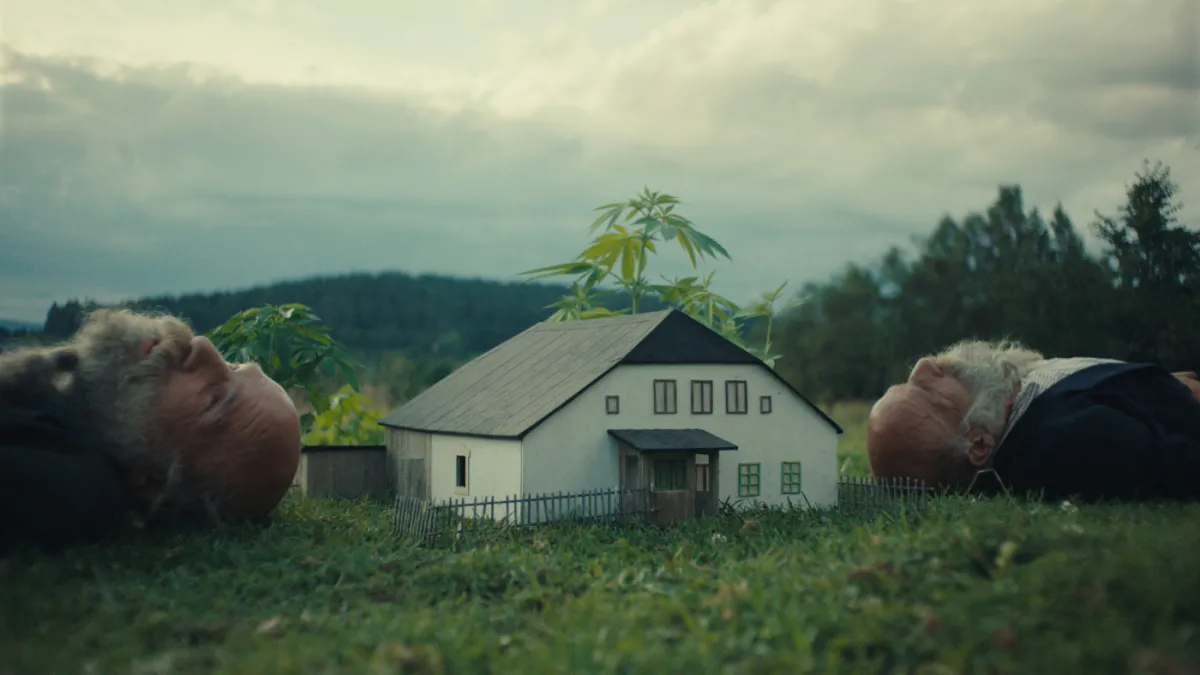
Better Go Mad in the Wild. Courtesy of Karlovy Vary IFF
While Karlovy Vary may be best known for its star wattage and warm midsummer embrace of fiction auteurs, this year’s 59th edition (July 4–12) once again made a powerful case for documentary’s enduring vitality. Across the official selection, sidebars, and special screenings, nonfiction titles proved indispensable in reflecting Europe and the region’s evolving identities, eccentricities, and contradictions. Despite a noticeable pivot in the Central European festival’s industry focus away from the documentary business, the artistic and philosophical weight carried by many of this year’s nonfiction works showed just how deeply documentary remains embedded in the gathering’s DNA.
Nowhere was this more evident than in the Grand Prix-winning Better Go Mad in the Wild, a formally inventive hybrid work directed by Miro Remo and co-produced between the Czech Republic and Slovakia. Remo’s win comes a year after Mark Cousins received the same award for his latest documentary, A Sudden Glimpse to Deeper Things (2024), an account of the life and career of British artist Wilhelmina Barns-Graham.
Although many doc professionals were in attendance and the line-up was rich in documentary genres, as confirmed by industry head Hugo Rosák, the festival has quietly phased out its Works in Progress platform—once a launchpad for both fiction and nonfiction titles such as Klára Tasovská’s I’m Not Everything I Want to Be (2024), which went on to premiere at the Berlinale and traveled widely.
“The Works in Progress platform no longer provided the kind of pre-sales traction that it once did—largely due to shifts in the industry landscape,” Rosák revealed. “In response to these changes, we’ve refocused our efforts on fiction films in the financing stage from the Central European region, where we feel our platform can still make a tangible impact in terms of visibility and closing funding gaps. We have also expanded into series recently, further shaping our industry focus.”
This shift does not reflect a loss of faith in documentary, he clarifies, but rather a strategic realignment: with regional support hubs such as DocuTalents at Jihlava already thriving, Karlovy Vary sees its value in complementing—not duplicating—existing documentary backing ecosystems.
Meanwhile, beyond the industry discourse, the program also showcased some of the best hits from other festivals, such as Sundance title 2000 Meters to Andriivka and Cannes ACID entry Put Your Soul on Your Hand and Walk, bringing broader global perspectives into the Czech festival’s nonfiction spotlight.
This year’s aforementioned prize winner, Better Go Mad in the Wild captures the singular existence of František (died just hours after the documentary earned the accolade) and Ondřej Klišík—twin brothers who’ve chosen to live off-grid, entirely rooted in one location. Equal parts absurd, poetic, and unnervingly relevant, the film examines what it means to reject the societal template in favor of stubborn, almost mythic, self-determination.
The movie is loosely based on one of the stories featured in the titular photobook by Aleš Palán and Jan Šibík, a collection of tales about the Šumava hermits. In detail, the film blurs the line between documentary and fiction, immersing viewers in the brothers’ eccentric, self-contained world in the Czech border region. Decorated for their activism during the Velvet Revolution, the twins never pursued conventional lives. They remain unmarried, unemployed, and bound to their crumbling house, filling their days with rambling monologues, recreational drug use (their dog is named Joint), and creative delusions like František’s flying machine.
Filmed across four seasons, Remo forgoes exposition to observe their daily rituals through poetic cinematography and rhythmic editing. While the classical score can feel overstated, the film’s genre-defying approach invites viewers to question norms around success, sanity, and freedom. Less concerned with answers than with presence, Better Go Mad in the Wild is a fascinating, open-ended portrait of radical self-sufficiency.
Similarly compelling was Syrian filmmaker Ammar al-Beik’s TrepaNation, which took a decade to make. Included in the Proxima line-up, the sprawling, deeply personal 222-minute film essay chronicles al-Beik’s life as a refugee in Germany. Shot entirely on a mobile phone, the film unfolds as a raw, eclectic collage, mixing home videos, personal voice messages, cultural references, art, and media clips. Al-Beik layers fragments from Goethe and Nina Hagen, video game music, and scenes from The Messenger with harrowing images of drone strikes in Syria and his injured friend Abu Ali, bringing together the banal and the tragic, the poetic and the political.
It’s not a linear narrative, but rather a fragmented meditation on exile, memory, and survival. Al-Beik’s late mother and his imprisoned wife Caroline emerge as emotional anchors in a film that resists sentimentality, even as it confronts grief head-on. His unflinching depiction of life in a refugee camp—including unsanitary conditions and psychological stagnation—doesn’t aim for poverty porn. Instead, even a pile of trash becomes a metaphorical “triangle of salvation,” invoking Jean-Luc Godard, Alexander Kluge, and Diego Armando Maradona.
While the film is rich in moments of insight and personal truth, its structure feels overwhelming and uneven. Al-Beik repeatedly reflects on the film’s own construction, and while this meta-commentary on editing and duration adds layers, it also highlights a lack of editorial restraint. Thus, TrepaNation remains a cinematic object hard to label, shaped by the intersection of war, art, and everyday life. It is less a conventional documentary than a living archive of one man’s experience, asking the viewer to witness, absorb, and reflect.
Shifting from exile to collective healing, Slovak filmmaker Paula Ďurinová’s Action Item builds on the personal tone of her previous feature Lapilli, but focuses instead on broader social struggle. Also showcased in the Proxima strand and concurrently playing at FIDMarseille, her new hybrid documentary reframes anxiety, burnout, and invisible illness not as isolated personal afflictions, but as symptoms of broader systemic pressures.
Rooted in Berlin and informed by Ďurinová’s own experience with burnout and support networks, Action Item blends observational footage, voice-overs, experimental montage, and archival fragments. The film opens with Eliana, a young woman navigating burnout, but soon expands into a mosaic of voices—unseen individuals reflecting on their mental health, work pressures, and precarious lives. This transition from the singular to the collective is key to the film’s argument: mental health is not a private crisis but a shared, structurally produced condition.
Ďurinová avoids traditional narrative and character arcs, favoring a meditative, fragmented structure co-developed with editor Deniz Simsek. Scenes from group therapy and quiet public moments are interwoven with poetic visuals shot by a team of cinematographers, including Clara Becking, Daria Chernyak, Radka Šišuláková, and the director herself. Silence is used as deliberately as speech, creating space for introspection.
Rather than offering solutions or closure, Ďurinová’s film functions as a shared space for recognition and reflection. It critiques the bureaucratic systems and neoliberal structures that contribute to emotional exhaustion, particularly among migrants, women, and young workers. As a hybrid work that mixes personal essay and social inquiry, Action Item exemplifies a growing strand of nonfiction cinema that is formally experimental yet grounded in lived experience. It speaks to a generation grappling with the psychic toll of contemporary life and offers a quiet, resonant act of solidarity—one that invites us not to pathologize our pain, but to contextualize it.
A similarly introspective, yet outward-looking approach defined Divia, young Ukrainian filmmaker Dmytro Hreshko’s third feature documentary, which premiered in the main competition. The film offers a powerful, dialogue-free meditation on the often-overlooked impact of war on nature and animals. Rather than focusing on human suffering or military conflict, Divia turns its gaze to the forests, rivers, animals, and landscapes of Ukraine, disrupted and scarred by Russia’s ongoing invasion.
Without title cards or interviews, the film builds its emotional rhythm through visual and sonic cues. A destroyed village is revealed when a veterinarian quietly feeds a cat; we see landmine removal teams at work, and dolphins washed ashore. Shot in immersive, flowing camera movements—often overhead or gliding just above ground—the film begins with the beauty of untouched nature, underscored by Sam Slater’s atmospheric orchestral score. But as the sound of aircraft and explosions emerge, the tone darkens. Animals flee, music becomes dissonant and industrial, and signs of devastation appear: burned forests, sunken towns, dead wildlife. The sound design—rich with ambient noise, eerie vocals, and static—intensifies the film’s immersive quality.
Yet Divia doesn’t dwell solely on loss. The latter part of the film quietly signals resilience and rebirth: plants sprouting through debris, wildlife returning, scientists in lab coats testing water. Nature, the film suggests, persists—even if altered. Though its coda slightly overextends the runtime with repeated motifs, this structural choice mirrors the endless, wearying rhythm of war itself. In a saturated landscape of war-related documentaries, Divia stands out for its cinematic ambition and fresh perspective. Among the expanding canon of Ukrainian war documentaries adopting observational forms or journalistic approaches such as 2000 Meters to Andriivka (2025), We Will Not Fade Away (2023), 20 Days in Mariupol (2023), and The Earth Is Blue as an Orange (2020), Divia distinguishes itself through its formal elegance and contemplative focus on the war’s imprint on the nonhuman world—a perspective that is as rare as it is haunting.
Davide Abbatescianni is a film critic and journalist based in Rome. He works as an International Reporter for Cineuropa and regularly contributes to publications such as Variety, New Scientist, The New Arab, Business Doc Europe, and the Nordisk Film & TV Fond website. He also serves as a funding expert for two European financing bodies.