

What more can be said about drag in film?
This was the question that lingered in my mind as I sat in the audience at the back of The Steps, a Sofia venue known for its queer arts programming, waiting for a screening of Fil Ieropoulos’ Avant-Drag! Radical Performers Re-Imagine Athens. From campy to commercial, niche to mainstream, explorations of drag culture and community on screen have proliferated exponentially since Jennie Livingston’s Paris Is Burning torched the hetero-house in 1990 (The Queen, the 1968 doc that preceded it by decades, is but one example of drag’s long lineage on the big screen).
In the past decade alone, projects as disparate as Muslim Drag Queens (2015), Kings, Queens and In-Betweens (2017), Drag Kids (2019), and Queendom (2023) suggest there’s no shortage of real-life stories from all over the world about the artistry of drag. It is into this budding canon that Avant-Drag!, a proudly unconventional documentary by Ieropoulos, an Athens-based filmmaker, writer, and teacher, arrives. The film, which premiered at Rotterdam 2024 and has played over 70 film festivals since, explodes with a fresh, incendiary—and pointedly political—perspective.
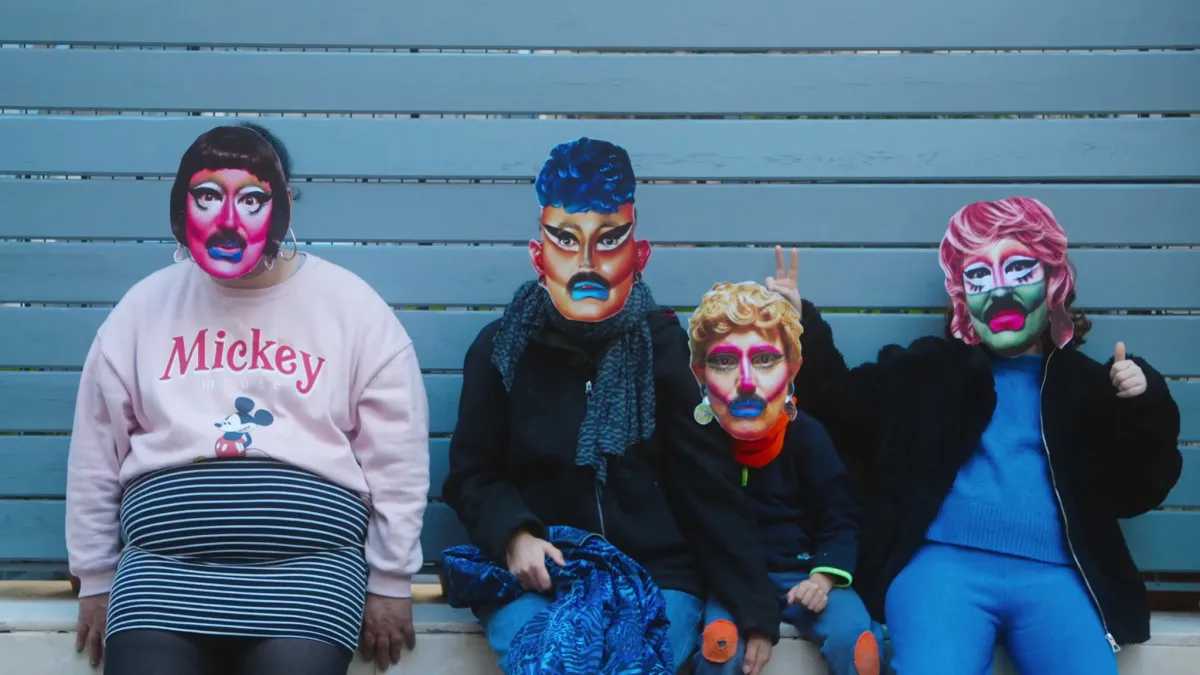
Over the course of the 92-minute experimental work, ten Athenian drag performers are introduced, initially through direct address, as they defiantly peer at the camera. Standing out in audacious makeup and vibrant ensembles, they each move through various public spaces of Athens, creating wildly incongruous scenes, as they stop to discover a beautiful treasure in the trash, or deliver a passionate monologue in heels to drivers stopped in traffic. Their recorded voices narrate complex layers of their lived experience, blending the personal with the political. Such ambulatory sequences recall the Aristotelian practice of walking while teaching, a peripatetic tradition infused here with fierce conviction and creativity, by the likes of local queens like Er Libido and Cruella Tromokratish.
As the film’s drag chaperones, they challenge mainstream representations of queerness, trans identity, and normative drag as they break apart rigid concepts of religion, nationalism, gender, and identity. Ieropoulos collaborated with each protagonist to produce short video art pieces that contribute to their profiles and serve as citations to radical LGBTQ art of the 1970s and 1980s.
These chapters are held together (loosely) with reflective cityscape shots overlaid with eloquently written, spectral narration by Foivos Dousos and voiced by actress Marisha Triantafyllidou, who together provide the deep texture for the eleventh character in the film: Athens, a “city where strangers, freaks, whores make their own infrastructure in their own image and likeness.” The short videos range from an infomercial offering Albanian migrants as cheap labor who have the “unique ability” of not talking back, to a sacrilegious performance involving phallic burning candles.
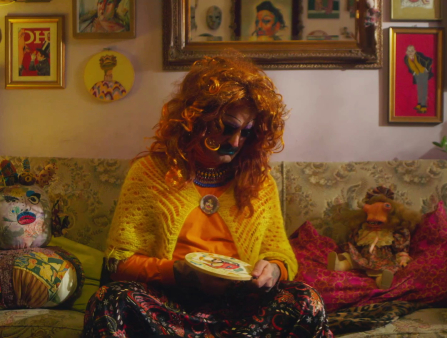
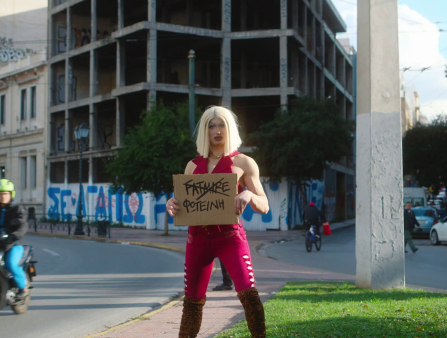
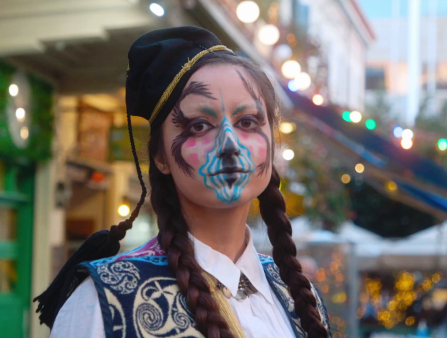
These are drag refuseniks taking their creative/critical space. They are artists and activists who insist on a radically inclusive Greek society and transformative commons while eschewing gender dogma and stuck liberal affectations. The result is an audacious, enticing, and subversive film whose explosive ideas and anti-orthodox storytelling attest that there is, in fact, much more to say from and about drag.
After being wowed at the screening in Sofia, I sat down with Ieropoulos, to talk about avoiding linear storytelling, why drag is fertile ground for political intervention, and why Avant-Drag! takes on Greek nationalism with such verve. The interview has been edited for clarity.
DOCUMENTARY: Why did you make Avant-Drag!, and what work is the film doing along political and aesthetic registers?
FIL IEROPOULOS: I’ve been involved with the queer arts movement in Athens for over 10 years now. A lot of what one sees in Avant-Drag! is connected to research that’s been happening for a long time.
When I started working with my collaborator Foivos around 2012, there were hardly any queer arts in Greece. The concept was barely known. Some people were asking, “Is it like feminism?” Or, “How is queerness related to art?”
We come from a very long line of queer arts internationally. We always felt that there was this background. But there wasn’t any of it in Greece. There have always been those who have in some way worked with gender, but it was always on the side and not necessarily very conscious. This has dramatically changed in the last six or seven years. Especially post-COVID. At some point, Greek arts foundations started thinking, “We want to be contemporary. We really want to hop on this international bandwagon of gender, queerness, and creativity.” And they commissioned queer works, which were mostly apolitical.
This approach doesn’t take into consideration class, precarity, poverty, the difficulty for trans people to find jobs. A Marxist approach to queerness was totally missing. Essentially, when COVID came, and we saw a lot of lonely—particularly queer and trans—people here in Athens, it was particularly hard. We thought, “Oh my God, we need to tell our stories because all the arts institutions are going to tell our stories in a very inadequate way.”
D: Where does Avant-Drag! fit within larger representations of drag?
FI: I think, for instance, Queendom is an ok film. The artist featured is spectacular. But it is a very linear story, filmmaking-wise, which is the norm. A lot of drag docs are fairly straightforward when it comes to their structure and filmmaking approaches. Plus, so many focus on the whole transformation/normality thing, [which] we purposefully avoid in our film. In Avant-Drag! we tried to drag up the very format of filmmaking, making it all a sort of camp manifesto.
D: You’ve said the film is a series of manifestos, and because of that, it must be both extreme and silly at the same time, and possibly even annoying. Could you elaborate on that?
FI: Queerness has a very long history linked to manifestos. I wrote a manifesto following the film I made before Avant-Drag! which talked about how the way of making queer films could be different in form. I put forward the idea that just doing films that have queer themes doesn’t mean anything anymore. But making up queer manifestos must be silly because we are very familiar with the fact that the Futurists did manifestos. They were very good at doing them. And they were fascists. So, we know from studying history that art and totalitarianism are not mutually exclusive. I believe that the spectacle is always dubious. It’s always something we need to deconstruct in order to reach where we want to be politically. But we’re not against the spectacle altogether. We flirt with it, but we also break it, which some think isn’t actually possible. But I totally believe that you can make a manifesto that is making fun of itself and still mean 100% what it is communicating.
I believe that the spectacle is always dubious. It’s always something we need to deconstruct in order to reach where we want to be politically.
— Fil Ieropoulos
D: Across your work, one sees a very pronounced non-normative anti-nationalism strain, especially concerning the Greek Orthodox context, Avant-Drag! included.
FI: As one of the performers in Avant-Drag! says, “Drag is a fertile ground for political discussion,” and how can you do drag and not talk about your own pain and trauma, and the difficulties of where you live? Our anti-national stance goes back, not necessarily to our backgrounds as artists, but as people involved in political scenes in Athens. Greece is a very complicated territory. It is true, nationalism is complicated everywhere, but in Greece, the layers are many. The moment you think you stripped away one layer, another form of nationalism based on another century of history comes up.
D: At the Sofia screening you said that concerning Greek nationalism, “We need to let go of certain attachments.” Is your film work meant to provoke a kind of destruction?
FI: I don’t have a problem with the word “destruction.”. I don’t think people should destroy other people’s lives. But destroying concepts? Absolutely. Could it be claimed that a film like Avant-Drag! could actually change Greek reality? That’s a very big statement to make. Do I believe that art can obstruct or transform reality? Maybe. It’s a very difficult thing to say. We have tried our best in the last 10 years, with our various projects, to really deconstruct Greek nationalism. Not just with Avant-Drag!, but with a whole series of things we’ve done. Every now and then, I notice someone poking fun at something to do with Greece’s mythology itself. And I think: “We helped plant this particular seed.”
D: You’ve described Avant-Drag!’s radical form and progressive politics as “punky.” Given the current cultural/political climate, is there room for punky films?
FI: I think there is a need for a real, serious shakeup of curatorial work in the world. Especially since such a big part of people’s lives has to do with the algorithms of social media. There’s no way the algorithm is going to throw you interesting things. It’s going to throw you the things based on the products it can help sell. I think what needs a shakeup is the so-called independent curatorial spaces. They point toward the poverty of the contemporary left, which we urgently need to revamp. We need to somehow return to radical hope and imagination for the future.