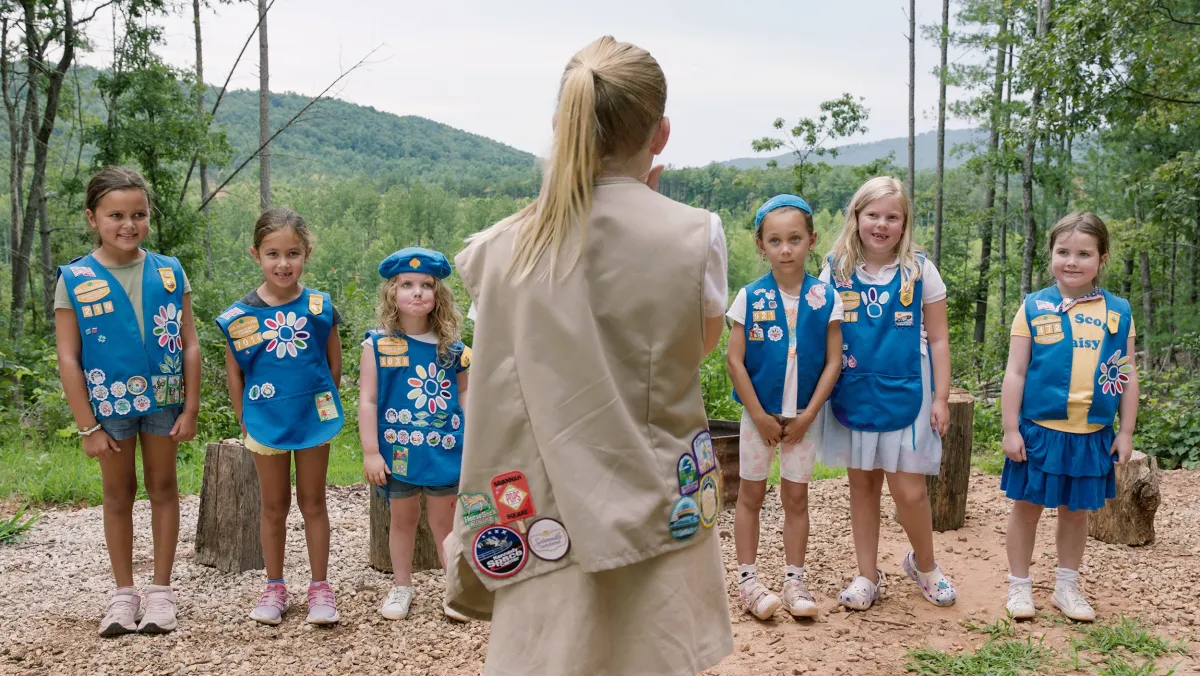


Equal parts delightful and disturbing, Alysa Nahmias’s Cookie Queens is a behind-the-scenes peek at an annual ritual as ubiquitous as caroling and trick-or-treating: Girl Scout Cookie season. The film follows four adorable U.S. troop members, ages five to twelve (and from different cities, ethnicities and economic circumstances), all determined to meet their individual capitalistic goals in a whirlwind six weeks of pitch-honing, social media strategizing, and practiced salesmanship. Ara, the youngest, plans to sell eleven times what she did last year (when she sold five). Nikki is hoping for a giant trophy and maybe even a trip to Europe—following in the footsteps of her teen sisters who are soon to be aging out of Scouts. Shannon Elizabeth just wants to attend Girl Scouts summer camp. Olive, the eldest and most competitive of the bunch, seeks to break her state’s record.
Cookie Queens is told almost entirely through vérité observation, alternating between its four protagonists through the countdown structure typical of competition documentaries.
But once the sugar rush ceases, the bitter reality of long hours and the pressure to meet outsized expectations comes into frame. How exactly does deploying “cuteness” for profit and celebrating consumerism lead to female empowerment? By the time we learn that Olive has earned over $200K for the organization in her seven years as a Scout, the critique of GSA as a billion-dollar enterprise powered by unpaid child labor lands like a powerful punch. And yet Cookie Queens ultimately offers a message of hope. With grit and determination institutional structures can be made to crumble, and then reimagined from within.
It’s a lesson the director, a trained architect, seems to know well, having already crafted a trio of films that examine how institutions encourage—and often constrain—creative ambition. Nahmias’s debut feature Unfinished Spaces (2011, co-directed with Benjamin Murray) followed three architects whose visionary Cuban National Art Schools, commissioned by Fidel Castro and Che Guevara in 1961, were abandoned mid-construction when their radical designs fell out of political favor; while The New Bauhaus (2019) and Art & Krimes by Krimes (2021) likewise center on ambitious artists, the former the famous Hungarian designer László Moholy-Nagy, the latter the less well-known muralist Jesse Krimes, who created his masterpiece in secret while serving time behind bars.
The week prior to the film’s Sundance premiere on January 25, Documentary reached out to Nahmias to hear about transforming a conventional doc structure featuring adorable stars into something surprisingly profound—a thought-provoking critique of corporate commercialism secreted inside a cinematic sweet. This interview has been edited.
DOCUMENTARY: How did this film originate? Did you set out to critique our consumer culture or did that aspect develop as you followed these girls?
ALYSA NAHMIAS: In 2023, after directing Art & Krimes by Krimes and producing Wildcat [2022], films that tackled heavier subject matter, my kids (at the time eight and eleven years old) asked me to please make my next film one that they’d really want to watch and tell their friends about.
A couple of weeks later, I was talking with my filmmaker friends Michael Dweck and Gregory Kershaw [The Truffle Hunters, 2020]. Michael mentioned that he’d just been sold an ungodly amount of Girl Scout Cookies by a Girl Scout with extremely high sales goals. We all agreed this would be a fascinating world to explore, and the vision for Cookie Queens hit me right away. It felt personal to me as a woman, an artist, and a mother. I knew this would not only be visually rich; it would also be a microcosm of larger themes about girlhood and capitalism. And maybe, if I was lucky, kids might want to watch it with their friends.
It was important to me that this film be different from typical “competition docs” as part of its critique of mainstream narratives about what success means, who gets to call themselves successful, and why. When Girl Scouts sell cookies they’re not only practicing for the real world economy, they’re generating nearly a billion dollars in annual revenue.
My perspective on consumer culture evolved as I followed these girls through the cookie season and worked with the footage during the edit. Girls learn from such a young age—consciously and unconsciously—that we can be wildly ambitious as long as we’re always charming. The pressures of these cultural assumptions persist into adulthood for many of us.
I witnessed the Girl Scouts in Cookie Queens find ways to express their unique identities and to define success for themselves—and the stakes were high at times. The visual and sonic details of their stories, in the entirely observational scenes, reveal insights about growing up as a girl in a consumer-driven world that I’d rarely seen depicted onscreen.
It was important to me that this film be different from typical ‘competition docs’ as part of its critique of mainstream narratives about what success means, who gets to call themselves successful, and why.
— Alysa Nahmias
D: Could you talk a bit about the casting process? How did you find your protagonists—and why these four?
AN: Casting this film was loads of fun. I wanted to feature Girl Scouts of different ages and backgrounds who are super passionate about selling cookies, whose personal growth during cookie season would be just as important as their sales goals. My producers and I took a grassroots approach, working with nonfiction casting consultants Whitney Adams and Dan Bell to connect with as many Girl Scouts as possible through social media, schools, and troop leaders around the country. Whitney completed Zoom interviews with more than a hundred families, and then I interviewed several dozen of them.
Unpredictable elements are the best part of documentaries for me, so I looked for each Girl Scout’s distinctive visual world and singular motivation for selling cookies, as well as her potential to surprise me. I was particularly interested in girls whose imaginations were active, and who the camera could observe as they made tough choices and faced challenges.
There were a few instant fits during the casting process, and we began to shape the ensemble around them. For example, Ara, the youngest Girl Scout in the film, created a video of herself talking about cookies, which was incredibly natural, funny, and memorable. Once the casting was narrowed down, I visited several Girl Scout families for a few days so we could get to know each other without filming. I met with their troops, listened to their questions and ideas, and was very transparent about my creative process and the type of collaboration and care that’s important to me with the people in my films. Fortunately, we ended up with fabulous Girl Scouts to film with during cookie season.
D: I was surprised to learn that you consider this latest film to be a thematic continuation of your prior works, which are mainly centered on artists and architecture. How does Cookie Queens fit into your oeuvre?
AN: As a director with a background in art and architecture, I began telling stories rooted in these fields. My previous documentaries highlight remarkable artists and designers, focusing on universal themes such as self-invention, value, and the dynamic between individuals and institutions. I see Cookie Queens as a continuation of my exploration of those ideas, as our protagonists are naturally creative spirits who find themselves up against structural and institutional norms that they’re challenging, even resisting, in their own ways.
The Girl Scouts in this film have entrepreneurial minds, and they’re constantly performing when they create songs, slogans, dances, pitches, and videos to sell cookies. I was interested in the camera showing them “turning on and off” as performers. Family and educational structures like schools, sports teams, or scouting organizations are among the first institutional authority figures we encounter in our lives, and I wanted to make a film that takes girls’ voices seriously as they engage with those dynamics.
At the same time, Cookie Queens also marks an exciting stylistic evolution for me as a filmmaker. I don’t see my films as a collection of similar items, but as a living body of work. My prior films blended observational and archival footage. My decision to tell this story entirely in present tense—without any interviews—required me and my DP Antonio Cisneros to be especially patient, adaptable and attuned to the girls as we filmed; and then for me to work diligently with my editors Kim Roberts and Jeanne Applegate to shape scenes without external scaffolding, generating meaning in juxtapositions between the storylines. I’ve never wanted to define my work by subject matter, but rather by my willingness to take risks and discover singular ways of telling each story.
My decision to tell this story entirely in present tense—without any interviews—required me and my DP Antonio Cisneros to be especially patient, adaptable and attuned to the girls as we filmed
— Alysa Nahmias
D: It struck me that following four adorable children pursuing a shared goal is a somewhat familiar setup, though laying bare the human “price” of Girl Scout cookie-selling is rather subversive. Which made me wonder if you purposely kept the film’s aesthetics upbeat and colorful as a way to contrast the less seemly commercial aspects. Was this a conscious effort or more a happy accident?
AN: Yes, the film’s story plays with expectations around “competition doc” narrative structure, and it challenges expectations about how kids—and in particular girls—are typically represented onscreen. The world of Girl Scout Cookies is not only aesthetically alluring—full of primary colors, plucky kids and eccentric customers—it is an accessible microcosm containing larger themes about girlhood and capitalism. The world of selling cookies is one of childhood joy, ambition, hope, and delight. At the same time, there are personal and collective costs involved with kids participating in the adult economy. Through the lens of young people selling Girl Scout Cookies, it can be a little easier to notice that everything about the economy is constructed, and the rules of the game tend to be created by the people who have the most power.
For me, the contrast between the bright, playful visuals of the external worlds that these girls inhabit and the more nuanced, vulnerable tones in their personal stories isn’t only about Girl Scouts or cookies. It’s a juxtaposition of the innocence of childhood and the intense social pressures and challenges that young women face in general. In making Cookie Queens I wanted to show how girls understand the power of our appearances as currency (or lack thereof), and that the reality of “cuteness” selling is hard. Not everyone fits the traditional girl mold (sugar, spice, nice), and Girl Scouts can give them a space to be themselves; yet during cookie selling it can also be where they need to mask to be more of what society expects of them. In this sense, Girl Scout Cookies are emblematic of all types of honey on the razor’s edge of capitalism, which are incredibly difficult for many of us to resist.
D: How have all the girls (and their families) responded to the doc? Has participating in or viewing it sparked any deep reflection about the Girl Scouts or corporate commercialism in general?
AN: The girls and their families have responded positively, and they are super excited for the Sundance premiere. It’s wonderful to see them not only feeling proud of their contributions, but also feeling joy in watching the stories of the other families in the film.
Although I can’t speak for them, after viewing the film many of these families have expressed to me how much they appreciate what Girl Scouts brings to their lives, how it has pushed the girls outside of their comfort zones, the memories selling cookies have given them, and how they see their troops’ impact in their communities—while also seeing opportunities for things to improve at a local and national org level. As shown in the film, Girl Scouts encourages their members to use their voices and harness their ambition. I’m proud to see the girls use their power to tackle changes they want to see in the organization, which they deeply care about.