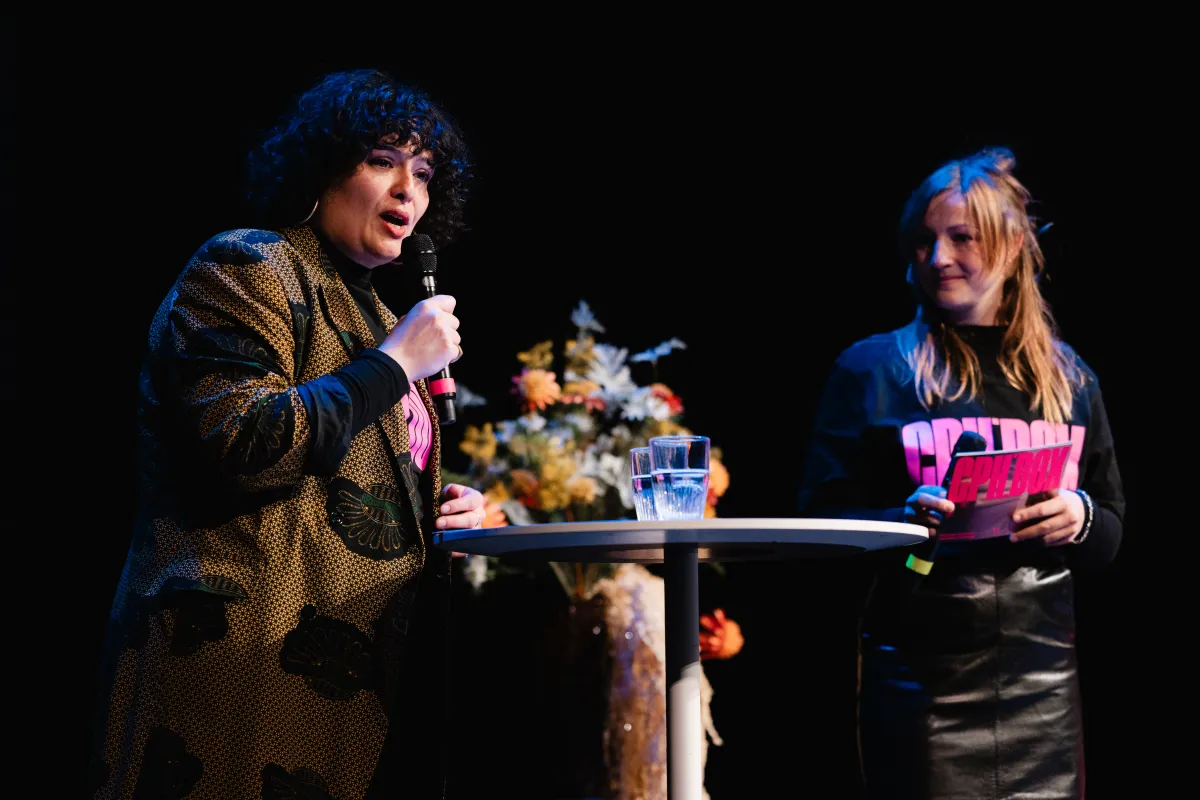


When CPH:DOX managing director Katrine Kiilgaard hired the Montreal-based Mara Gourd-Mercado as Head of Industry, the explicit goal was to deepen the festival’s connections between Europe and North America—a bridge-building mandate that has since become considerably more urgent. Three editions later under Gourd-Mercado’s tenure, CPH:FORUM’s decision-maker and accredited audience attendance has grown (one day this past edition had over 650 entries), filmmaking training programs have expanded, and the CPH:DOX SUMMIT launched as a dedicated space for policy and advocacy ambitions.
Gourd-Mercado, who moved to Copenhagen for the position, oversees a platform that is, by most measures, thriving at a moment when the market it serves is not.
In the following conversation, conducted over Zoom this month, Gourd-Mercado discusses how festival industry programs can demonstrate their impact rather than merely assert it, the importance of creating cohorts among emerging filmmakers, and how to measure the success of a pitch forum. This interview has been edited for length and clarity.
DOCUMENTARY: CPH:DOX, like many film festivals around the world, is partially supported through Danish public money. Before, you came from roles leading RIDM and the Quebec division of the Canadian Academy, which I assume both had very strong public mandates as well. How have your experiences shaped how you think documentary institutions should serve filmmakers versus how institutions should serve the industry or the field at large?
MARA GOURD-MERCADO: I think the way funding bodies in Canada see the role for both festivals and film is pretty similar to the Danish system. Specifically in Denmark, there’s this idea of supporting cultural organizations and events to strengthen civic participation among the general public, as well as within the industry and the community. At CPH:INDUSTRY, we approach it from a global point of view. Yes, it is based in Denmark. Yes, we serve the Danish community. But the idea behind CPH:DOX is to serve the Danish industry by being that bridge between Denmark and the rest of the world, including the Americas.
Globally, we bring financiers and funds, whether private or public, to serve the industry, including producers. On the individual filmmaker side of things, we look not only at financing, but at community building, networking, developing skills through different training programs, and developing the artists who come, whether through our lab or INTRO:DOX.
D: INTRO:DOX is a relatively recent program. What does it give emerging filmmakers? Are you modeling it after other introductory programs? I’m noticing more and more festivals are doing this type of table setting orientation.
MGM: Originally, this program was thought of in 2022 for the 2023 edition. At the time, the idea was that CPH:DOX offered a pretty good deal for established filmmakers and people already in the industry with a solid enough background to pitch at the forum and take part in coproduction roundtables. What we get a lot from the Danish or Scandinavian region is line producers or junior producers missing a path to soft launch without being lost in all the activities of CPH:DOX.
Now, it’s two days in a closed setting with a specific cohort, where the activities are designed to learn some parts of the industry in a more personable way and in a smaller setting. After those two days of prep time, you get folded into the “regular” industry activities. This isn’t super original—IDFA has IDFA Academy—
D: —there’s also Berlinale Talents, Locarno Academies. For participants, it sounds great to have your crew of people that you can roam around the rest of the industry activities with.
MGM: Last year, we started a buddy program where we connected groups of five or six via WhatsApp and introduced them via email. INTRO:DOX is a closed setting, but it’s still 100 people. We could see the buddy groups together in the different activities at CPH:DOX. Anything that can break down barriers so it doesn’t feel like your first day of high school when you get there and don’t know anyone is useful.
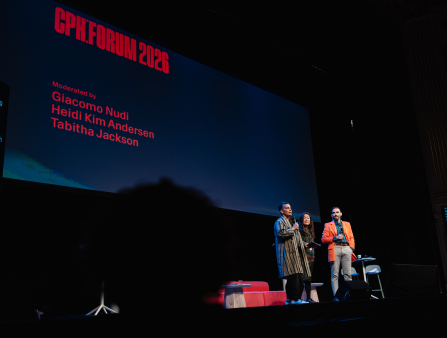
(L to R) Tabitha Jackson, Heidi Kim Anderson, and Giacomo Nudi at this year's CPH:FORUM.
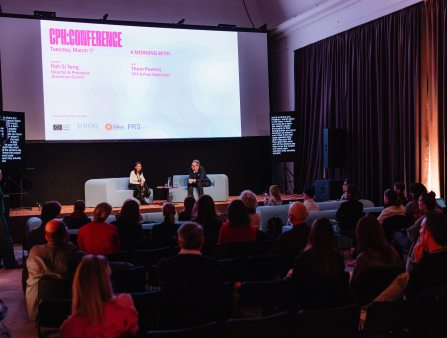
Poh Si Ten and Thom Powers during a conversation at CPH:CONFERENCE.
D: The summit and conference have taken on increasingly ambitious intellectual frameworks. I’ve observed it move from a more standard industry conference and into questions of media sovereignty and the infrastructure of truth. This year’s opening keynotes involved advocacy and policy. These are real stakes; democracy dies in darkness. But ambitious framing and policy or social impact are two very different things. What do you think a festival conference can produce beyond the conversation that happens there?
MGM: Since the inception of the conference, the concept was to have a space to think outside of the usual nuts and bolts of the industry—producing 101, coproducing with three, four partners, etc.— and, instead, to give a breather to filmmakers to think of their practice in other terms. For some iterations, it was divided into three days, focusing separately on science, society, and art, and curators were selected to respond to that focus specifically. It was that mix of ideas. With time, the conference had different models. What we realized over the last few years is that attendees choose based on when they are available in their schedules. Katrine [Kiilgaard, managing director] had long had this idea of having a summit that was really separate from the conference.
Two years ago, we launched the Summit with a simple idea: The house is on fire—what can we do? The results that we’re looking for, beyond what happens at CPH:DOX, is to really have an impact in some way on the people who are thinking about our future, the policies that are needed to maintain public media, and the infrastructures that will sustain and facilitate access to public media. I think that it’s an ambitious goal... I’m not sure we’ve achieved it yet.
It’s hard to get policymakers to actually be in the room. We have some coming in here and there, but the goal is to also then reach out to policymakers with the notes from the summit and say, “Here’s a document of a group of people who are experts in their own fields that got together to think and to get these ideas that you can read and maybe can influence where you’re going with your policies.”
When we were looking at and evaluating what had been done, we were satisfied with the speakers and the ideas that were brought together. But we also discussed, What’s the following step? What do we do to bridge that moment during CPH:DOX and then the rest of the year and other film events?
D: How do you measure the success of CPH:FORUM, the shiny star of the industry program, at a time when the financing of documentaries is so precarious?
MGM: We have a lot of metrics. We do follow-ups right after the festival, as well as two-, three-, and five-year surveys. Not only do we reach out to the teams that pitched, but we also do a lot of tracking of the pitch projects—research on circulation, premieres, and distribution—we have a huge Excel sheet. We also track the amount that each project was able to raise between the moment they pitch at CPH:DOX and when they completed the film. That’s not to say that it was because of CPH:DOX, but to measure what happened in the financing of that film. We also track the projects that fell through and stopped. We know what percentage is still in development, in post-production.
For us, the measure of success is different depending on the region and the subject of the film, but the metric that for us is also really important is the survey that we send asking, “What type of results did you achieve? Did you get an LOI? Did you get an LOC? Did you get a coproduction? Did you get a creative partner? Are you just in conversation?” We really try to drill down to every type of result that they can have to see if that’s useful.
Two years ago, we launched the Summit with a simple idea: The house is on fire—what can we do? The results that we’re looking for, beyond what happens at CPH:DOX, is to really have an impact in some way on the people who are thinking about our future, the policies that are needed to maintain public media, and the infrastructures that will sustain and facilitate access to public media.
—Mara Gourd-Mercado
D: The huge spreadsheet tracking of premieres and distribution is a super common practice in our field. But I’m not sure whether that actually tracks impact or the team's ability to identify projects that already have momentum. Many projects now are going to multiple markets and forums. I wonder how we actually prove causality.
What are you finding from that survey with filmmakers? Are you seeing that the amount of business is the same, or has changed?
MGM: The amount of money is not the same. The amount of business is kind of similar, which is interesting. When you look at, let’s say, the percentages of “Yes” responses to questions about making new connections and being in talks with potential partners, they’ve remained quite high since I’ve been here. This year, we changed the survey to be more precise, and I think that we’re going to update it again for next year to ask more specific questions, for example, on the amount of LOIs or LOCs that people get. We’ve never asked, “Did you get promised an MG? And if so, how much?” We should give people the option to not answer if they don’t want to. But I’m pretty sure that then you would see a drastic change in the amounts that people get and in what gets promised or what gets confirmed. I’m also interested in going back to projects a year or two years later and asking, “What happened to those LOIs?” And then track that.
We also do a round of calls with both some of the teams and some of the financiers that take the meetings, and then we really sit down and look at the list of meetings and go meeting by meeting and ask the teams, “How was this? Was this a good meeting? If yes, why? If not, why was it not useful?”
And that’s where we get a lot of insight. If we can pool those insights with other pitching forums and find a way to improve tracking, I think it would be so helpful for the industry in general.
D: CPH:FORUM still uses the rotating panel of experts format that festivals have used for decades. The CPH one can be entertaining because it’s a new set of three panelists for every project. But I’ve been noticing recently that other pitch forums are switching up that format. What does this format do well, and where might it fall short?
MGM: For me, the point of the pitch is to raise the profile of the project and to get it out there into the world and then try to get it financed, of course. But I also think that there is such a fantastic educational value in that type of format. Though two or three panelists repeat from year to year, people who might not know those financiers and might not have a meeting booked can learn a bit more about what they’re looking for. Through the comments and questions that those financiers and industry reps make, you get a glimpse of who they are, how they function, what interests them, and how their brains work. I do appreciate other formats at other festivals. In the context of CPH:DOX, our format works for now, but it is something that we revisit every year.