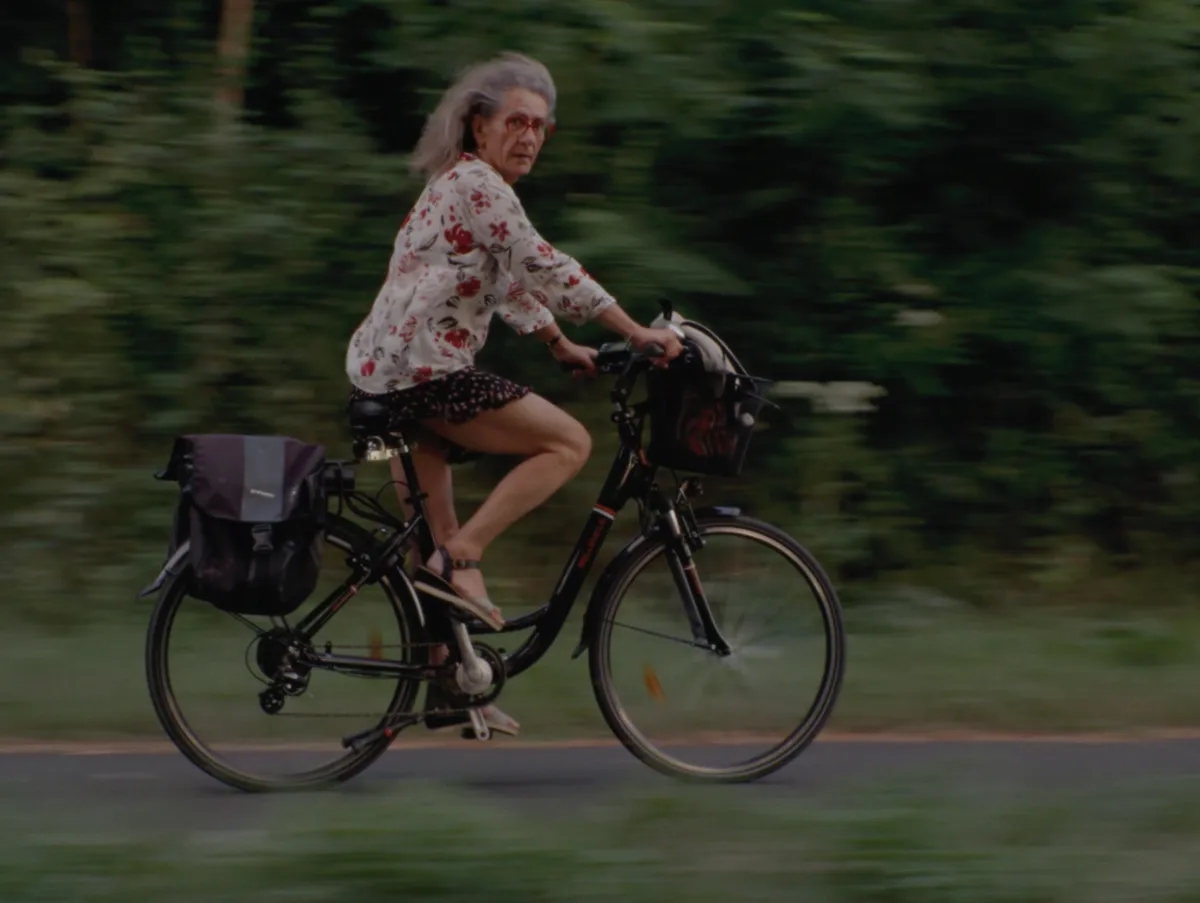


Coeur Secret (A Secret Heart) is not the documentary Tom Fontenille set out to make. In fact, even when he picked up his camera to film his sixty-something-year-old father in the months following the passing of his mother, Tom couldn’t have known that he’d eventually chronicle, in real time, the process of his father coming out as trans and gifting herself a new name: Lilou.
Shot over four years, A Secret Heart is a study in closeness and distance. It is only through the distance afforded to him by the camera that Fontenille was able to get ever closer to Lilou, a woman who feels like both a rebuke and a reinvention of who Fontenille knew his father to be. In many uncomfortable scenes where Fontenille prods Lilou to talk about her inner life or feelings, she bristles. Yet slowly, the more she plays with women’s clothes, grows her hair out, and even dabbles in wearing makeup, she softens. She offers a new vision of herself that her son cannot wholly understand, even as his camera follows her every move for days at a time.
The tensions—between father and son, between filmmaker and subject, between who Lilou was before and who Lilou allows herself to be now—are captured in intimate moments at Lilou’s home, each scene functioning as a cross between a family home movie and an unsettling taped family therapy session.
Following the film’s premiere in the ACID program at Cannes, I sat down with Fontenille (and his producer, Helen Olive, who served as his translator when the French filmmaker needed to find the right words) to talk about how two family deaths helped originate and later structure this film about his father, and how the very process of finishing this documentary helped him get even closer to someone he realized he may not have known all too well to begin with. This interview has been edited for length and clarity.
DOCUMENTARY: I wanted you to talk to me a little bit about the doc’s origins and how it changed as you were shooting.
TOM FONTENILLE: At the beginning, the purpose wasn’t to make a movie. I just wanted to film my father, because there was some difficulty in my family after my mother passed away. It was difficult at the beginning, because my father didn’t have an interest in being filmed, and could not understand what I was doing. It was more like a confrontation. A lot of times, he asked me to turn off the camera because he didn’t want to communicate about a lot of things, and he told me, “Just film me in everyday life, but don’t talk to me because I don’t want it.” After four months of filming with my sister, we discovered my father likes to cross-dress. One time, my father asked me to show him some footage from the shoot, and after that, he told me, “Okay, let’s go. You can film me as a woman,” it changed, because she had for the first time an interest in being filmed, and I think my father knew it was a new beginning for the two of us at this time.
HELEN OLIVE: There was more joy and playfulness.
D: And in that playful collaboration, because it does sound like there was a kind of equity of subject and director, how you were approaching those shooting moments. Were you taking her lead? Were you deciding when you were shooting?
TF: We built the film together because she knew what I wanted to have when I was going to film, and so a lot of times she told me, “Okay, I’m going to do that. Do you think it’s good for the movie?” So there are these kinds of things, and sometimes it’s just for me, I tell her, “I want to film you in this situation, because it’s important for me, for the film,” because after four months of filming, I started to have a reflection and to write a bit of the movie, and that’s how I knew what to film.
But when I went to my family house to film important things, between scenes, I sometimes decided to film in the moment because I could see important things happening in front of me. So sometimes I told her, “Stop, don’t say much,” put my camera on, and said, “Okay, let’s go.” So some scenes I planned and some we improvised.
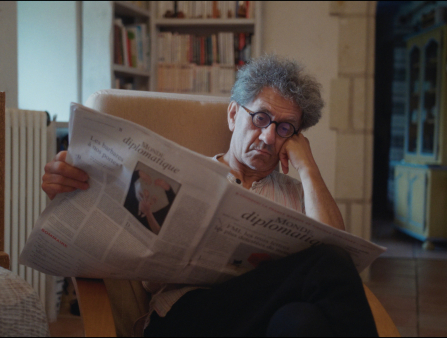
A Secret Heart.
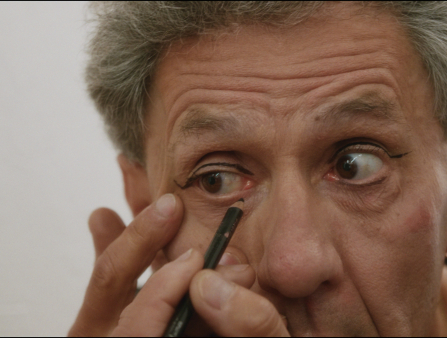
D: In terms of logistics, how long was the shoot before her death?
TF: Before the death, about three years and six months. But in total, four years.
D: As you said, you were sometimes sitting down to write, to plan, finding moments. How were you envisioning this film once you set it in motion, and how does the death then reframe the film’s structure?
TF: It was a big question because when my father passed away, I didn’t want to give up. Never. Because it was so important for her and for me to go to the end of this movie, but I didn’t know what the end of the movie was. So, actually, [the film team and I] talked too much about this, but actually, we had all the material to tell the story. And that’s why finally, with Marie Bottois, the editor, we decided to just begin and end the movie with the death, but between…
HO: —those two bookmarks…
TF: …was the story I wanted to tell.
D: Were you already pitching the film at that point?
HO: It was complicated for the financing, because we were only in the development of the film. Tom had been filming for several years, but it was still development financing and trying to find a story and writing process. Suddenly, of course, when she passed away, we weren’t ready to move into production. And yet we had to retell the story, and that was actually perhaps one of the hardest things. Because when you’re editing, you find the film, but to pitch, it was complicated and emotional. We took a little while off.
TF: One year.
HO: Time to grieve, and then also time to restructure, and to rethink, and reframe. And then we were in production, and we just had to go, and so everything just kind of fell into place. We were almost finishing the film before we started it. But I think that happens a lot with documentaries.
TF: But that’s why it was complicated to finance.
HO: But we were lucky, we got lucky. Things fell into place.
TF: We did it.
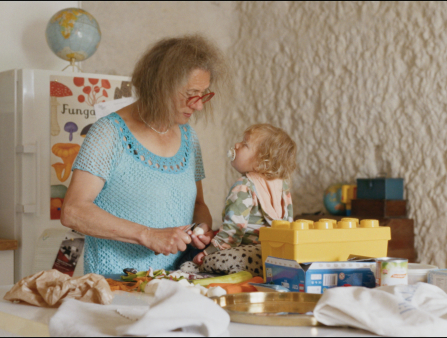
A Secret Heart.
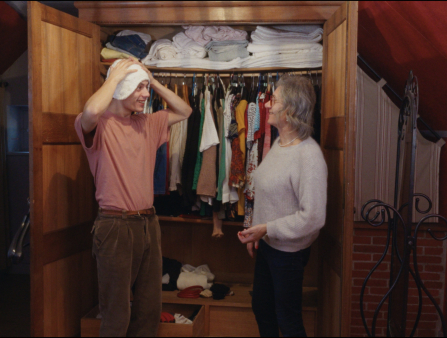
D: What did that look like?
HO: We started with writing grants. [Tom] got the Brouillon d’un Rêve, and also FAI [Fonds d’aide à l’innovation], national funds, and spent time filming and writing. And then with the passing of Lilou, we again went for development funds, right?
TF: Yes, but we didn’t get it from the CNC [Centre National du Cinéma].
HO: No, we didn’t get the CNC. We were too advanced. That was why it was complicated. Because the way financing works is you have to finance the film before you shoot, and yet we didn’t know what we were going to shoot. Tom knew that he wanted to shoot more, with himself and with his sister, and with the house, and so we knew that there was work to do, but there was also so much footage which was bound to be in the film now because that was the footage that we had, so that was why it was a little bit complicated.
TF: So we tried to imagine what kind of scenes we have to shoot now—
HO: —to complete the film.
TF: But it was not enough for one of the funds,
HO: But we did get another, Ciclic. And then, with the work in progress, we were at Entrevues de Belfort, a French film festival that has a work-in-progress prize. And thanks to that, we could finish with industry funding.
TF: But in terms of the writing, for me, the vision of my mother changed at that time. Because before my father’s death, I was more like, I’m doing the movie, and I’m living it, and it’s the present time, but when I lost my father, it was like, Wow, I studied those materials, and it’s incredible. It’s an archive.
HO: Yeah, it suddenly became an archive, precious.
TF: I don’t know if you’ve already lost someone, but it’s like you grow up.
HO: Suddenly, you’ve aged.
TF: It felt like those images were a long time ago, suddenly. And that’s why I could make an introspective reflection about it, and try to understand all of the story, and this evolution about our relationship; how I feel now, and thanks to that, how I can keep going in life. We worked a lot on this, but it’s not in the film because, ultimately, that’s not the film I wanted to make, and my material didn’t tell that story.
HO: Your family story came back and took over again.
A lot of people used to tell me, ‘Oh, you’re so brave to make this movie, because it’s about death, and it’s about your family,’ but I don’t feel like I was brave to do it. I didn’t have a choice.
—Tom Fontenille
D: The movie is very controlled and it’s very intimate, because we’re staying mostly in the house—sometimes we’re in the car, or we’re biking—but for the most part it is very contained, and I was curious about that choice, and whether that was always the choice, or whether there were scenes where we could see Lilou outside interacting with other people. Because we hear about these intrusions of transphobia and homophobia, but you keep us in this domestic, intimate space instead.
TF: We could see it’s the best way to stay with us, and with my family. It was important to stay on this subject in the movie, and we decided it’s better just to hear about the exterior—
HO: —about what’s happening outside in the world. And it was happening during an election.
TF: But actually, we shot some other scenes outside, but we couldn’t—
HO: —they didn’t find their space in the film.
TF: And finally, we understood we have to stay at this intimate place, and it’s better for everyone—for the spectator, but me as well.
D: As you’re describing it, and as it is in the film, this is a film about grief and about different kinds of grief: grieving the life you didn’t have in more ways than one, grieving your mother, grieving the life that your father didn’t have, and did have, and another one that she couldn’t have. I’m curious how that process itself helped your grieving, whether this was cathartic or helpful or challenging, because it strikes me as an audience that those are very heavy themes to hold.
TF: A lot of people used to tell me, “Oh, you’re so brave to make this movie, because it’s about death, and it’s about your family,” but I don’t feel like I was brave to do it. I didn’t have a choice. For me, it was easier to make it like this. With my sister, we said, This story should happen, even if there is no movie. But thanks to the movie, it makes this story go faster. I felt I had to make it, and that’s why the movie is universal. A lot of people tell me, Oh yeah, I think about my relation with my father, my mother, my family…
This was my process. For me, it was not heavy. It was my life. It was easier to make it as a professional object, an artistic object, and it was beautiful; I could meet my father through this. And I felt so happy, and so lucky to do that.