
Yira storyteller Petna Ndaliko Katondolo does not call himself an artist. In Nande, his mother tongue, the closer term is “knowledge keeper.” To be a knowledge keeper is not to create a story as a single, solitary author, but to activate what a lineage already holds: a way of seeing and listening that colonization tried, and failed, to sever. It is the work of ongoing becoming.
That lineage runs through everything Ndaliko Katondolo has worked toward since. In 2000, while in exile in Kampala, he founded Yole!Africa, an arts and community space that, by his own account, began as a modest endeavor. Rooted in a philosophy of ancestral regeneration and community transformation, Yole!’s beginnings were a means of refusal against the demands and urgencies of displacement, as well as a reminder of the liberatory nature of collective expression.
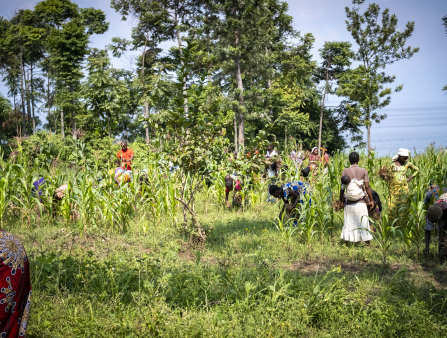
Five years later, he brought the space home to Goma amid the Second Congo War, launching Ishango Encounter—formerly the Salaam Kivu International Film Festival—which has continued to draw thousands, even at the height of regional conflict. With its now decades-long insistence that artmaking is a condition of both resistance and being, Yole!Africa’s reach spans three generations of artists and, more recently, has seen that same lineage take root in Yole!Farm, an agroliberation and land-based education project born out of the 2021 volcanic eruption of Nyiragongo, which displaced tens of thousands of people around Goma.
Yole!Africa has trained several filmmakers now working internationally, and its model for art-making under the material conditions of conflict and occupation has become a reference point for cultural workers elsewhere doing the work of decolonial refiguration—reclaiming land, archive, and narrative from extractive systems, and building infrastructures of self-determination in their place. In this sense, decolonization is not a metaphor, but an ongoing, material practice. His longtime collaborator, Dr. Cherie N. Rivers, directs research and education at Yole!Africa and has extended its agroecological philosophy through her own farming practice in the United States, a reminder that the questions Ndaliko Katondolo asks about land, story, and sovereignty travel well beyond Goma, and beyond any single lifetime.
Across all of these initiatives, Ndaliko Katondolo’s work moves fluidly between historical archives and the entangled past-present-future of being in all its forms, whether land, water, animal, human, or otherwise. Rooted in Indigenous cosmologies that refuse to fragment these forms of existence from their sacred and political contexts, his films reassert them as inseparable dimensions of a living, insurgent site of memory and language. His films, including the triptych Matata (2019), Kapita (2020), and Katasumbika (2024), alongside Mahere (2023), often return to colonial archival footage, reworking it through a method he calls “recoding”—an approach to time, sound, image, and witnessing that unsettles the colonial camera’s claim to authorship. This understanding of how past, present, and future interrelate insists upon a kinship with the natural world built on reciprocity rather than dominance.
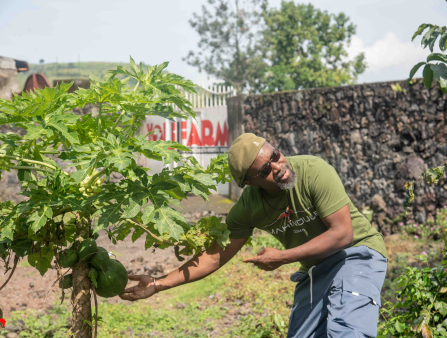
Yole Farm.
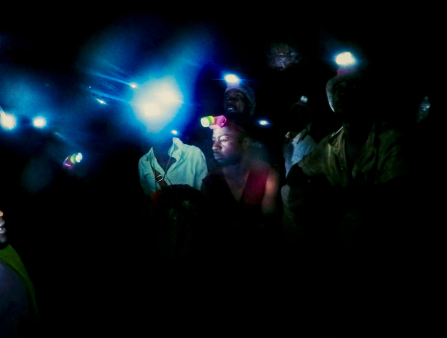
His most recent work, Ndjimu (2026), which screened at this year’s Rotterdam film festival, was filmed in Mutoshi mine in DRC’s Katanga region. The film turns to the politics of coltan and cobalt mining and the violent disruptions that the region’s people and land have been made to bear so that the Western world’s supply chains and geopolitical interests might be sustained. Returning to ritual and collective memory, Ndaliko Katondolo’s project centers regeneration and healing through a return to—and reworking of—indigenous practices and knowledge.
Ahead of his keynote at Getting Real ’26, where he’ll expand on what the work of ancestral ecology means amid extraction, displacement, and technological change, Documentary spoke with Ndaliko Katondolo about knowledge-keeping, the practice of listening, and what it means to build community—and sovereignty—through storytelling. This interview has been edited for length and clarity.
DOCUMENTARY: How has living and working in Goma, and Eastern Congo generally, shaped the language and the form of the work that you create?
PETNA NDALIKO KATONDOLO: I grew up between multiple and often conflicting narratives. The generations of my grandmothers understood the world from a specific perspective. When I went to school, I was learning something completely new that had nothing to do with the knowledge I embrace every time I go home. These two worlds were coexisting in a way.
I grew up with this sense of having multiple narratives; of trying to understand how narratives can render cultures invisible. For my family, we live on Yira land. Yet in terms of the official Belgian narrative, we were simply Congolese. In school, I was taught to be a proud Congolese person—I was punished for speaking Swahili, but rewarded for speaking French.
These narratives were rooted in the Western world, one that needs what is [produced by] the land of Congo—coltan, for instance, the mineral that is in everyone’s cell phones and the [extraction of which] is causing people in Congo to die all the time. I have learned that this land is our relative, our family, and we have to take care of one another. In Nyira, we speak of katasumbika, meaning the unbreakable, the indivisible. Before you break something open, you ask permission and draw upon community knowledge of how to access the energy in these minerals. When people extract them without permission, how are those minerals then reacting when you transform them into your cellphone that you sleep next to at night? That’s why the Western world is getting really crazy. [Laughs].
In Goma, there’s an active volcano on one side and methane-rich Lake Kivu on the other. My grandma used to say, “Fire on one side, water on the other, and we are in between.” Living between that energy gives you the strength to balance these two elements. When scientists came to study the area and told us living here was dangerous, it was the opposite of the narrative I grew up with. It made me a person who wants to find balance in times of conflict. These possibilities, however, are embedded in a language we have forgotten. So the question really is, How do we remember that language?
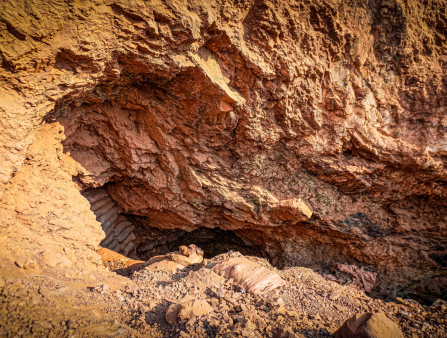
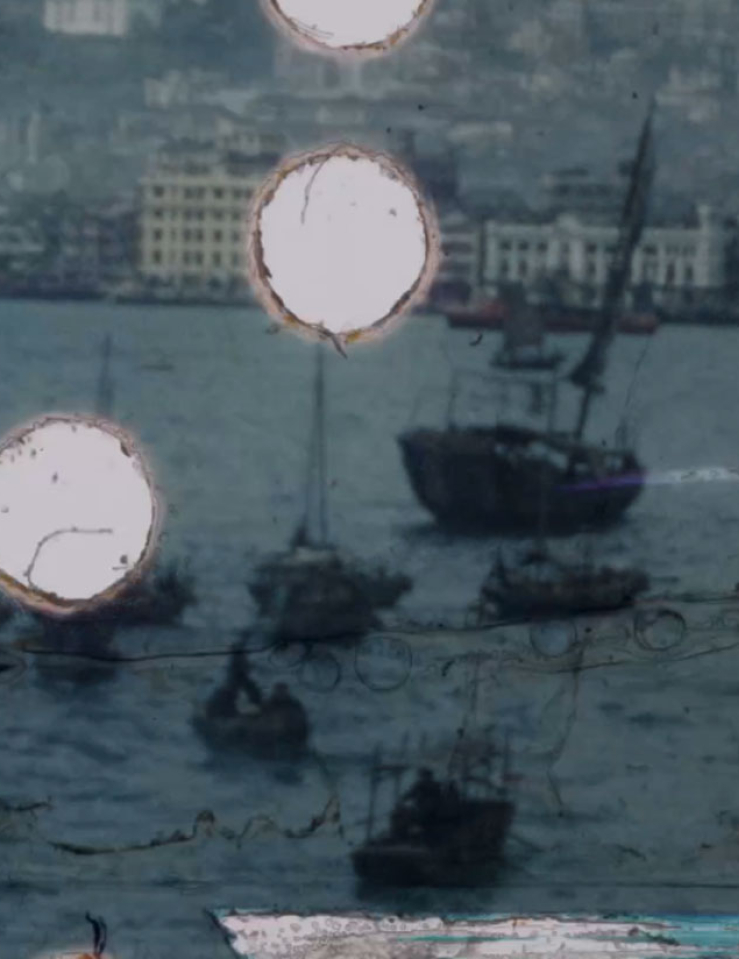
Ndjimu. Courtesy of IFFR
D: You founded Yole!Africa in 2000, first in Kampala, and then in 2005 back in Goma, in the midst of the Second Congo War, the brutalities of the M23, and the extractive forces driving the conflict. Why was Yole!Africa a necessity during this time?
PNK: Yole!Africa emerged because I could see how hatred had become a surviving for many people who were in exile. Between 1989 and 1999, much of the Great Lakes region was at war. South Sudan was fighting North Sudan, Ethiopia was fighting Eritrea, Somalia was caught in internal conflict, and Rwanda, Uganda, Burundi, and Tanzania were all involved in the war in Congo. Young people from across the region found their way to Kampala, bitter, and it was like a house full of hatred. I knew this sentiment really wasn’t coming from the people—it was more the conditions we were put in.
What I did was something I’d already been doing in Congo at a smaller scale—an ecology movement called Maideni that created a space for youth to make art together. It started in a single room with one guitar. Then came paint, canvases, poetry, theatre, music, and film. After eight months, people really started getting confused because [Yole! had] South Sudanese were [working alongside] North Sudanese—people couldn’t believe that was possible.
Filmmaking was a necessity because when we’re full of hatred, that same energy, redirected into creativity, becomes a language that lets people start a dialogue. It made everybody an actor of change rather than a victim of it—once occupied with making, they were no longer refugees. That label disappeared. We were just artists.
D: I want to shift towards the formal aspects of your work. You’ve spoken about the colonial project as fundamentally being an abstraction of time; one that creates the illusion of controlling not just time, but, of course, also the production and ownership of narrative itself. This abstraction governs who gets to tell the story of a place, a people, a body. What does it mean to you to utilize cinema, especially documentary, in the service of both a decolonial project and, more broadly, liberation?
PNK: I would actually like to start with wording of the question, in terms of referring to my work as a “decolonial practice” or not: Yes, at a certain time, I was known as a Fanonian, so it was all about decolonial practices for me. Throughout that same process, I came to see that, once we position ourselves within reacting to our colonization, we stay in the trap of colonization. So, I don’t refer to the work, even if it is part of the same process, as decolonial. I call it Ancestral Ecology—a position that comes from thinking about the world from a specific place, Goma, and from the relationships that have always sustained life there.
Within that, filmmaking and documentary become a way of listening. For me, cinema is not only a tool; it is part of my vocabulary as a storyteller from the region of Kivu and the Yira land. One of our first technologies was the voice, and we used that to create images. Cinema is a way to activate that voice. I work in documentary to utilize its capacity to create and continually rethink community.
I’m not starting a story and not ending one; I’m part of it. The colonial Western position privileges a single master of the story, so the idea of saying I am part of the story being told humbles my positionality. It’s an act of recalibrating our brain to start seeing the unseen.
—Petna Ndaliko Katondolo
D: When you work with colonial footage, you’ve spoken of the work and aesthetic of ‘recoding.’ What are you trying to disturb, undo, or recode with your practice?
PNK: The act of recoding is a way of understanding life. Colonial footage was framed to tell a specific story—it is a worldview that is imposed on the people being filmed. With the way film technology was developed, celluloid was never calibrated to Black skin, which means our emotions often remain unseen. We are not alive in this footage.
The first time I accessed all these images from the colonial archives in Belgium, I called my partner in a panic—it felt like we were buried alive in these images. I started applying filters, and slowly the Black bodies would appear and start to transition. I realized these materials were not simply archives; they were also crime scenes. I reframed them to tell a story on both an emotional and psychological level.
Recoding also involves that temporality I am working with. I’m not starting a story and not ending one; I’m part of it. The colonial Western position privileges a single master of the story, so the idea of saying I am part of the story being told humbles my positionality. It’s an act of recalibrating our brain to start seeing the unseen.
D: Your camera often sits very close to the ground—we see feet, tires, animals, and land—in what you call “the anima shot.” What challenges to documentary’s claims to objectivity and truth of perspective does that vantage point offer?
PNK: The anima shot is a practice within what I call Soul-full Soil Cinema, where a plurality of points of view is essential. These points of view are not there to reproduce the same hierarchy where we use animals and land as a decoration or backdrop. They are based in spiritual practice, in activating our kinship with the living world and transferring that point of view to a camera eye. It’s an immersive practice that creates an experience for a viewer that I refer to as “ritualization.” When you are an ancestral ecologist filmmaker, you gain the responsibility of working with these vocabularies that help people remember their place within that community.
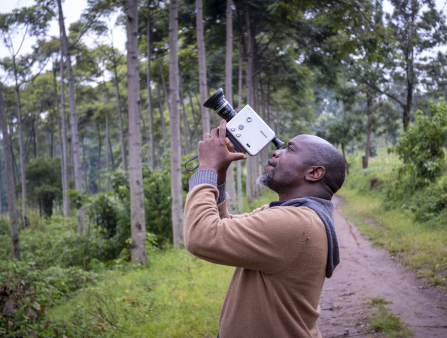
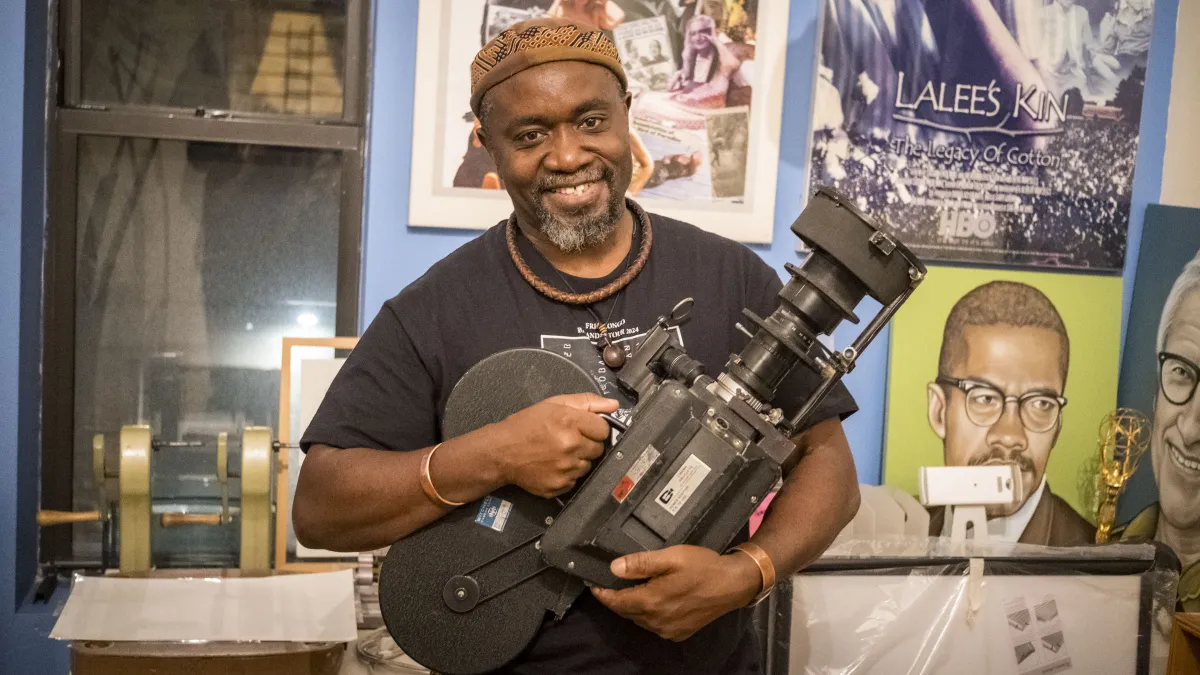
Petna Ndaliko Katondolo at work.
D: What knowledge and practices have shaped how you understand cinema, or even art more broadly, in terms of its purpose and potential?
PNK: I think it’s better to set an understanding around the word “art.” In Nande, the language of my people, there isn't really a word that corresponds to the Western idea of an “artist” in this same understanding. What we would say instead can be translated as “knowledge keepers.” In West Africa, they would call them griots. When you’re a knowledge keeper, knowledge is being reactivated through the manifestation of art forms. It’s no longer just that Western idea of talking about “creativity.” It is a consulting of multiple levels of knowledge keeping—be it physical, spiritual, or emotional.
Art, then, is not primarily about creativity. It is about entering into conversation with different ways of knowing—physical, spiritual, emotional, ecological, and ancestral—and allowing them to manifest through form. The artwork is simply one expression of that living relationship.
A beautiful story I always share whenever the question of cinema is asked of me is how I had to tell my parents that I wanted to become a filmmaker. They looked at me like, “You can, if you ask for your grandmothers’ permission.” These are the matriarchs of my family who I am very close to still—my grandma, great grandma, great-great grandma,. And, when I asked them, they said, “What is that?”
Most of them had lived outside the world shaped by colonial institutions. My grandmother, who was born in Kitamiaka during the colonial period, was perhaps the only one who experienced that reality directly. They looked at me and asked, "Why would you need to go to school to learn how to tell stories? You are already a descendant of storytellers."
That sentence transformed my life. It shifted my understanding of filmmaking entirely. It became, for me, a deeper question:
How do I tell a story that’s alive with images?
That has been the center of my entire practice since.
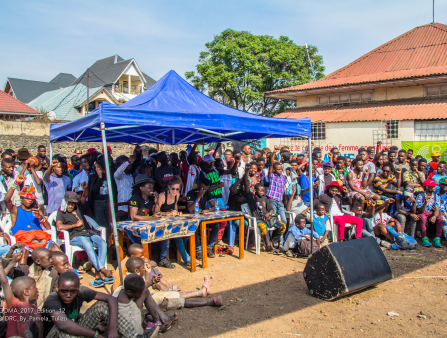
Congo International Film Festival/Goma 2017.
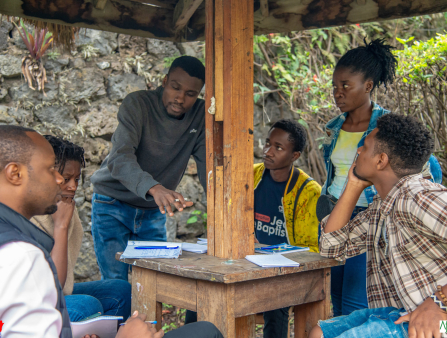
Lab at Yole.
D: What does that understanding of ancestral ecology demand of cinema as it has existed thus far? Especially documentary filmmaking, which has, broadly speaking, historically tended to recognize the human as the subject, and, within that, has recognized only certain factions of people as human. How are you retooling cinema to align with these ancestral ecologies you’re practicing?
PNK: It’s about building the practice of listening. Cinema, historically, has been a tool of extraction. Soul-full soil cinema’s first act is to listen—being in a circle of belonging is central to that. Rather than assuming I have to tell this story, [you ask,] But who are you to tell that story? And, Why do you have to be the one—the only one—to tell that story? The dominant storytelling position treats visibility as inherently positive, forgetting that it can dismember an existing community by positioning them for a consumer. Often, the first act is to say no; to let a story stay within the community. “Minority” communities rarely have space for “no” or space for refusal; everything must be “yes,” and cinema becomes part of that culture of invisibility and a tool of oppression, since pulling a single story out of a community creates an imbalance in that community.
Before I ask, "What story am I here to tell?" I have to ask much more difficult questions. Do I have permission to enter this space? What will the act of my presence render invisible? How does the story I’m proposing become a point of listening? You have to listen to the land and the plants as a member of a community. In Mahere there is a scene where we see humans talking onscreen, but all you actually hear in the film at that moment is the sound of crickets—and, as my great-great-grandmother taught me, the crickets are telling their own story too. I am not the only storyteller. The rigor and space of negotiation of ancestral ecology is why this kind of story often doesn’t get funded or shown. But it exists as an act of community responsibility toward the living.
D: What non-human voices have surprised you the most by insisting on their own place in your films?
PNK: Mushrooms! [Laughs] The sound of mushrooms is audible without any equipment—they scream so loudly. If you pay attention, you will hear them talking, especially when you harvest them. If you do not ask them for permission, they scream. [Laughs]. Mushrooms are amazing beings. I’m still discovering a lot about them; I’m fascinated by them and the way they live both underground and above ground.
While we may refer to it as cinema today, filmmaking is really the voice of the storyteller activating and creating images.
—Petna Ndaliko Katondolo
D: You’ve described the sound-image relationship in your work as “asynchronicity that is also synchronized.” Can you talk to me a bit more about the logic of Ejo Lobi that guides the form and temporality of your practice?
PNK: Ejo Lobi is often difficult to explain because it is less a concept than a practice of perception. Part of that practice is what, in Yira, we call Mukumbira—the recalibration of our capacity to perceive. Traditionally, in ancient Yira culture, someone who committed an unspeakable crime, absent any prison system, would be sent into the forest for 21 days. School taught us this was “savage,” but its real purpose, as my grandmothers taught me, was recalibrating your brain to the fact you don’t control anything, that you’re part of a living system. After a week, you start listening and hearing animals and water—even when they aren’t there. Part of the Ejo Lobi practice is that kind of asynchronicity: the moment your brain gets confused, that confusion opens a window instead of closing one. That’s why you can start one of my films from almost anywhere.
In ancestral ecology storytelling, we talk about composting: the new story does not erase a story that was there before or one that has yet to come. For the dominant culture, visibility and development are positive words. But for ancestral ecology, that framing doesn’t make sense at all. Development must be differentiated from becoming. Becoming is what we achieve by meeting with community and entering into dialogue. To enhance what we may call augmented intelligence—where we can open portals, develop the capacity to heal ourselves and those who are sick, and enter into conversation with ancestors—we need to enter into a covenant with all living beings and their energies.
While we may refer to it as cinema today, filmmaking is really the voice of the storyteller activating and creating images. If we think about that in terms of temporality—through the concept of Ejo Lobi—then it has not actually predated cinema, because that interconnectivity is continuous. Memory is not behind us, and the future is not somewhere waiting for us to meet it. Both are continually arriving through the relationships we choose to cultivate. Perhaps that is why I have never understood cinema as the production of images. For me, cinema has always been another way of listening. And perhaps listening itself is simply another way that life remembers.
Editor’s Note July 16, 2026. Dr. Cherie N. Rivers’s association with Yole!Africa was updated.