

In contemporary lore, documentarians are monstrous. They roam the streets looking for unsuspecting people to manipulate, exploit, objectify, and aestheticize—anything to get their film right. Whenever a documentarian, or anyone wielding a camera, appears in a fiction film, it’s likely they’re monsters outright: think of Peeping Tom (dir. Michael Powell, 1960) and Benny’s Video (dir. Michael Haneke, 1992), in which the titular fiends murder with their cameras. It’s true that in some films the documentarian is portrayed as innocent, even noble, in their search for the truth. But this means an almost certain death, as happens in countless found-footage horror films. Which is to say, when a documentarian appears in a film, they are either monsters or are being attacked by monsters.
Or sometimes both: In Luis Ospina and Carlos Mayolo’s Vampires of Poverty (Agarrando pueblo, 1977), we follow a faux documentary film crew as they prowl the streets of Cali, Colombia, collecting footage for a German television show. “We need crazy people, beggars, street kids,” the director explains, imagining a grand curiosity cabinet of immiseration. As they cruise the streets, they find a man jumping through knives for money, lure naked children to jump in a glass-strewn fountain by tossing in coins, and then break into a seemingly empty lot and stage an interview with actors playing an impoverished family. If there’s a problem with the shoot, the director tells a producer on the phone, “Who cares in Europe?”
Because the film is fiction, we’re granted an otherwise impossible view of the documentary artifice. Behind the veneer of a respectable, politically engaged documentary, we see not only the lies, manipulations, and exploitation, but also the way people on the street resist and interpret this spectacle. “They get paid to show this; I’m sick of seeing it every day,” one onlooker complains, while another counters, “They’re telling the truth.” This uncontrolled element reaches its explosive climax when they begin filming in what they assume is an abandoned lot. As the narrator delivers his monologue in front of the camera—“cases of family abandonment abound, child vagrancy”—a theatrically wild-eyed man jumps in front of the camera, sticking out his tongue, yelling: “Bloodsucking vampires! You only come here to make people laugh in faraway places!” When they try to bribe him to allow them to keep shooting, he pulls his pants down, bares his ass to the camera, and wipes it with their bills, finally chasing them off with a machete. Here is the poor and crazy subject they’ve been looking for, but rendered revolutionary rather than docile. What could be the crown jewel of miserabilia is the very thing that destroys it: We watch him unspool the abandoned footage, wrapping his body in exposed film.
In the decades since Vampires of Poverty, the documentarian has remained a monster in fiction films, parasitically taking the blood of others. But something strange has happened in recent mainstream fiction films. Gone is any clear politics motivating this disdain, or any sustained concern with the style, form, or content of contemporary documentary. Instead, in these films, the actual work of the documentarian is beside the point. Rather, the documentarians themselves are presented as the problem. They may not seem as overtly predatory as they once were, but we are told again and again that they are no less dangerous for it. There is something disfigured in their very character, secret failings these fiction films claim to expose.
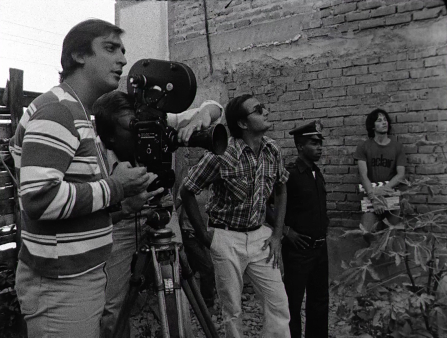
Vampires of Poverty. Courtesy of Archivo Bruma Cine/Lina González
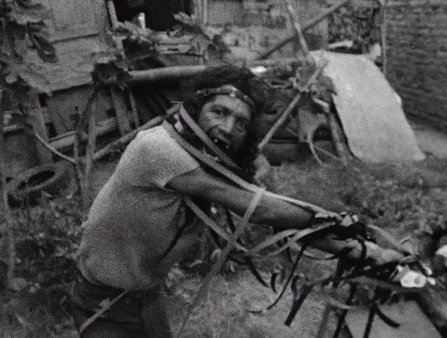
The wild man in Vampires of Poverty refuses to be docile in front of the camera.
In Noah Baumbach’s While We’re Young (2013), we can see a harbinger for the new critique of the documentarian as a socially myopic figure whose gaze is both predatory and impotent in equal measure. Baumbach introduces us to Josh and Cornelia (played by Ben Stiller and Naomi Watts), a white, middle-aged couple, comfortably ensconced in a bourgeois life in Brooklyn. He teaches continuing education courses in documentary while neglecting a ponderous, six-hour political doc he’s been making for close to a decade: “The film is really about the working class, and I can’t speak on behalf of the working class. I can’t make their film, of course, but they have to be felt as the impossible subject of the text,” he tells a would-be investor. Meanwhile, she’s the producer of her famous father’s canonical documentaries. The two are, in short, the contemporary caricature of the insular, American cultural elite: university-educated, complacently center-left, cloyingly self-absorbed, both blandly apologetic and completely dependent on their privilege.
During one of his particularly feckless course lectures (“Documentaries, I want to say to you today, can and should be about me… ‘me,’ meaning all of us.”), Josh meets a younger, hipper couple. Jamie and Darby (Adam Driver and Amanda Seyfried) inexplicably seem to love his obscure earlier film. The couple embodies much of what Josh and Cornelia wish they still were—spontaneous, whimsical, enthusiastically amateurish, unembarrassed by privilege, sexually alive. And they offer the older couple a license to move, however modestly, beyond their usual social world: they join them at a hip hop dance class (virtually the only exception in a film otherwise hermetically sealed in whiteness), a block party, a gay club, and an ayahuasca ceremony with a white shaman. All this spontaneity and these small transgressions of race, class, and age reawaken Josh, who seems ready to make a real film again. However, his bumbling attempts at a more ethical approach to filmmaking prove immaterial. His vampiric urge has never left.
This is all, of course, too good to be true. The young couple hadn’t inexplicably taken a shine to this neurotically repressed older couple. Instead, Josh slowly uncovers that Jamie had staged an elaborate con, ruthlessly manipulating Josh as a bit player in a new documentary. When vampires can’t suck the blood of the other, Baumbach’s film suggests, they turn inward, devolving into an internecine battle over ever-dwindling resources and relevance. It’s reminiscent of monster film franchises at their final, decadent stage: Frankenstein Meets the Wolf Man (1943), Godzilla vs. Mechagodzilla (1974), Freddy vs. Jason (2003), Alien vs. Predator (2004). Here, though, there are no explosions. It all just ends in a self-regarding whimper.
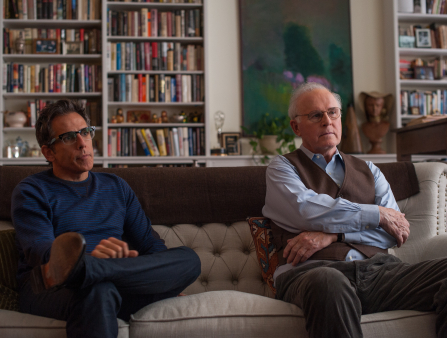
In Noah Baumbach’s While We’re Young, filmmaker Josh Srebnick (Ben Stiller) can’t stand his father-in-law Leslie Breitbart (Charles Grodin), a renowned documentarian in his own right. Courtesy of A24
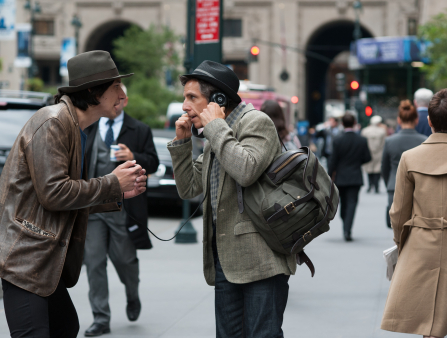
Adam Driver plays a young documentarian seemingly enamored with an older filmmaker in While We’re Young.
In these new fictions, we are forced into this claustrophobic mise en abyme of documentarians looking at other documentarians (or fighting other documentarians, because in this genre, to look is always aggressive). We see this in the opening of Oh, Canada (dir. Paul Schrader, 2024), based on Russell Banks’s novel Foregone, when former students of the famed political documentarian Leonard Fife (played by Richard Gere and Jacob Elordi) set up an interview using Errol Morris’s famous Interrotron, which uses two-way mirrors to superimpose the interviewer’s face over the camera lens, creating the illusion that the subject and filmmaker are making eye contact while looking directly into the camera. The effect, made famous in Morris’s own The Fog of War (2003), creates an uncanny sense of immediacy, as if the subject is speaking directly to the audience. But the dream of immediacy is only that: “It’s a lot easier to say what I wanna say if I know who I’m talking to,” Leonard complains at one point. And, indeed, it’s the nature of documentary that he will never fully know or control who he is actually talking to.
But this moment becomes increasingly strange, eventually revealing the film’s deeper preoccupation. When welcoming Leonard into the interview, the younger director flatters him. “We’re using the camera technique you pioneered,” he says. “Consider it a protégé’s homage.” Later, a frustrated Leonard tells the director to “get behind your machine over there, your Errol Morris doohickey, whatever you call it.” When the director insists that he’s wrong, that he in fact pioneered it, Leonard responds, “Not me. Sigmund Freud.” There’s a feverish, dream-like quality here, this tangling of pedantically technical details, small inconsistencies, flattery, and self-aggrandizement, all of which evaporate and condense into something oddly grandiose, vague, and nonsensical. After all, the Interrotron, with its emphasis on ersatz immediacy and eye contact, is nothing like the aloofness that Freud recommended with the analytic arrangement of the couch, which was explicitly designed to frustrate eye contact. But the analogy doesn’t need to hold; the film is far less interested in mediation and representation—let alone the very tools of contemporary documentary—than in what Freud, as a vague cultural symbol, represents: the psyche, desire, repression, secrets buried in youth. In other words, the documentary impulse is a pathology to be examined.
This is why the film is primarily set during Leonard’s youth, not when he was making his documentaries (about which we hear very little), but when he was a young cad, an aspiring writer who recklessly seduced women, cheated on his wife, and abandoned his young son with little contrition. He may be a great documentarian (for the film never questions that, never wonders what compromises he made in his career), but that is all secondary to the question of his character, and the cruelty and mendacity that lurk behind the image of the noble, activist filmmaker. This is more than a little redolent of the ending of While We’re Young, in which Josh and Cornelia learn to embrace their age and responsibilities and adopt a baby from Haiti, while Jamie divorces his wife and becomes the new rising star of documentary. In these films, there’s a clear choice: be a vampiric documentarian or grow up and be a good parent. And the moral arc clearly bends toward the latter.
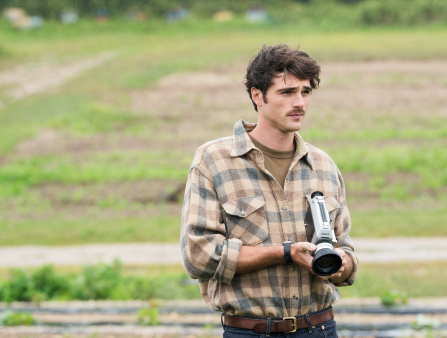
Paul Schrader’s Oh, Canada casts Jacob Elordi as a young Leonard, an aspiring writer who recklessly seduces women, cheats on his wife, and abandons his young son with little contrition. Courtesy of Kino Lorber
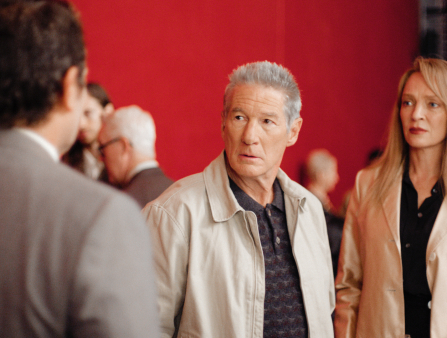
Filmmaker Leonard Fife (played later in life by Richard Gere), married to his former documentary film student Emma (Uma Thurman), confronts his past in Oh, Canada.
Alfonso Cuarón’s miniseries Disclaimer (2024), based on Renée Knight’s novel of the same name, picks up these themes with lurid eagerness. As with Oh, Canada, the series is fundamentally interested in the psychosexual history of the documentarian, an excavation of youthful and dangerous sexuality. Here, the famed filmmaker is Catherine Ravenscroft (whom Cate Blanchett plays as a more insipid Lydia Tár of the documentary world), although what her films are about, or what she even cares about, is never something the series even feigns interest in. Instead, the show revolves around photographs that resurface from a vacation she took with her then three-year-old son more than a decade earlier. In them, she appears to be in the throes of sexual passion, posing for the camera of a 19-year-old amateur photographer, who would die the next day saving her son from drowning. Someone has found these photos and written a fictionalized accoufint of the encounter—a veiled warning or threat to her.
The series’ creaky plot machinery hinges on Catherine’s karmic comeuppance. Private images made public will destroy her life, in ways her own vampiric use of others’ lives may have done throughout her career. Catherine’s colleagues at the chic documentary production company, caricatures of disingenuous corporate sharks, quickly betray her, and as the film nears its end, she’s left a broken woman, separated from her husband and at the hospital bed of her suicidal son. Of course, the obvious (and cynically manipulative) twist comes: these were photographs not of her pleasure but of her rape, and we are told yet again that the documentary image can only be an act of violence. The miniseries ends with her redemption, which means she has given up being a documentarian and decided to devote herself to reconnecting with her son. As with While We’re Young and Oh, Canada, the ending insists on making the documentarian face her own personal failures—failures that always seem to be intertwined with the impulse to film the world.
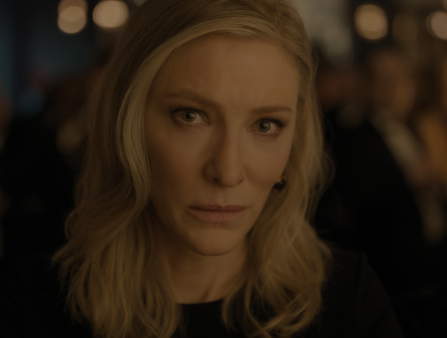
Catherine’s personal failures in Disclaimer are intertwined with the impulse to film the world. Courtesy of Apple TV
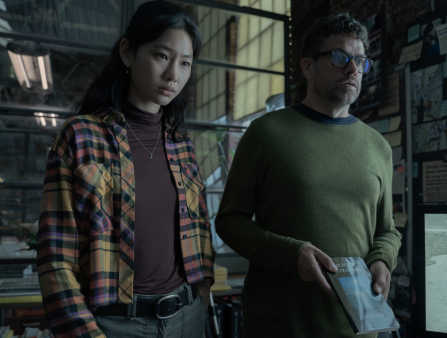
Jisoo and Simon (Hoyeon and Michael Spicer) are Catherine’s colleagues in Disclaimer.
When Ospina and Mayolo made Vampires of Poverty, its critique was clear, incisive, and vital to their contemporary world of documentary. They had watched a once-admirable gesture in militant cinema, the clear-eyed depiction of systemic poverty, become coopted by a politically tepid and more commercial form of cinema, and they saw in fiction the possibility of documenting this perversion. But for them, the stakes were real: they both had worked in documentary and would continue to do so. They were invested enough in the form to challenge it. That Vampires of Poverty ends with a documentary interview with the wild man, in which he discusses the importance of satire and obscenity in his performance, suggests that the filmmakers and actor believed that nonfiction was not simply dead-ended at exploitation.
Without any real political commitments and with no interest in critically examining documentary practice, these most recent films depicting documentary filmmakers revert to little more than caricatured morality tales, in which figures like Leonard and Catherine must be punished for personal faults that feel very much imbricated with their own documentary practice. These tales repeatedly insist that the documentarian is an adolescent, with all the patronizing connotations this carries: impulsive, narcissistic, manipulative, promiscuous, idealistic yet ultimately vapid. As those embittered by adulthood say, they haven’t grown up and accepted the real world. And it’s easy to understand why the world of industrial fiction might see it that way. Fiction lives in a world driven by profit, in which every position and task is regulated by contracts, and where ideas are scrutinized by focus groups and censored by whichever oligarch has recently purchased the studio. Fiction has long accepted this, the way a parent might grudgingly suit up for a job, comforted by the fact that they are bravely accepting the world as it is.
Documentary has traditionally taken a different path, and the unaccountable lives of Leonard, Catherine, and Jamie all attest to fiction’s fundamental discomfort with it. Especially since sync sound, it has had a roguish air, living on the cheap, and receiving its funding not from a centralized industry, but in a more eclectic and unpredictable manner: through government funds, philanthropic grants, public broadcasters, universities, scientific centers, corporations, festivals, film cooperatives, and so on. Because of this, we have had far fewer regulations or unified standards than other specialized professions. Journalists have editors and fact-checkers, academics have institutional review boards, and there are certifying boards for doctors, financial brokers, plumbers, teachers, and other professionals. Documentarians, in contrast, are regulated only when working within specific organizations—the Standards and Practices reviews with broadcasters, and the implicit mores of funders and festivals. As a whole, there is simply no unified standard that holds documentary cinema together. This shouldn’t be romanticized—no one should contest the profound ethical troubles in documentaries past and present—but it is part of what has fostered such a remarkable diversity of approaches to representing the real, and what has helped shape it as a vital art form.
It’s nice to have a character upon which to place our anxieties, to have the illusion that there is still someone to hold accountable, someone we can blame, someone who is driven by dangerous urges they have not yet contained and that are dangerous to themselves and others.
But the very conditions that once allowed documentary to flourish have now helped undermine it. Government support and nonprofit grants have diminished, streaming networks have attempted to co-opt the form as a hedge against Hollywood strikes, and the difficulty of building a robust union has left many documentarians increasingly dependent on the dictates of the market. With all this, you might think Hollywood would see the documentarian as a scrappy underdog story or even as a heroic figure speaking truth to power. But alas, documentary must still endure this ponderous moralizing from fiction: Grow up, get a real job, accept your family responsibilities! How similar this sounds to the generational divide between those who benefited from an ascendant U.S. economy in the 1950s and 1960s—which enabled this particular relationship between adulthood, labor, and the nuclear family—and those of a more recent generation, who are forced to ricochet within gig economies and algorithmic caprice. To those trying to survive these new forces, it’s hard not to see the condescending advice of these fiction films as more than a little anachronistic.
Even more anachronistic, however, is the idea that traditional documentarians are the most dangerous people wielding a camera nowadays. Many of us documentarians know the field’s history and its numerous misdeeds, and while we are hardly faultless, we do generally think more seriously about the ethical stakes of our films. At the same time, the turbulent world of (purportedly) nonfiction videos online has only grown more extreme: Events are decontextualized and fabricated, once-private images spread unchecked, and every form of misery and pain is presented without regard for the subjects involved.
In this way, the violence of the documentary image—exploitation, manipulation, trespass, dissimulation—is increasingly present in all our lives. But accountability is ever more diffuse, ever more decentered and disembodied. Like the Interrotron of Oh, Canada, we are all documentarians looking at other documentarians, caught in a huis clos of digital images. Perhaps this is why these fiction films continue to excoriate the documentarian: It’s nice to have a character upon which to place our anxieties, to have the illusion that there is still someone to hold accountable, someone we can blame, someone who is driven by dangerous urges they have not yet contained and that are dangerous to themselves and others. This scapegoating has a sad irony. For documentary has, since its inception, been sensitive to the process of recording the world, to its social complexity, political dangers, and aesthetic possibilities. If documentarians are monsters, it is in the etymological sense of the word: as warnings, as omens of things to come. Rather than blame the monster, we’d be wise to listen to it.
This piece was first published in Documentary’s Summer 2026 issue.