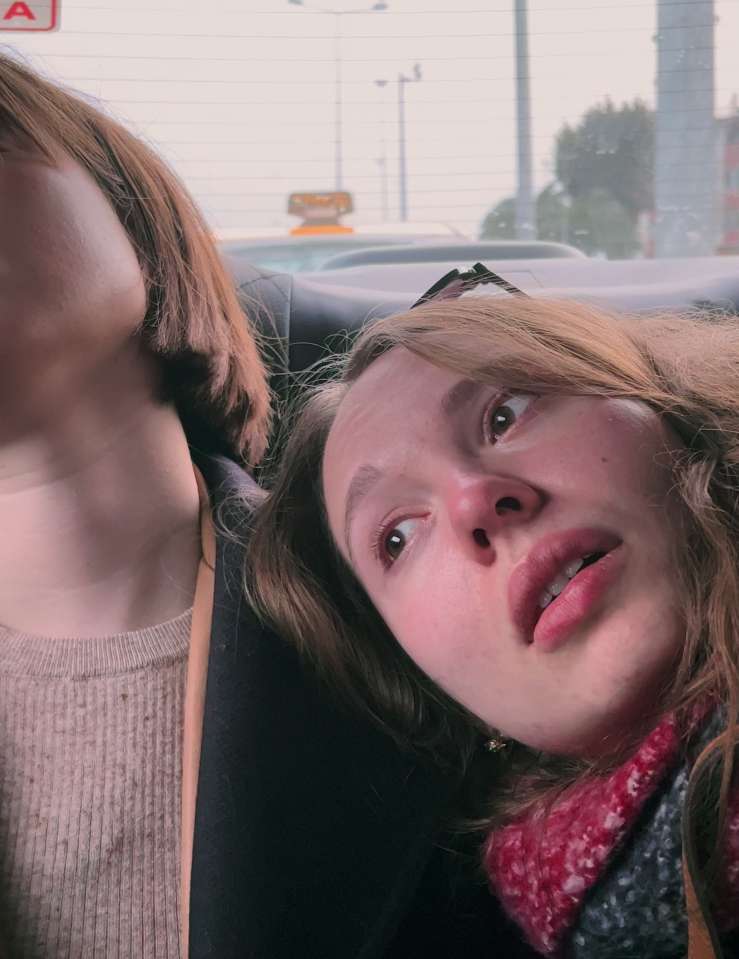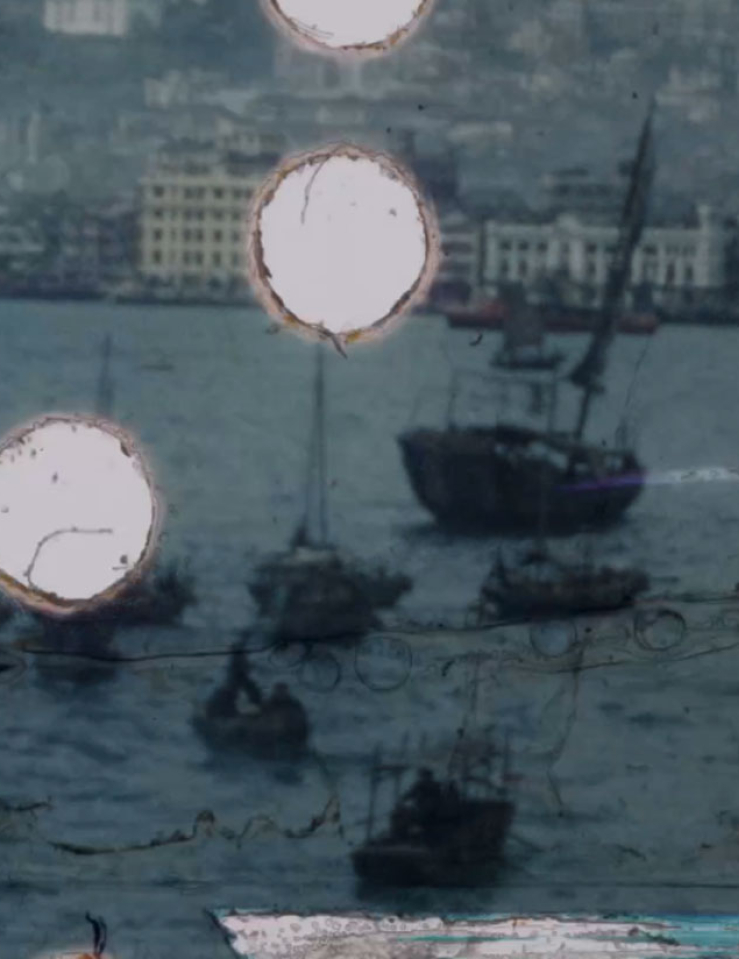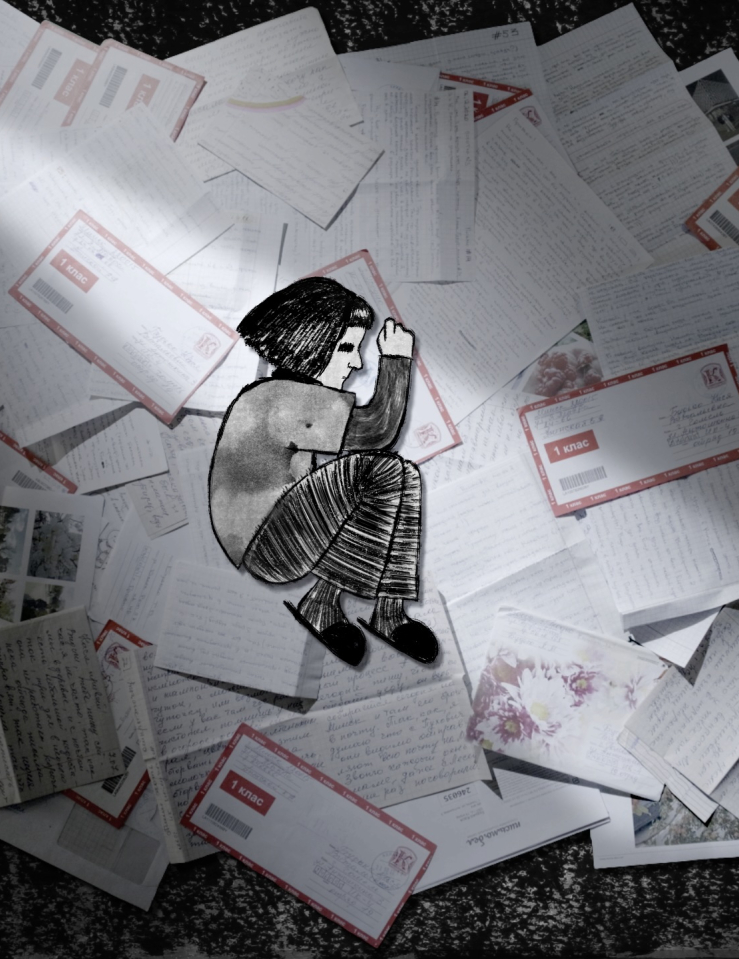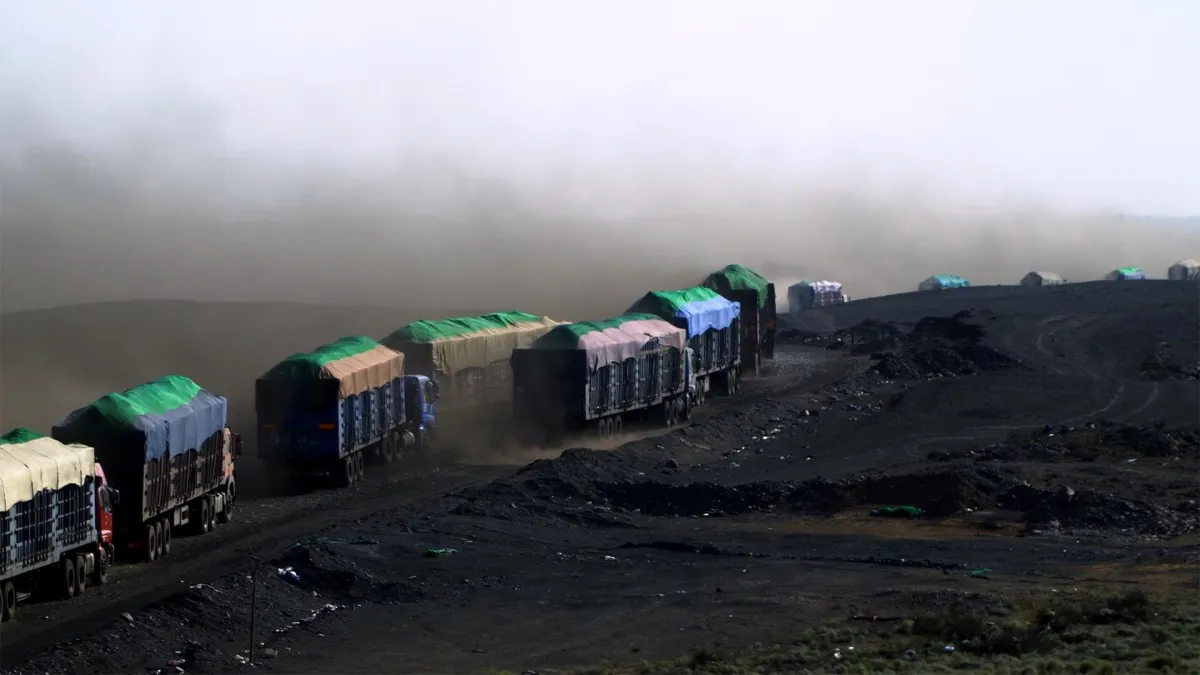


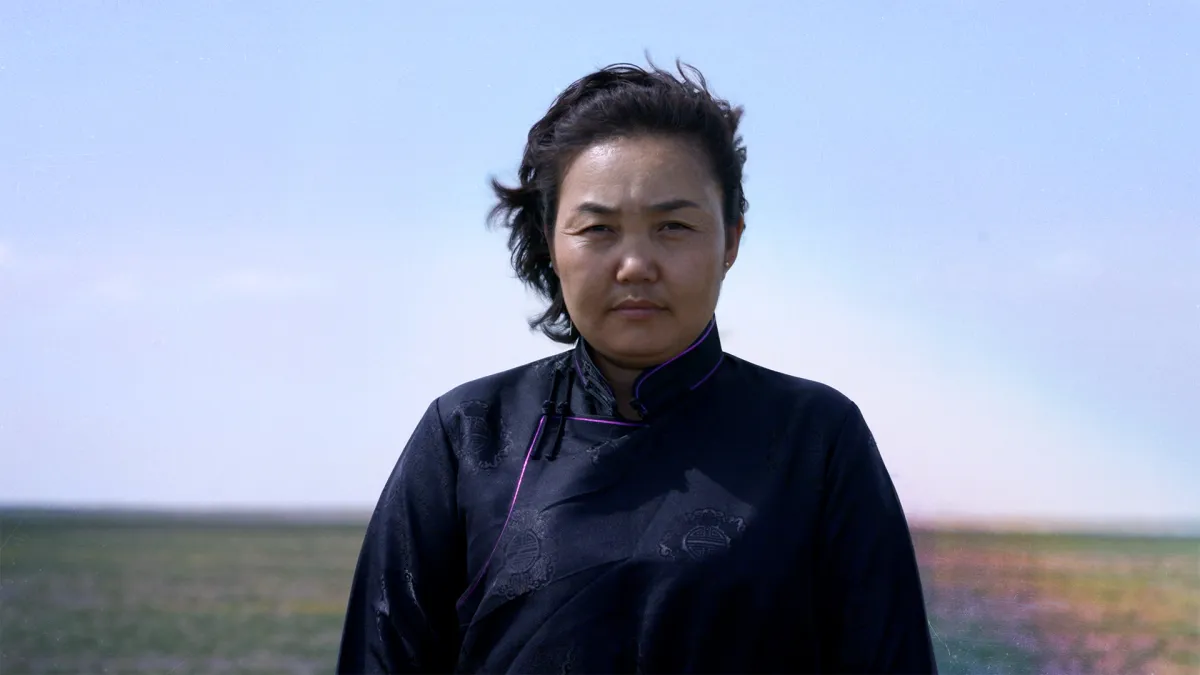
Post-1990 Mongolia has been defined by neoliberalism and mineral exploitation. Coal, the country’s single largest export, flows daily by the tons into China through many border ports in the Gobi Desert. White Rock is one of many dingy settlements that formed along the coal roads, and Maikhuu, a single mother of three, is one of many drivers who queue for as long as 15 days inside their truck cabin to deliver coal across the border.
Blending interviews and observational footage filmed over six years, Colors of White Rock shows what it means and costs to live in “Minegolia” through the experience of those who quite literally keep the resource-reliant economy moving. Expanding on his Grierson Award-winning short documentary, Lady of the Gobi (2022), Khoroldorj Choijoovanchig fleshes out the idea that the mining boom has changed the colors of not just the land but the people, reflected in whether state corruption or cutthroat competition between drivers who are paid on a per-trip basis.
Ahead of the film’s world premiere at Tribeca, I sat down with Khoroldorj in his Ulaanbaatar office to learn more about the process of making his first documentary feature. Colors of White Rock continues its festival run at Sheffield DocFest. This interview was conducted in Mongolian, translated into English, and edited for length and clarity.
DOCUMENTARY: Your 2013 debut feature, Yellow Colt, and previous shorts were all fiction works. How did the idea to make a documentary about this particular topic come to you?
KHOROLDORJ CHOIJOOVANCHIG: When I made Yellow Colt, it got support from and went to Busan and other festivals. I was a relatively young filmmaker in my twenties, and that encouraged me a lot to continue working as a filmmaker. But the stories I was looking for and trying to write weren’t working out. So in 2018, I went to France to do a master’s in cinematography to learn new things, broaden my networks, and seek coproduction opportunities. As part of a course, I was assigned to make a short documentary and the idea for it came from a previous experience: One time while flying a drone in the Gobi for a mining company promotion video, I was deeply struck by the intriguing visuals of the long truck line and how the drivers looked passionate yet exhausted. (Since filmmaking doesn’t pay the bills, my main job is making corporate promotion videos.)
This impression popped up in my head when I got the assignment. I returned to Mongolia that winter, headed to the Gobi by myself on a bus, and returned to my university with a 9-minute short that was the starting point of Colors of White Rock. I knew that it could be developed into a feature film and asked Chantal Perrin from Petite Maison Production for help. She became my cowriter and brought in Tessa Louise-Salomé and Luc Sorrel as coproducers.
D: Were there other drivers you initially followed? How did you decide to make Maikhuu the main participant? The female truck driver subgenre seems to have become quite popular in recent years, for example, the mini docs on YouTube or Nesa Azimi’s Driver, which coincidentally also premiered at Tribeca two years ago.
KC: I found and contacted Maikhuu before I went to the Gobi that first time because she’s quite active on social media. After that first assignment, I kind of knew she was a good match for the film, given her very welcoming personality. But I also followed at first three male and one other female drivers who were all dropped in the end. There’s a male driver, Tsog, whom I filmed for a while, but his scenes were cut out in the edits because they didn’t really work within the film. He still appears very briefly in the film, though.
I haven’t seen the film you mentioned, but I’ll look into it. While pitching my film around, I did encounter two other projects that were connected to truck drivers, but they were all male drivers. I think the aesthetics of the YouTube videos about or by female truck drivers are very different [from Colors of White Rock] and make them difficult to be seen as films.
D: Much of the film is shot inside the small truck cabin. Does this mean you mostly worked by yourself during production?
KC: That was the case in the first few years because we didn’t have money. Then we won the Colors of Asia pitching award at Tokyo Docs, which enabled us to make the short doc Lady of the Gobi with NHK and start working with production assistants. I’d be in the truck cabin with my camera and they’d follow along in a separate car. In two shoots towards the end, I went with a sound recordist and a second camera operator.
D: Was it difficult to get access to film at the mining sites and at the coal handling facility on the Chinese side of the border?
KC: Yes. The large companies usually don’t allow filming because coal is such a contested topic in Mongolia. You hear about several billion USD worth of “coal theft” corruption cases and because of that such large companies are extremely sensitive. Those operating the coal unloading sites in White Rock are very opposed to any kind of filming. I was lucky in that things were not so bad in the first few years. But during and after the pandemic, access became a really difficult issue. I’m also very grateful to government organizations, such as the General Authority for Border Protection and the local police force, who permitted us to shoot once we explained that it was for a film.
D: A drivers’ union leader who goes by the nickname Gray also appears a few times in the film, talking to the drivers and protesting. But it’s never clear who’s on the other side of this mediation process or who the employer is.
KC: The phone recording of Gray’s protest in the film shows his attempt to represent the drivers’ interests and voices to the Ministry of Road and Transport Development and the Ministry of Industry and Mineral Resources and not to a certain individual or company. Part of the problem with focusing on the employer was that there were many employers and the drivers often work for one company today and for another the day after. There’s a severe lack of organization or regulation in the industry. Drivers sometimes request Gray’s help when they aren’t paid and he negotiates with company representatives to help get their salary. But it’s hard to be present during such moments since I’m based in Ulaanbaatar and even when I was there, there’s no access to film these negotiations because the companies become exceedingly careful about their privacy exactly in situations like that.
D: As you mentioned earlier, coal is a very politically sensitive topic in Mongolia. You generally steer clear of politics in the film. Was that because of such sensitivity and lack of access or was it intentional?
KC: The political side of it was just one angle for me but never the main intention. In between shoots, I’d come to Ulaanbaatar and talk with people about what I’m filming and most Mongolians would be completely unaware of this life on the coal road. I was more interested in and inspired by that. Some of us are covered by and breathing in coal dust, playing a huge part in the national economy, while the rest of us are clueless about what’s happening. Few speak about the drivers’ struggles and rights and many simply talk about coal in abstract, politicized terms. During the production process, it became clear to me that I want to show these drivers’ reality, their sacrifices, and how they are fighting for a better life.
I trusted the drivers with their vehicles, just as they trusted me with my camera.
—Khoroldorj Choijoovanchig
D: Was there anything that shocked you while discovering and documenting this reality?
KC: I did a lot of research beforehand, so it was generally okay. But there were several truck accidents, two of which appear in the film, and they were absolutely horrifying. Early in the film, you see a truck whose cabin is completely wrecked after it rear-ended another vehicle. Behind them, there was a third truck whose driver swerved off to the side of the road and rolled over to avoid crashing into the trucks ahead. Seeing that terrified me, because when a crash is unavoidable, drivers instinctively try to protect themselves by either taking the impact on the passenger side or swerving toward the passenger side—which is exactly where I sit with my camera. But I kept going. I trusted the drivers with their vehicles, just as they trusted me with my camera.
D: The voiceover narration in Lady of the Gobi is your own, while in Colors of White Rock it’s Maikhuu’s and it’s quite poetic rather than vernacular. What led you to make that change?
KC: When making Lady of the Gobi, I was very aware that I was part of the story, which can be seen in the film as well through my reflections and more conspicuous interactions. But for Colors of White Rock, I decided to take a step back and sought to let Maikhuu’s inner voice present the story and I wanted it to be as poetic as possible. Mirage over the Gobi Desert is incredibly beautiful and I saw it as a metaphor for the situation of these drivers and of our country. They are in a pursuit of happiness, tirelessly chasing after the possibility of a good life that they see which upon arrival turns out to be nonexistent. This felt like the feeling after listening to someone recite a moving poem and I wanted to convey the same feeling through the film. Maikhuu’s prayer that opens the film is an actual recording of her at the Demchig Monastery near the Chinese border. The rest was written by myself and my cowriters [Perrin, Louise-Salomé, and Kate Kennelly]. We discussed with Maikhuu and sought to reflect the feelings and impressions she shared with us in the text.
D: There are many documentaries filmed in Mongolia about Mongolians but most are made by international filmmakers. What was it like to work as a local filmmaker in a country with virtually no documentary industry?
KC: I agree that there’s no documentary industry here and hope there would be more productions. We are a country with quite a long history of filmmaking, including nonfiction. But since the ’90s [as the country transitioned from planned to market economy], making money has become the goal for most filmmakers and documentary filmmaking has stalled. Our television industry is also quite commercial and doesn’t support documentaries in the way broadcasters in other countries do.
In Colors of White Rock, I was documenting real life and real people so it was all quite unpredictable. As a storyteller, particularly as a first-time documentary filmmaker, I relished that. Some local audiences have this view that foreign filmmakers come here and make a spectacle out of all the negative aspects of Mongolia. I think they might feel the same way about my film. But I want them to know that that’s not my intention. I’m not trying to “sell” a problem that Mongolia’s facing. I just wanted to tell a story of people fighting for their survival with dignity and humanity.
D: Is Maikhuu still driving her truck on the coal road?
KC: Yes, she’s still driving.