

Making a Production is Documentary’s strand of in-depth profiles featuring production companies that make critically-acclaimed nonfiction film and media in innovative ways. These pieces probe the creative decisions, financial structures, and talent development that sustain their work—revealing both infrastructural challenges and industry opportunities that exist for documentarians.
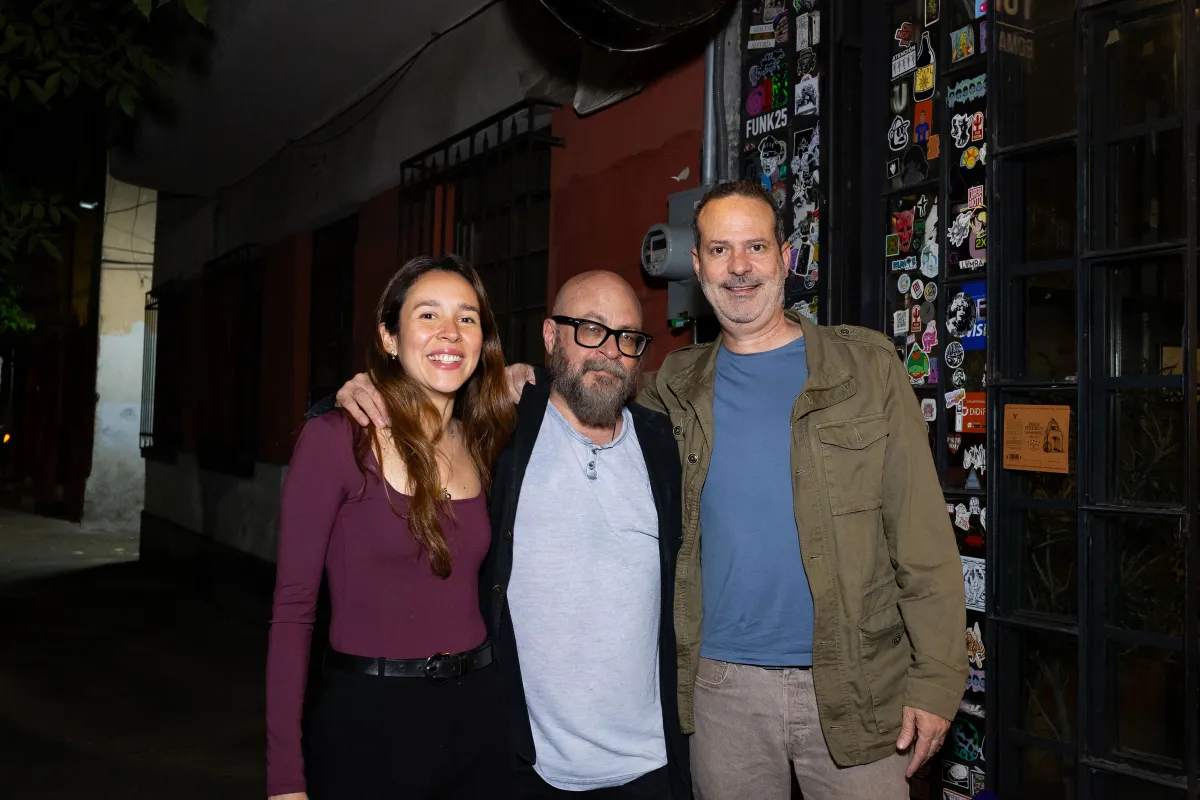
In their very first meeting of 2026, the three partners behind Artegios, a documentary-focused production and distribution company based out of Mexico, spend as much time looking backward as forward. Artegios’s head of distribution, María Josefina Parra, who oversees day-to-day operations, summarizes some end-of-year reports for 2025. She and her partners, Everardo González and Roberto Garza, then move on to detailed discussions of their Q1 2026 releases—and later still, volley ideas about what other projects they may be picking up for later in the year.
Their main priority—amid funding applications that need to be submitted and talk of which of the Oscar-shortlisted docs may well be a good fit for Artegios’s 2026 slate—is Trisha Ziff’s Gerry Adams: A Ballymurphy Man (2025). Just the week before, Parra met with Circe Arreola, a freelancer who helps draft press materials and assists with said funding applications, to discuss how they would be approaching a third collaboration with Ziff.
“What’s always nice about Trisha is that she’s giving us a lot of freedom when it comes to strategy,” Parra tells Garza and González via Zoom. After distributing Ziff’s previous films Witkin & Witkin (2017) in 2019 and Oaxacalifornia: El regreso (2021) in 2022, Artegios has a good working relationship with the filmmaker.
“Have we recut the trailer for it yet?” González asks.
“No, not yet,” Parra states. “But when I met with Trisha, she said whatever we wanted to do with the trailer, we could go ahead and do it. We’d just need to find someone ourselves.”
The trailer (which Parra had already considered recutting and repackaging for increased engagement as an Instagram Reel, the better to take advantage of their own 10K followers) is but one of the outstanding details for the planned March launch of Gerry Adams. The partners also discuss how to better tailor their press approach (aware of the shrinking pool of publications that help move the needle within Mexico’s entertainment and documentary space) and how best to utilize Ziff, a Mexico-based British photographer and director, in interviews and Q&As, since that would require hiring a translator. One possibility is to have González himself on hand for such media appearances. But that may prove tricky, since the documentary filmmaker, best known for critically acclaimed docs like Devil’s Freedom (La libertad del diablo, 2017) and A 3 Minute Hug (2019), spends much of his spring months teaching in Cuba.
As with many of the decisions that are eventually made about Ziff’s film and the rest of Artegios’s current and future releases—which include Ibrahim Nash’at’s Hollywoodgate (2024), still playing in theaters, and Ana Ts’uyeb’s Li Cham (2025), slated as a May 2026 title—there is a practicality that belies Artegios’s nimble but mighty operation, which has to contend with a theatrical landscape that remains relatively inhospitable to both documentaries and homegrown fare.
In 2025, Mexican productions accounted for 20 percent of all theatrical releases but only 4.5 percent of the country’s box office. And even as the form exploded across the country in the 21st century (with filmmakers like Tatiana Huezo, María José Cuevas, Luciana Kaplan, and González himself creating world-renowned work), the current Mexican theatrical landscape, much like in the U.S., privileges celeb-driven documentaries. In 2025, some of the highest-grossing docs were concert documentaries from Juan Gabriel (Mis 40 en Bellas Artes), Taylor Swift (The Official Release Party of a Showgirl), and Kenia Os (Kenia Os: La OG), all of which attracted over 200,000 attendees.
Artegios stands out for its commitment to both Mexican productions and documentaries. Over the last decade, they have released four to six documentaries a year (at times accounting for 20 percent of all Mexican docs released annually). Aided in no small part by tax incentives designed to bolster support for the Mexican film industry, Artegios has been on a mission to carve out spaces and audiences for what even their own internal research has shown is seen as a niche genre that has become all but synonymous with streaming fare. In response, the Mexico-based company has emerged as a savvy distributor able to leverage the country’s budding alternative exhibition scene—not just the well-established Cineteca circuit but an ever-growing number of cinema clubs and cultural centers—for independently produced docs from Mexico and beyond. In a sign of how well-positioned they have become in handling high-profile titles, Artegios distributed No Other Land in Mexican theaters.
The three partners are very hands-on with every documentary they decide to release, preferring to work closely with filmmaking teams who are open to treating distribution as a collaborative endeavor meant to redress how opaque and broken this system has become. That comes from having been on the other side of those conversations. Ts’uyeb, a first-time Tsotsil feature filmmaker, was drawn to the care and attention she saw in Artegios’s bid for her film Li Cham, a portrait of three Indigenous women finding renewed strength in political action. Every meeting leading up to the release has felt revelatory. “I have no experience in this field,” she says, “and so I’ve had to ask a lot of questions and consulted them at every turn. But I’ve felt very supported, especially as we prepare to open it in alternative and itinerant spaces in regions and communities all over Mexico, which is only possible because of the contacts they have in place.”
What Ts’uyeb is describing is an infrastructure that operates with neither an expansive team nor unlimited resources. Instead, it is born out of a simple idea that has driven Artegios for more than a decade: small, intentional individual efforts are the only way to push back against systemic problems in the film industry. In philosophy and in practice—and especially given Garza and González’s own background—Artegios is a filmmaker-first distributor.
***
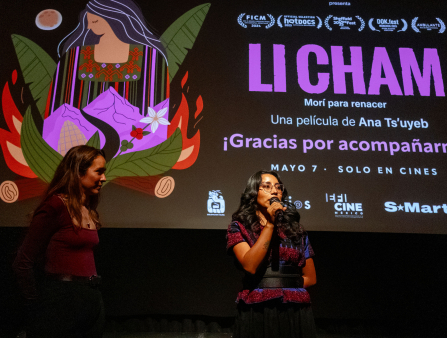
(L to R) María Josefina Parra and director Ana Ts’uyeb at a screening of Li Cham in May 2026. Photo credit: Rodolfo Zacarias.
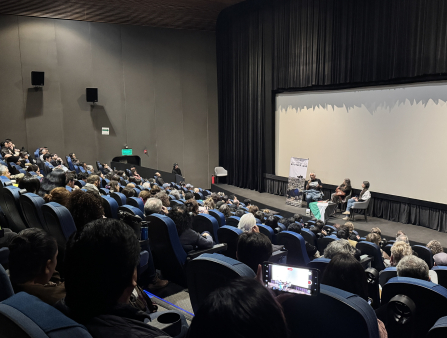
No Other Land screening at Cineteca Nacional Xoco in February 2025. Photo creidt: María Josefina Parra.
Everardo González first came to prominence with his feature film debut, Pulque Song (La canción del pulque, 2003), a 60-minute documentary that offered a slice of life of those who make pulque, a millennia-old alcoholic drink, from the fermented sap of the maguey plant. González’s debut quickly established him as a filmmaker to watch. In 2007, when working on his third feature film, The Old Thieves: The Legends of Artegio (Los ladrones viejos: Las leyendas del artegio, 2007), a playful account of aging thieves reminiscing about their own wily ways of stealing (namely, their “artegios”), González opted to set up his own production company, along with that film’s producers Roberto Garza and Alejandro Molina, both of whom he had met years prior while shopping around a never-finished docuseries. Together, they cofounded Artegios Producción.
By 2014, González, Garza, and director-producer Juan Patricio Riveroll realized they should have greater control over their projects once completed, especially amid a rather barren doc distribution landscape. That year, the Instituo Mexicano de Cinematografía (IMCINE) tracked a record-breaking 45 Mexican-produced documentaries, but the number theatrically released was a measly 16. Moreover, Mexican documentaries, which represented over a quarter of new releases that year, only accounted for one percent of admissions. Artegios Distribución was born from a purely pragmatic proposition (Riveroll left shortly thereafter). At the time, there were very few distributors, and none specialized in documentary. “So at the beginning, there was a push toward safeguarding our movies,” Garza recalls. “Because bigger distributors don’t—can’t, really—take care of the kind of small documentaries we were making. So we said, ‘Let’s just do it. Let’s distribute our own titles.’”
At this onset, both arms of Artegios—production and distribution—were twinned endeavors, emboldened by the growing presence of efforts like Ambulante and DocsMX, which ushered in a renewed, burgeoning independent documentary scene. The company’s first real test came when it decided to distribute a documentary it had no hand in producing: Eliezer Arias’s The Silence of the Flies (El Silencio de las Moscas), which premiered at IDFA in 2013. The Venezuelan project focuses on the suicide epidemic afflicting rural communities in the Andes. Arias’s quiet, haunting snapshot of parents who have had to grapple with an unimaginable loss was, both González and Garza knew, a difficult title to sell. But they were still surprised when, in the spring of 2015, the doc remained in theaters for over eight weeks. Although not a runaway success by any measure, its modest box office numbers proved to the partners that there could be a path forward for the distribution model and philosophy they hoped to build on.
The Artegios titles that followed The Silence of the Flies paint a picture of a distribution company trying to hone its curatorial eye while also positioning itself for financial stability. In addition to releasing crowd-pleasing docs like Crystal Moselle’s Sundance doc The Wolfpack (2015) and Kyzza Terrazas’s deep dive into Mexico’s underground hip-hop movement Somos lengua (2016)—then their highest-grossing titles—they also championed more of those “small” projects by first-time feature doc filmmakers like Fernanda Romandía (Pacífico, 2016; released by Artegios in 2017) and Karina Garcia Casanova (Juanicas, 2014; released by Artegios in 2017). And while The Wolfpack and Somos lengua attracted numbers that dwarfed Romandía’s dreamy, hybrid work and Garcia Casanova’s vulnerable family tale, the years that followed found Artegios looking out for works that, by González’s own assessment, “don’t fit neatly into rigid narrative frameworks.”
The film that set the tone for what Artegios could accomplish—critically, and crucially, commercially—was González’s own Devil’s Freedom (2017); to date, it is Artegios’s most successful film. The filmmaker’s Berlinale-premiering doc (which later played Guadalajara, CPH:DOX, IDFA, and Thessaloniki, among others) is a harrowing examination of Mexico’s culture of violence. The interview-laden project is an attempt to allow victims and victimizers to share the screen, their testimonials equally flattened and amplified by the skin-colored, skull-like masks the participants wear.
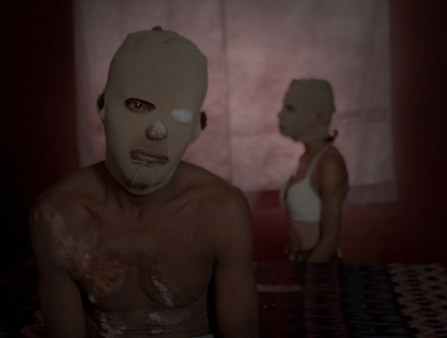
Devil's Freedom.
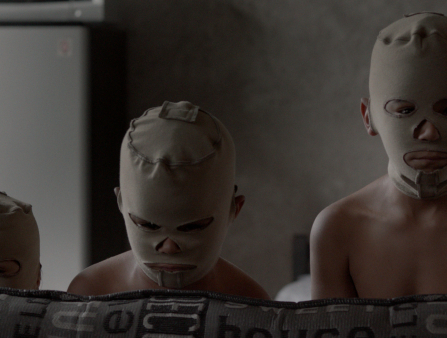
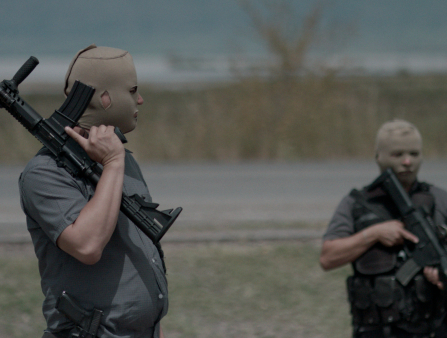
One of the most well-regarded Mexican films of that year, Devil’s Freedom played for over 27 weeks (in up to 19 screens in 10 different cities) and ended the year as one of the top 50 Mexican releases at the domestic box office, grossing MX$1,001,511 (US$57,600), and attracting 20,217 attendees. Gonzalez’s film was the third-highest-grossing Mexican documentary of the year. Sitting right below a sports doc about a soccer team and a music doc about ranchera singer Chavela Vargas, this tough watch of a doc was a bit of an anomaly—proof that with the right combination of marketing, hype, and know-how, independent documentaries could break through if handled appropriately.
Part of what allowed Devil’s Freedom to succeed was the MX$750,000 Artegios received from Estímulo Fiscal a Proyectos de Inversión en la Producción y Distribución Cinematográfica Nacional (EFICINE) to cover its P&A costs—everything from DCP deliveries; digital, print, and broadcast ad campaigns; trailer spots; publicity; and the like. Established in 2006, Mexico’s EFICINE 189 is a fiscal incentive designed to reinvigorate the local film industry. In essence, the program is funded by Mexican corporate taxpayers, who receive a fiscal credit equivalent to their contributions to national film investment projects. Up to 10 percent of the total contributions is then dispensed to distribute the resulting national films. In addition to tripling film production during its first decade, EFICINE has also bolstered domestic distribution. The sums Artegios received over the years (between MX$240,000 and MX$1,350,000) has given the company the cash flow needed to support documentaries that otherwise would nor have been viable theatrical releases. But it is also what made the success of a project like Devil’s Freedom at the box office all the more profitable, especially since it had also been produced in-house.
Other distributors of similar scale and taste have, in recent years, received funds to help distribute well-traveled festival documentaries like Malintzin 17 (2022) and El reino de Dios (2022), but they do not release as many independent docs as Artegios. “We are really committed to producing and distributing documentaries; we really enjoy living within that space,” Garza notes.
What those numbers do not reflect is the way Artegios is expanding its distribution to reach cultural centers, cinema clubs, and other noncommercial spaces where its documentaries can be better appreciated. They have been not only seeking audiences but also building them. Even as nontheatrical exhibition spaces were more plentiful pre-pandemic (upwards of 600 cineclubs existed in 2018), Devil’s Freedom was barely shown in them; the bulk of its box office came from the well-established multiplex circuit. Over the succeeding years, and with the expansion of nonmultiplex options—in 2024 IMCINE counted more than 800 alternative exhibition spaces compared to the 7,383 commercial screens in the country—Artegios has pivoted toward using their EFICINE funds to further cater to and support those noncommercial spaces as viable exhibition alternatives.
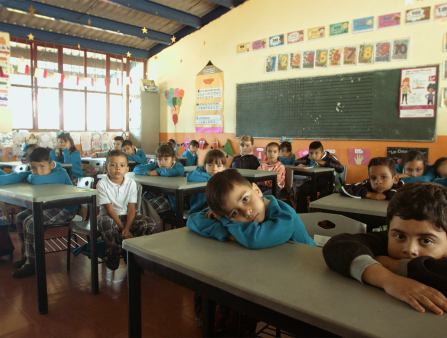
La falla.
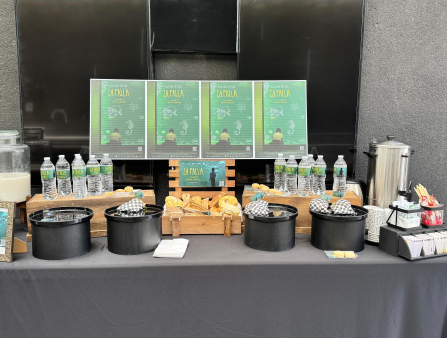
La falla screening at Cineteca Nacional Xoco in May 2025. Photo credit: María Josefina Parra.
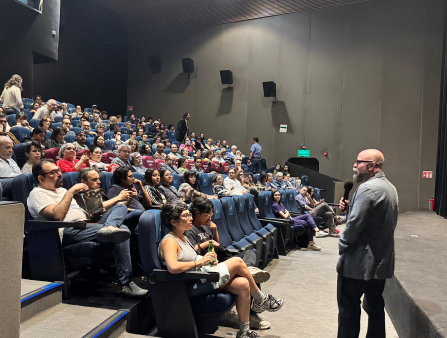
Everardo González introduces La falla at Cineteca Nacional Xoco in May 2025. Photo credit: María Josefina Parra.
Nontheatrical screenings involve more work, though. Not all venues can pay screening fees, while others do not yet have the infrastructure to market their titles effectively. To bolster that infrastructure, Artegios has toyed with everything from creating giveaway merch to facilitating Q&As and talkbacks, not to mention creating personalized posters and social posts, to strengthen relationships with venues and audiences alike. Their goal has been to help professionalize some of those venues, all while supporting cultural centers, schools, and even makeshift screening spaces where a filmmaker (or a passionate community) may want to screen their films.
For Alana Simões, the filmmaker behind La falla (2025), a sly and playful observational doc following a second-grade classroom in rural Jalisco, Artegios’s artful expertise and out-of-the-box experience with handling independent documentaries immediately drew her to working with them. “It’s clear that what sets them apart is their love and understanding for the complexity of documentary,” Simões says. “They know it inside out, which means they’re able to really explode its potential and find audiences for their films in places where you may not initially think to look.”
The strategy they jointly came up with for La falla is a more sophisticated extension of what Artegios had first begun piloting with Devil’s Freedom: it included screening the critically acclaimed doc widely across the country, reaching over 100 exhibition spaces, many of them outside the commercial circuit. Comscore notched the film at around 5,800 attendees, but Artegios’s internal numbers, which include cultural centers, cinema clubs, educational screenings, and the like, show that number increasing by close to 50 percent. This is Artegios in a nutshell: distribution as grassroots organizing, able to reframe what feels like shrinking theatrical opportunities for documentaries into a chance to carve out fresh niches and serve a new kind of in-person audience.
***
What those numbers do not reflect is the way Artegios is expanding its distribution to reach cultural centers, cinema clubs, and other noncommercial spaces where its documentaries can be better appreciated. They have been not only seeking audiences but also building them.
Following the success of Devil’s Freedom, Artegios officially divided its production and distribution arms in 2018. For González and Garza, that year marked a turning point precisely because they were in dire need of setting their company up for continued success. From an organizational (and financial) standpoint, Artegios was, in their own words, “un desmadre”—a mess. The arrival of María Josefina Parra that year as the head of Artegios Distribución was, for them, a godsend. “She came to sort out how to set ourselves up to have a future,” González says. “She came to clean house, basically.”
Parra, like González and Garza before her, had not envisioned entering the distribution business. After working at Colombia’s Festival Internacional de Cine de Barranquilla starting in 2013, she soon moved to Mexico to attend UNAM, where her master’s thesis continued her interest in film festivals. She eventually joined FICUNAM, where she assisted the then artistic director, Eva Sangiorgi, until Sangiorgi’s departure to head the Viennale in 2017. By 2018—mere weeks after catching Devil’s Freedom and in hopes of figuring out her own next career steps—a producer friend introduced her to Garza. “I was very honest with him at the time about how little I knew about distribution,” she recalls. “But I told him I was ready to learn, and so they took a chance on me.”
Learning on the job through those next few years, she has helped make Artegios Distribución a sustainable business. Since 2020, they have dispensed with their offices, gone fully remote, and maintain a slim operation. Rather than keeping folks on staff, Artegios contracts with a three-person social media team led by Victor Gochi, and hires Tatiana La Bella (for PR) and Circe Arreola (for programming and delivery) on a film-by-film basis. With such a reduced overhead, Artegios has been focused lately not on growth but on stability.
Parra, who became a partner in 2021, is a numbers person—and the one on top of the company’s exhaustive EFICINE applications during any given cycle (which require detailed plans outlining distribution strategies, company background, release dates, target audiences, marketing plans, benchmarks to hit, and budget considerations). If González is the documentary auteur who is driven by a commitment to the vibrant malleability of the documentary form, and Garza is the keen-eyed producer who can handily make lasting connections with sales agencies all over the globe, Parra is the steady, warmhearted ballast holding the ship that is Artegios Distribución together. On any given week, she is meeting with filmmakers, overseeing marketing rollout plans, checking in on contracts and theatrical bookings, and tracking DCPs.
Artegios, born first out of González and Garza’s own drive to have more control over how their projects fared in the Mexican theatrical landscape, matured alongside Parra (who was selected as an IDA Getting Real Fellow in 2022). Over the years, she has thrown herself into this world and helped Artegios weather an ever-changing distribution landscape. The business strategy the company has honed over the last decade consists of championing artistically distinctive work (often by first-time Mexican filmmakers) while pursuing internationally renowned docs like No Other Land (which cannot receive EFICINE funds) that can help them generate revenue.
“We always aim to have at least one title that allows us to take risks with some others,” González explains, breaking down the significance of No Other Land’s success with respect to Artegios’s 2025 roster. The Oscar-winning title, which Artegios acquired from international sales outfit Autlook Filmsales, was easily their most successful title at the box office last year. It earned MX$603,365 (US$34,950) over its eight-week run, which is close to five times what they spent in P&A. More tellingly, it almost matched its commercial attendance in cultural spaces, and was one of the 30 most-watched films released in Mexico’s Cineteca theaters.
González sees the encroaching streaming dominance as part of a larger homogenization of both documentary and its audience, at once a business and an aesthetic crisis in the field.
As that commercial/cultural center breakdown points out, Artegios’s tailored release strategies are paying off, even as they’re not immediately replicable from title to title, if not altogether impossible to scale. But Artegios’s commitment to theatrical exhibition, and its reliance on foreign titles to help sustain its bottom line has come with some necessary challenges. In 2020, for instance, they prepared to launch what they hoped would be a perfectly timed release for the Oscar-nominated, Syria-set doc For Sama. When the pandemic closures hit local theaters, the three partners knew the investments they had made on the film would be made all the harder to recoup as Waad Al-Kateab and Edward Watts’s doc was, per a streaming agreement they had been scheduling around, released on Netflix shortly thereafter. By the time For Sama was released in theaters later that fall as the country eased up on COVID restrictions, it would end its run with one of the company’s lowest box office returns in its entire history.
The pandemic was an inflection point for Artegios, which was forced to diversify its own revenue streams. They forewent their offices and retired the many educational workshops and programs they had been developing for up-and-coming doc filmmakers. And while it has become harder to reach the box office numbers its docs once achieved, their average number of attendees (which hovers around 4,000) is close to double the median number for contemporary Mexican doc releases. Though the pandemic accelerated streaming dominance and pushed Artegios into handling its own VOD releases, theatrical remains the company’s main source of revenue—a decision that is as pragmatic as it is philosophical.
If anything, the seismic changes within the industry in the past decade have further emboldened González to see Artegios as mission-driven to stand its ground. He sees the encroaching streaming dominance as part of a larger homogenization of both documentary and its audience, at once a business and an aesthetic crisis in the field. He is often quite disappointed with films that come across his desk that feel ready-made for streamers, with little of what he conceives as the artistic potential of the documentary form. He explains,
Much of our work involves building lasting audiences, which is becoming more and more necessary due to this hyperglobalized system. The work of spaces like ours will become more relevant because a hegemonic discourse is being constructed where there’s only a single way of telling stories. So where does that leave everything else? We need to nurture a system that works apart from that homogeneity that’s sold elsewhere.
For close two decades now, Artegios has positioned itself as a bulwark against such homogeneity. With a carefully honed curatorial eye, it has leveraged government funding to help nurture a documentary ecosystem in Mexico that allows for the breakout success of films like No Other Land and La falla. Even still, the company’s longevity, González knows, is never quite assured. He is as surprised as anyone that this three-person team, so committed to the social dimension of film distribution, continues to stay afloat. “We enjoy knowing we’ve made ourselves useful to this industry in creating those new audiences,” he says. “That makes a difference even as it likely leaves us at a disadvantage, sometimes. But I think so long as we keep on hitting the numbers we need, as we’ve been able to so far, we’re going to keep moving forward.”
This piece was first published in Documentary’s Spring 2026 issue.