

During my time at the 2026 International Film Festival Rotterdam, I couldn’t help but think of Theodor Adorno’s claim that to write poetry after Auschwitz would be barbaric. Throughout his career, Adorno would retract, revise, and reformulate his most famous quote, but the interpretation that most strikes me is that a culture that enabled (or at least failed to prevent) the Holocaust was not worth preserving, or, as he put it in “Commitment,” “when genocide becomes part of the cultural heritage, it becomes easier to continue to play along with the culture that gave birth to murder.” As I thought back on IFFR artistic director Vanja Kaludjercic’s opening remarks two years ago, when she positioned the festival against the “reductionism and the extremism of either/or” on Israel-Palestine, I wondered if our documentary landscape constitutes its own form of barbarism after the latest Gaza war.
IFFR’s documentary programming mostly reflects the festival’s old status quo of uneven formal experiments, political gestures, and bloated programming selections, with the best films buried in the large noncompetitive programs. The Tiger Competition featured two documentaries among its 12 films, down from 14 the previous two years. The more political and ambitious of the two is Unerasable!, directed under the pseudonym Socrates Saint-Wulfstan Drakos. The film follows another pseudonymous filmmaker, “CP,” who escapes Vietnam for Thailand when his dissident art puts him in the crosshairs, and eventually makes his way to Sweden. Before Sweden, the film is a collage, pulling images from cinema history—Un Chien Andalou (1929) features prominently—and the colonial archive, with CP only occasionally turning the camera on his immediate surroundings. In the last half hour, it streamlines considerably, likely because filming oneself and run-ins with Swedish bureaucracy is safer than doing the same while dodging migrant police in Thailand.
While the production history and timeline explain the film’s formal shifts, the connections between CP’s situation and the colonial past are broad, and the film’s attempts to link CP’s own persecution to a lineage of film directors in exile are forced. The vagaries of place in the first hour paradoxically make the shift to Sweden abrupt rather than transformative, with neither the emergent freedom of the West nor the parallels between its stifling bureaucracy and CP’s fears of Thai police resonating. The film feels caught between bricolage essay and refugee story without fully integrating the two approaches.
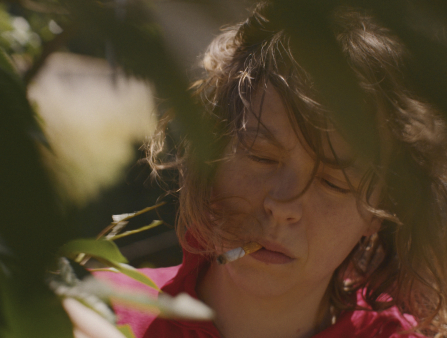
The other Tiger documentary, the more modest La belle année, about director Angelica Ruffier’s contemplation of mortality on the occasion of her father’s impending death and her revisiting of a childhood crush on a high school teacher, faces a different formal challenge. La belle année takes for granted that Ruffier’s fixation on one has to do with the other. We can imagine, abstractly, how a confrontation with mortality and the inevitable sifting through old treasures that a parent’s death brings might send Ruffier down this path, but the film does not let the audience share in that emotional journey. Still, Ruffier demonstrates command of the image, conjuring memories through letters and diaries and capturing her interactions with her family—and, eventually, her former teacher—with careful handheld framing and the use of natural light.
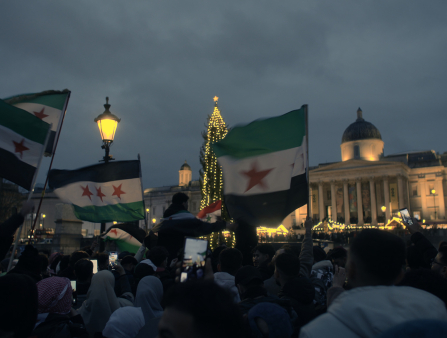
This year’s festival also premiered the five short films made with grants from last year’s Displacement Film Fund, a program IFFR has promoted extensively, as the lead headline in press releases and by securing Cate Blanchett’s participation to help fill one of the festival’s largest venues. The one documentary in the program is Allies in Exile, directed by Hasan Kattan (DP of the 2016 Oscar-winning short The White Helmets and an assistant director on 2017’s Last Men in Aleppo). Allies is at its best when presenting footage Kattan shot in Syria before making his way to London, where he was granted asylum after nearly a year of waiting. The film documents that asylum process and mixes in footage of the Syrian Civil War and more recent footage of Syria’s liberation, but the London material rarely achieves the same resonance. The result resembles a “special report” you might see on cable news—valuable war reporting paired with domestic images that provide crude illustrations. (The fiction films in the program fared no better.)
More troubling still is what this section demonstrates about the limitations of partnerships between film festivals and both nonprofit and for-profit institutions. The Displacement Film Fund is funded by Uniqlo and partnered with the UN Refugee Agency, and the shorts are by filmmakers displaced from Ukraine, Afghanistan, Syria, Somalia, and Iran, countries whose conflicts Western institutions frame as less contentious—and shoulder less blame for—than Palestine. Whether the absence of a Gazan filmmaker is the fault of the festival or simply a reflection of the impossibility of leaving Gaza right now, the absence is telling.
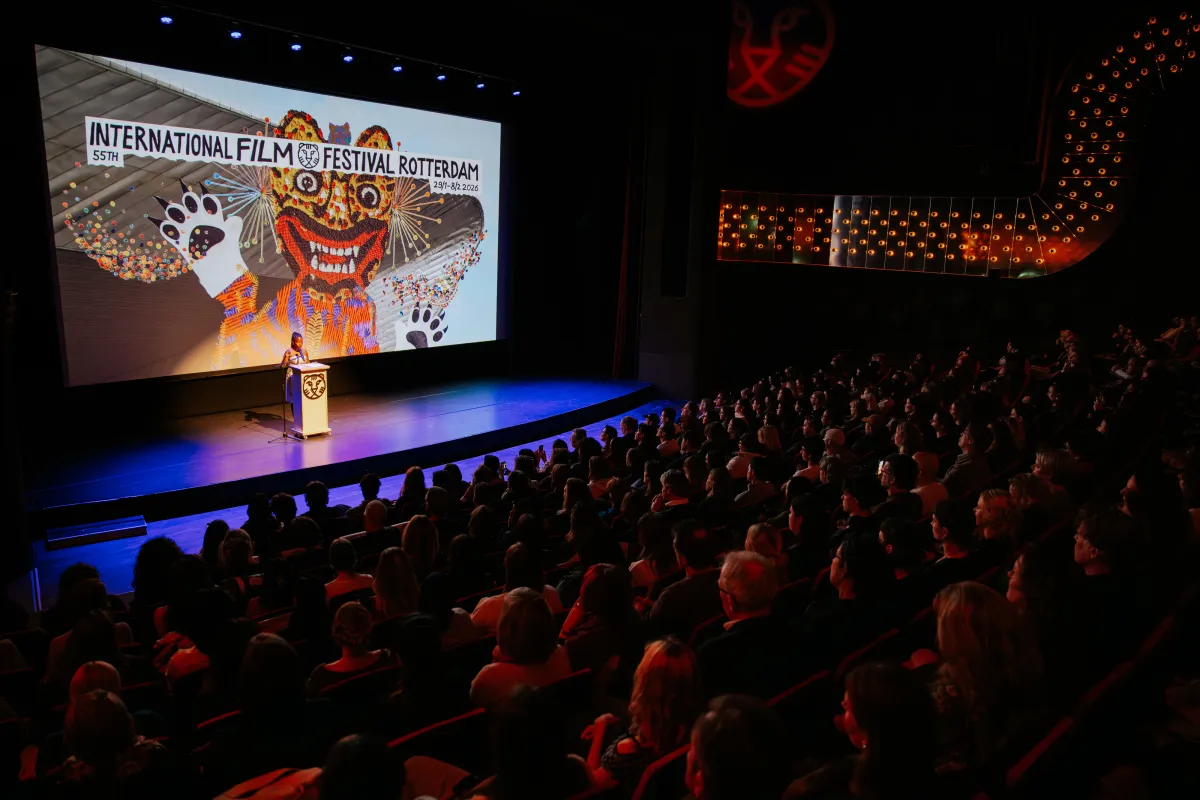
With the onset of the Gazan genocide, the industry had an opportunity to prove that the paradigm that positions film festivals as cultural leaders and documentary films as agents of change is worth maintaining. This writer has found such attempts wanting. IFFR’s own shortcomings are evident in this year’s opening remarks, for which Kaludjercic struck a different, more pleading tone than 2024’s defiant posturing. She noted that in Gaza, “genocidal violence has unfolded in full view of the world,” while also condemning civil wars in Myanmar and Sudan, the invasion of Ukraine, Iran’s violent repression of protests, ICE’s takeover of Minneapolis, and the American attack on Venezuela. The list reveals which political positions have become safely articulable at film festivals. Gaza has apparently graduated from a “complex” conflict requiring even-handed dialogue to a travesty whose condemnation is expected, though this reclassification has little to do with the conflict itself; nothing has changed in Israel’s conduct of genocide or the unwavering American state support.
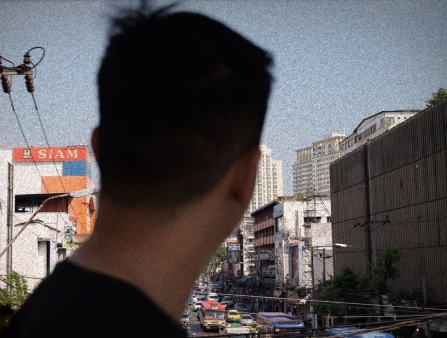
Unerasable!
La belle année
Allies in Exile
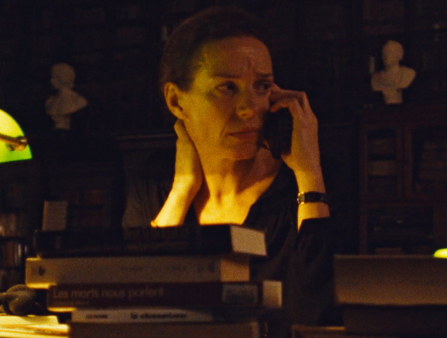
What was missing in the festival’s most prominent documentaries I found instead in its undercard. The best of these, and the best premiere I have ever seen in Rotterdam, was tucked away in Bright Future, a noncompetitive section for debut filmmakers: Jack Auen and Kevin Walker’s defiantly anticommercial hybrid Chronovisor. More than half of Chronovisor is text: shots of books, newspapers, and journals in English, French, and German about a device called the chronovisor, which, in real life, the Italian Benedictine monk Pellegrino Ernetti claimed allowed him to see images from the past, including Jesus’s crucifixion. This very real research is undertaken by the fictional Béatrice Courte (played by real-life scholar Anne-Laure Sellier), though at some point—or perhaps multiple points scattered throughout—the presentation of real research crosses from documentarian to fictitious. Trying to determine precisely when this happens creates a parallel between the protagonist’s obsession with the fantastic and our own obsession with the hyperreal conceit.
For a film that consists so heavily of text, its sound design is remarkable. The film is buttressed by Gustav Holst’s The Planets, which masterfully accompanies the film for most of its runtime. The film’s few conversations are mixed carefully with background chatter so that we understand that the words we hear are less important than the exuberance and curiosity with which they are spoken. The hiss of cassettes and the sounds of folding newspapers and pages turning punctuate passages otherwise lacking diegetic noise, creating unlikely suspense in sequences of words on the screen and the occasional reverse shot of a protagonist whose own stillness belies her descent down a rabbit hole.
Chronovisor is also concerned with the sorts of things only researchers, analog fetishists, and cinephiles care about—the way light hits different kinds of paper; how to repair a broken VHS tape; even the minimum amount of light required to make the film’s 16mm images legible. Between such esoterica and the borderline untranslatability of the film—the French and German text comes to us not in subtitles but with on-screen superimpositions translating only key parts of a longer text, and a couple of segments are shots of a single English word with cuts escalating in speed—it’s likely that Chronovisor will have a difficult time traveling. On the other hand, Walker told me that critical raves have done wonders for its hopes of distribution, and it’s to IFFR’s enormous credit that it not only programmed this film but has also cultivated a network of attending critics with enough sway to invigorate its commercial prospects. Both its selection and the film itself are a testament to the value of looking closer.
Gaza did find its way into the festival. Hidden in the enormous Harbour section was Roy Cohen’s Far from Maine, another in what has become a significant body of Israel-Palestine documentaries playing international film festivals. At the beginning of the film, which turns the camera inward to the director at least as much as it turns it outward, the film establishes political clarity on Palestinian rights when Cohen refers to “the genocide.” Structured partially as a letter to a Asel Asleh, a Palestinian killed at the beginning of the Second Intifada in 2000, Far from Maine follows Cohen as he discusses the ongoing genocide with family and friends—many of whom, including Asel, he met at Seeds of Peace, a summer camp in Maine that brought together Jewish and Arab Israelis and Palestinians—while wrestling with where he and his partner should raise their daughter.
Cohen’s politics are clear-eyed and unapologetic, and his devotion to his long-lost friend foregrounds the core asymmetries in the Israel-Palestine relationship. The very question that torments Cohen—should he stay or leave—is one that most Palestinians, especially Gazans, are not afforded; likewise, a reflective documentary is the province of the privileged. When Cohen wonders aloud what film Asel might have made, we are reminded whose story we get to hear and who is denied not just their life but the preservation of their interiority. Indeed, the dominant mode of filmmaking in Gaza is the short-form videos that have permeated our social media feeds for almost two and a half years.
Cohen speaks to other friends from Seeds of Peace, particularly Palestinian friends, as well as to his sisters, one of whom lives in a kibbutz near the Gaza border and the other of whom is a medical worker who makes frequent trips to the West Bank. The interviewees hold distinct perspectives—a Palestinian professor who attempts to empathize with October 7 militants; a sister who supported the Palestinian cause until October 7; friends with older children who are attempting to explain inequality and violence—but because they are Cohen’s friends, they inhabit a remarkable humanity that prevents them from functioning purely as mouthpieces. With their help, Far from Maine is intelligent and sensitive as a witness to both the geopolitical moment and to Cohen’s personal dilemma.
Chronovisor

Far From Maine
After the Cities
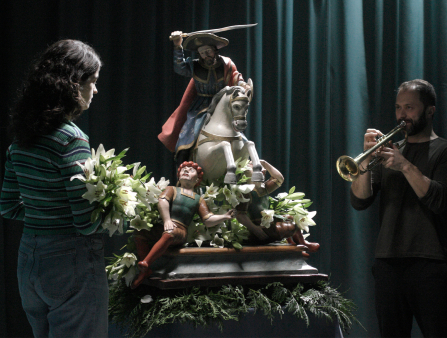
The best films in IFFR’s noncompetitive sections are ambitious, and the sidebars often bring in 16mm prints of experimental films that fill only the smallest theaters at the festival. Perhaps it’s no surprise, then, that the festival’s other nonfiction highlight offered a different type of witnessing. Another Harbour title, Xacio Baño’s After the Cities is an essay film collecting postcards from Santiago de Compostela in Galicia, Spain. Most of these postcards date from the 1950s to the 1970s and feature notes from a lover, friend, or family member, some on vacations and others on longer journeys. Baño is creative with how he presents the postcards, opting sometimes for voiceover, other times for studio readings by actors with the postcard a mere superimposition on the frame. He cares not just for the images and the sentiments but also the handwriting that adorns them.
With this thoughtful and diverse approach, we begin to appreciate the full range of the postcard’s possibilities. They provide at once an ideal and unattainable version of the site they depict, turning a real place into an abstraction while serving as the site of interpersonal confession. Taken in large numbers, their meanings accumulate, documenting the reinvention or consistency of that fabricated ideal over time. The apparent individualism of one letter mutates into a data point in our shared experience as travelers. Repetition with variation takes on both personal and historical dimensions as Spain and Santiago de Compostela’s sites change, sometimes together and sometimes separately. A token at once generic and personal on its own becomes a meaningful historical text in bulk.
Altogether, After the Cities is a testament to the vitality of witnessing. If an old postcard can be discovered decades later, put into conversations with countless others at once so like and unalike it, so too can a documentary film find audiences and relevance beyond its festival premiere. It suggests one answer to the question of what documentary can do in a moment when its capacity to affect political change seems constrained by institutional economics and political timidity. While it does not offer the redemptive value of “documentary as social change” that some festivals invoke, or lend credence to the status quo that grants film festivals meaningful cultural capital, it demonstrates the value of taking notice. If I haven’t been dissuaded from my notion about the barbarism of the status quo, I have at least found some relief in the value of bearing witness.
This piece was first published in Documentary’s Spring 2026 issue.