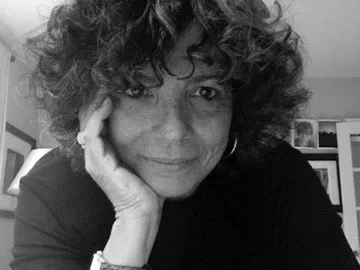
Christine La Monte headshot
Welcome to IDA Member Spotlight, a monthly interview series highlighting IDA members and showcasing the depth and diversity of our community. This month, we had the pleasure of speaking with Christine La Monte, a longtime IDA member. Christine is a producer, director, writer, and former marketing executive for Universal, Disney, and Orion. She is the founder and president of La Monte Productions, where her current projects include two Oscar-qualifying feature documentaries on the awards circuit. In this interview, Christine shares insights into these projects as well as what’s next for her and her production company.
IDA: Could you please tell us a little about yourself and your profession or passion?
Christine La Monte: The visual and performing arts—film, theatre, opera, photography—are my passions and, luckily, also my profession. As I find myself with two Oscar-qualifying opera-related feature documentaries on the Academy portal, VViva Verdi! and Ai Weiwei's Turandot, it seems that my entire career has led me to this particular place in time. From work at Universal, Disney, and Orion as a marketing executive, to working at Cinecittà in Rome; from teaching film at New York’s School of Visual Arts and serving as editor at an avant-garde photo magazine, Musée, to producing/directing theatre and television—all this afforded me necessary tools and essential idiosyncrasies, like being relentlessly driven and endlessly patient with an existential sense of humor, to produce feature films—opera films, no less. For me, opera connects my present with my past. I fell in love with opera as a young girl, mesmerized by the sounds of Mario Lanza and Caruso coming from my grandmother’s gramophone; that’s when opera first seeped into my soul. But it wasn’t until I was in my late twenties, working with Franco Zeffirelli on La Traviata at Universal Pictures, that I was struck again by its allure and overcome by its magic. Since then, there has never been a season that I have not been front and center at La Scala, the Met, Palais Garnier, La Fenice, San Francisco Opera, or some jewel of an opera house, shouting my bravos along with the rest of the opera-obsessed, moved by the stories being told on stage. Opera is and always will be an inspiration that continues to motivate my life and my work. And what a gift to be at this stage with two glorious works that aim to inspire, entertain, and educate—uplifting, hopeful gamechangers that offer new ways of looking at the world.
IDA: You have had an incredible career in the field. Can you tell us a bit about your work? When did you first start working in the documentary field?
CL: I’ve been fortunate in my career, although working hard and saying yes are also key factors. I remember after working at Universal and Disney, getting married and moving to New Zealand, where my husband was named the new CEO of Lion Nathans, and I ended up working at TV3 NZ. After two years, when we returned to New York City, I was about to open my own PR firm and had just had stationery made up when I received a call from Charlie Glenn at Orion asking me to join them as Senior VP of Marketing. I mentioned my new stationery that was sitting in front of me, and he said tear it up. I did, said yes to Orion, and those two years of working with Arthur Krim on Dances With Wolves and The Silence of the Lambs, which took back-to-back Oscar sweeps in spite of the lean staffing at Orion, were exhilarating and most remarkable, heady years. Following a decades-long career as a studio executive, I then segued into producing and directing theatre, which I love because it’s so dynamic, with each day unique and an opportunity to bring more to the stage; then producing television, a short feature, and now documentaries. I had already learned a great deal from the masters while working as a studio executive, traveling with directors and producers, and had developed the marketing skills and corporate mindset that made the transition smooth. My first documentary, Viva Verdi!, started in 2013 in Milan. It was a joyful and delicious experience in Italy, where we built an arc over three shoots for our main characters and became part of the local scene. Production was interrupted by COVID, so we pivoted to remote editing from Parma, New York, and Los Angeles. Ai Weiwei’s Turandot’s first shoot was in 2019; production stopped shortly after, when the Rome Opera House closed down due to the pandemic. There were over 600 people working on the opera and the film at the time. I believe it’s passion and persistence that drive groundbreaking productions through these times of adversity. Both productions navigated the fallout of the COVID-19 pandemic and various other challenges across the board. For me, it’s always about challenges and mantras. My first mantra is: The challenges ARE the opportunities. The second is: Look for and expect miracles. And of course, working hard and saying yes is a given.
IDA: Two of your recent films, Viva Verdi! (2024) and Ai Weiwei's Turandot (2025) have had an incredible journey and are up for Oscar consideration. Congratulations! Could you tell us about each film?
CL: There are many concentric circles here in both films, which all start with my meeting and working with Maxim Derevianko, the director of Ai Weiwei’s Turandot, when I lived in Rome in 2012. Maxim was just finishing his first film, Bodypieces, at film school, when I helped him finish the film, as well as the marketing. He was already an artistic, creative talent. When Viva Verdi! started shooting in Milan a year later, I asked him to join me and my producing partner, Yvonne Russo, the director of the film, as our cinematographer. We remained close friends as he went on to serve as the head of film/video for the Rome Opera House for seven years, working with Sofia Coppola, among other celebrity opera directors. In 2019, after he met Ai Weiwei, and their life stories resonated (both with artist fathers, from countries where freedom of expression is challenged), Maxim started Ai Weiwei’s Turandot. Shortly after, the production closed down due to COVID, and shooting didn’t resume until 2022, when the opera was finally performed at the Rome Opera House. It was early 2023, when Maxim was getting ready to film Chiang Ching in New York, that he called and asked me to come on board as producer of the film. It was an immediate yes. Marta Zaccaron and I formed an Italian/U.S. co-production and became owners and producing partners of the film. Together, we came to a great rough cut and raised funds to complete the film. I brought Andy Cohen on, who invited Julian Lennon to join us as an executive producer, and my friend, Executive Producer Marcie Polier, joined us this year. We are all activists and honored to be a part of this “opera for peace,” as Ai calls it, agreeing that the best art makes us question our preconceived ideas, offering us food for thought, and ideas for change. More circles: Ai Weiwei and I both worked with Franco Zeffirelli: Ai Weiwei when he was an extra in Turandot at the Met in 1985, and I worked with him during my Universal days on his La Traviata film, another Verdi connection.
IDA: In both of the films, you are working with an artist. How has that process been?
CL: Maxim Derrevianko, the director of Ai Weiwei’s Turandot, worked closely with Ai Weiwei and found him to be open and cautious at the same time, and extremely focused on his work. His strong political and artistic voice is woven throughout the opera, as well as the documentary in the behind-the-scenes, the interviews, the projections on the screen, and the archival footage that we chose. I was not on board during the Rome Opera House shoot; however, my interactions with Ai Weiwei since then have been wonderful. He’s been very supportive of our film and kind. He’s continually creating art; currently, he’s in Ukraine shooting a documentary. I’m always eager to see his new work, whether it’s written, performed, an art piece, or an art installation. Working with Verdi’s legacy home and his music has been an elevating experience for me. Verdi’s operas are all written and performed in 432Hz as opposed to the standard 440Hz. Called Verdi’s “A,” it’s an alternative tuning that is mathematically consistent with the universe, and the same pitch as the Amen and the Om. I have the utmost respect for both these humble geniuses who are humanitarians first and foremost, and I am fortunate to be associated with them in any way.
IDA: Where can our members learn more about each film?
CL: You can check out Ai Weiwei's Turandot’s Website and IMDb, and Viva Verdi!’s website and IMDb for news and more details.
IDA: What is next for you? Are you working on anything you can share with us?
CL: I am producing a third Italian documentary, Figli del Fiume (Children of the River), about three men in search of meaning who explore ancestral waters along the banks of the Po, Italy’s longest river. Directed by Federico Rodelli, the film is part of the slow cinema movement, with less dialogue and more visuals that take you on a meditative journey. In addition, in development is my husband’s Len Williams’ critically acclaimed book, Justice Deferred, which was picked up by Warner Brothers and is now back to me; Laura Curran is attached to write the screenplay.
Christine La Monte, producer/director/writer and former Universal, Disney, and Orion film marketing executive is founder/president of La Monte Productions where current projects include two OSCAR-qualifying feature documentaries on the awards circuit: AI WEIWEI’S TURANDOT, a co-production with Italy’s Incipit Film and La Monte Productions with Executive Producer Julian Lennon, which follows revolutionary activist and artist, Ai Weiwei as he makes his operatic directorial debut at the Rome Opera House; and VIVA VERDI! about Casa Verdi in Milan, home for retired opera singers built by Giuseppe Verdi in 1896, serving as producer, writer, executive producer; and in postproduction, FIGLI DEL FIUME / CHILDREN OF THE RIVER, three men in search of meaning along Italy’s Po River. Len Williams’ critically acclaimed legal thriller, JUSTICE DEFERRED is in development. La Monte produced Palm Spring International Film Festival audience award-winning short film, DANDELION DHARMA; Gary Goldstein scripted play, “Three Grooms & A Bride,” and syndicated television talk show, "Marilu" starring Marilu Henner. Her directing credits include SAG’s “A Heart United” with Sharon Lawrence, and “The Angina Monologues” with Brenda Strong. She spent over five years as Executive Vice President of the Motion Picture Division at Rogers & Cowan; and as an international strategic marketer, worked at Italian studio CineCittà in Rome; and served as Marketing Executive at TV 3 New Zealand while living in Auckland. A long-time member of the Academy of Motion Pictures Arts & Sciences, she is a member of Academy of Television Arts, and Alliance of Women Directors. La Monte is a past faculty member of New York's School of Visual Arts, and is on the Advisory Board of Southeast European Film Festival. She’s a frequent guest speaker/ panelist/jurist at filmmaking events, including USC, UCLA and Humanitas Awards. With US/Italian dual citizenship, she divides her time between Los Angeles and Rome.