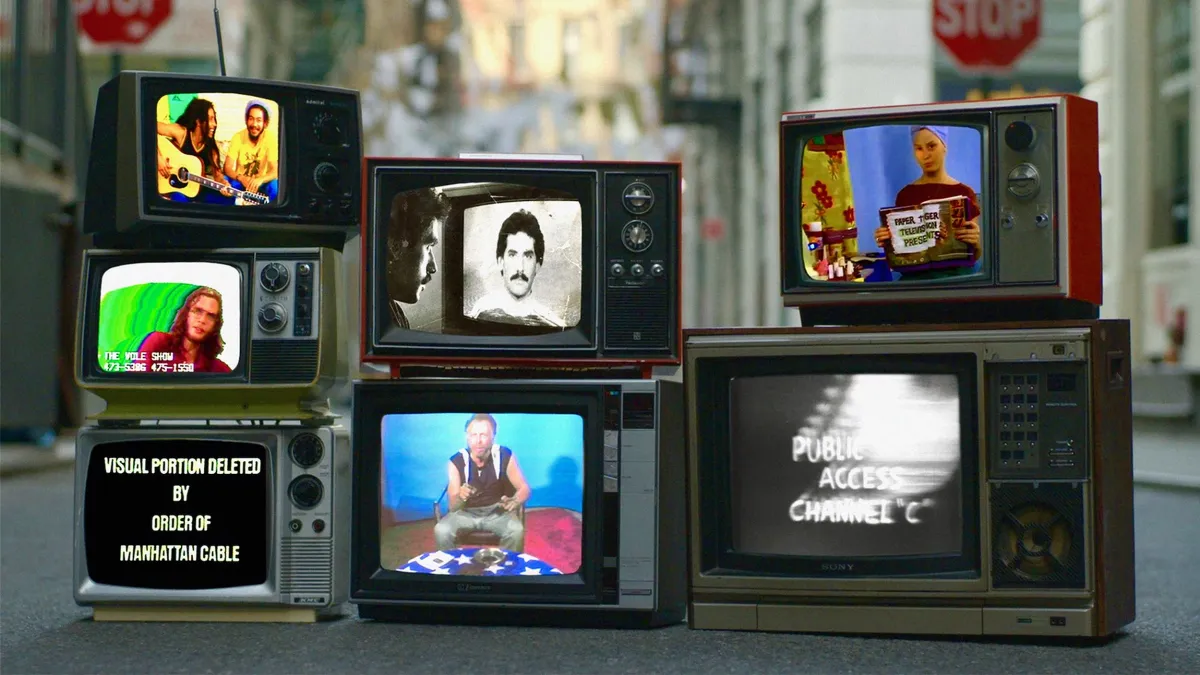

It’s almost a surprise that someone had not made a full-fledged attempt at the subject until now, but the archivally rich Public Access aims to get into the history and the mindset of the particular form and moment of the medium. Initially, one can feel director David Shadrack Smith looking for a way into the subject, with montages about New York in the 70s and so on. But once the timeline of public access begins—inaugurated in the early 1970s through an agreement with cable companies to provide two channels for the public to use directly—we’re smartly given over to the voices of creators, personnel, regulators, and more, in all their stubborn independence and idiosyncrasy.
“It really was just people trying to connect to someone, to anyone, out there, and putting themselves out there,” Smith, a veteran TV producer, told me in an interview a few days before the world premiere of Public Access at Sundance. An early fan of public access, he used to watch at his grandma’s house in Brooklyn every Friday night around age 9. With his team, he amasses a respectable assortment of shows—call-in, “downtown” and experimental, music, community news (including the Gay News Network)—told through extensive archival excerpts and audio interviews.
But the spine of the film is the long, historic battles over freedom of speech, which necessarily brings in characters such as the late pornographer Al Goldstein of Midnight Blue and the differently dedicated employees at both Manhattan Cable’s regulatory offices and the public access facilities.
As a fan and amateur scholar of public access, I was excited to talk with Smith about assembling the film’s narrative from an inherently unwieldy history, his choice to use audio interviews, and more. (Smith’s own well-loved show, by the way, was Mrs. Mouth: “It was a man—it turns out, I now know—who had painted an upside-down face on his face and spoke in a falsetto and ate eggs and olives, and that was it. That was the whole show.”)
DOCUMENTARY: The nature of public access is that it allowed so many people to tell their own stories. How did you arrive at the particular story of public access that you told?
DAVID SHADRACK SMITH: The thesis statement was essentially: Here was this experiment in open media, the first time that anyone could have access to broadcast themselves, or anything that they wanted, to the public. New technology made that possible, and it started with this utopian idea of multiple voices and underrepresented communities getting a chance to have their voices heard. And that idea, when it hit the real world, morphed, grew more complex, and became the story of public access. I understood how well that grafted onto the story of the Internet and all the other experiments in our technologically driven media world. From there, it was really creating a set of criteria and filters for the stories that we wanted to include.
Roughly, we wanted to follow a timeline from its beginning to when the internet arrived, and it sort of lost its place in the world. But along the way, there were gazillions of amazing shows. So, did it have an archive that was preserved and available to us? Were there creators who were able to speak to the making of the show and put it in context for us? And finally, how did this particular story advance the overall story of public access? How did it impact the way public access evolved? And as we went down every possible lead that we could find, someone would tell us about this show, and this archive would show up, and then we’d hear everyone had a show they remembered. I had shows that I remembered very personally, and it was this puzzle that started to come together. There’s many more that also would have, could have, should have been, and are heartbreakingly on the edit room floor.
The thesis statement was essentially: Here was this experiment in open media, the first time that anyone could have access to broadcast themselves, or anything that they wanted, to the public.
— David Shadrack Smith
D: What’s an example of a show that was personally important, and what’s one that you came across by hearing about it or stumbling on it?
DSS: The ones that were experiences I had as a kid also hit right in the center of this target of trying to understand the role of self-expression and free speech and the First Amendment: Midnight Blue, which was Al Goldstein’s late-night show, the first show about sex on television, as they call it. That was so shocking and new and unimaginable back then, and of course, it led to all the questions we ask: what do we accept when we say, let’s have an open, free First Amendment society, and what are the potential harms? What are the most important things that we want to protect about these spaces? That show was obviously one that everybody knew about in New York growing up. We kids talked about it.
I think the one that really came out of nowhere for me was that one person we were interviewing early on, who had worked at the very beginning in the Manhattan cable offices, and talked about this live birth happening on TV. Someone had filmed their baby being born and shown everything. That was in 1972, a year after public access launched. It was one of the first examples they brought up of everyone saying, Okay, well, I guess really anything can go on public access TV. We can’t stop it. So when we heard this, we had to find that tape. We need to figure out who, how, and what. Thanks to a great team of producers and archive producers, we did track that down Bob Gruen, who had a show about rock and roll. He’s a renowned rock and roll photographer, great friends with John Lennon, and used to watch public access with John Lennon in his Dakota living room—he had all these incredible stories. And he had saved the tape of the birth, and that was just one of those moments where it all came together. You have an incredible character, unbelievable footage, and it tells the story of what was possible and happening in this new space.
D: Was the 1970s music scene always one entry point to introducing public access, or did you ever have versions of the movie that threw us in the deep end?
DSS: I think we had at least a hundred different beginnings. The beginning is the hardest part, because you’re building a world, and some people have very specific memories of public access. And many people, especially if you weren’t in New York at that time, don’t have a very strong memory of it. It was happening around the country, but it was a reflection of every place that it was in, and New York happened to be the boundary-pushing extreme version of public access, as well as the first channel. Some people have never heard of public access, and anyone born after 1990 definitely had never heard of public access. So we had a lot to do at the beginning of the film to sort of get people grounded, either in a sort of nostalgic reference or a kind of archaeological dig of, Here’s this world that is foundational to our world today, but you didn’t even know it existed until we are excavating it and giving it to you here.
We did play with throwing people in the middle of wonderful, strange shows like The Vole Show, which was an hour of Willie Hohauser doing absolutely nothing, you know? And we even talked about starting with the birth scene. We tried to get to those stories as quickly as possible, but trying to give audiences just enough context to understand what a revolution this was, why this was unlike anything that had been seen before, and the very basic fundamental idea that this was the first time anyone could make their own show. That’s so common to us now, we almost take it for granted. Especially the sort of post-1990 babies, you can just point the camera at yourself and put it on YouTube, you have your own show. We just wanted to make sure that that emotion of how radical it was in its time was there before we got into the very early stories, and punk music, and Bob Gruen’s birth, and Warhol’s Factory crowd finding this space. So, yeah, a thousand ways to start this film. And no right ones.
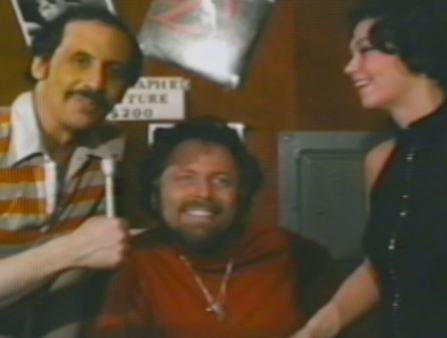
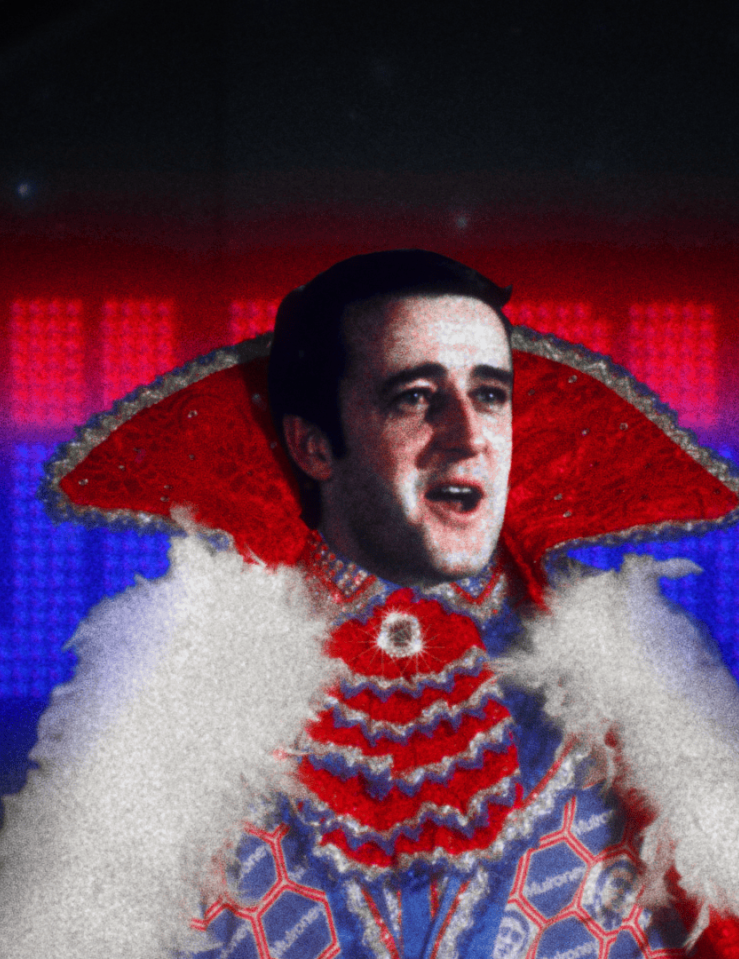
Al Goldstein, Alex Bennett and Georgina Spelvinappear in Public Access. Photo by Midnight Blue.
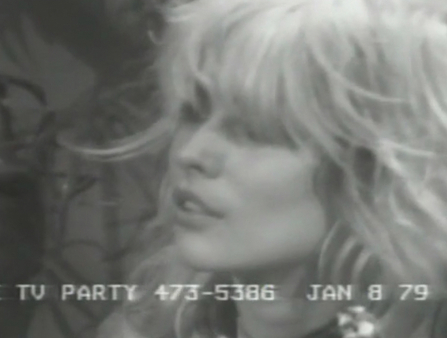
Debbie Harry appears in Public Access. Photo by TV Party.
D: Many people don’t know that there’s not some main public access archive that was kept, at MNN (Manhattan Neighborhood Network) or otherwise, right?
DSS: Yes, exactly. The way it worked is that producers would bring in a tape, they would play it, and then the producers would get their tape back. And then, of course, there were also all the live shows that were done out of the ETC [Experimental Television Center] workshop, where they literally ran a cable out the window next door to Manhattan Cable and plugged into their switchboard and ran these live shows. That’s where some of my favorite shows were—TV Party, Steve Gruberg, and Coca Crystal’s show. Those were all live shows, so producers had to have the foresight to tape them, whether it was taping them at home as they aired, or I know there was some facility that they could have those tapes too. But yeah, producers own their own shows, and it’s kind of up to them to hold onto them. Nothing was kept by Manhattan Cable or their corporate overlords.
D: What was the scale of your archival team who were hunting everything down?
DSS: We had a very small team. It really was myself, our great editor, Geoff [Gruetzmacher], and my two producers, Sarah [Crow] and Anne-Marcelle [Ngabirano] and then the assistant editor, Cristian [Uriostegui]. Most of the time, it was four of us tracking down every lead and looking for footage in every basement that we could get access to. I think we collected something like 2,000 assets of archives, well over 100 hours of archival footage. Some of it we had to help transfer and preserve, including material that was archived at libraries like NYU. They had received tapes from the Gay Cable Network, which was Lou Maletta. It wasn’t its own network, but his panoply of shows that he put on public access. But many hadn’t been transferred from three-quarter[-inch] or VHS. So we helped facilitate preserving and transferring materials in many cases. In others, it was like Anton Perich, this wonderful artist who’s still alive. Part of his team and others sent us a tape and said, “Here, I don’t even know what’s on it, good luck to you.” And it ran the gamut of people that really self-consciously preserved what they filmed, like early CBGB’s footage, or Earl Chin, and others, where this was a kind of funny detour in their life, and they didn’t maybe take it as seriously and had a tape maybe lying around somewhere. We collected so much material that it was absolutely the biggest aspect of making the film. The archive is the star of the film.
D: Could you talk a bit about Earl Chin’s show as a kind of case study?
DSS: We love Earl! He had the first reggae show on public access, Rockers TV, and he had been a radio DJ in New York City. And I give all credit to my producer Anne-Marcelle, who had been tracking his story. We wanted to tell a story right in the middle of the film that was about a very specific community. In this case, it was the Jamaican community in New York and how they were trying to represent themselves on public access and on TV. The music obviously is a fantastic way in, with reggae, which was something I was particularly tuned into at that time and at that age.
So we tracked Earl down. He’s living in Florida. He had been posting some of clips from his shows on YouTube, which is how we found out about him. We didn’t really know the full extent of his story, but as we got further into it, we started to realize how the timing of his show really dovetailed with the beginning of MTV and that tension between the mainstream of MTV, which includes the mainstream of music and culture, versus this smaller, immigrant-based, specific community that was trying to be heard. And Earl was this beautiful spirit to talk about it very, very honestly, and finding him was one of those happy accidents that happened all through making the film.
I don’t want to see anybody. You want to live in the footage. You want to be immersed inside the hermetic world of public access in New York at the time and stay there—live within it.
— Benny Safdie to David Shadrack Smith
D: Why did you choose to have audio interviews only? It’s a strong storytelling choice because it keeps us in the moment of the shows and evokes an oral history.
DSS: I will be super honest that we started in a slightly more traditional way. When we filmed our very earliest interviews, we had our subjects in a kind of cool background with televisions flickering, and I kind of loved it. But it was actually Benny Safdie, who was one of our executive producers, who said, “I don’t want to see anybody. You want to live in the footage. You want to be immersed inside the hermetic world of public access in New York at the time and stay there—live within it.” It was one of those aha moments that has to come from someone else sometimes, where you go, “Of course, that makes total sense.” And also, by the way, is going to save us an enormous amount of work and effort. We’re going to be able to do more interviews, we’re going to be able to do them deeply, we’re going to be able to do follow-ups if we need them, without having to tell people, you know, to wear the same sweater.
It was really a breakthrough moment for us, and when we started experimenting with it, it just felt right. It took a minute. You’re so inside the footage, and sometimes you need a little break because it is this video, and it’s grainy, and it can be hard to watch. And going to someone telling you these great stories and seeing their face and their emotion is also very satisfying, to me as a documentary filmmaker. So it took me a minute to let go of that and just embrace this idea that it could be an oral history—a painted oral history that kept you in the moment of what you might have experienced if you had turned on public access in its day.
D: I know everyone has their favorite show. What was Benny Safdie’s?
DSS: He told me his favorite was The Grube Tube call-in show. You know, this guy just talking for hours...
D: Oh, I remember it well!