

In his final years, filmmaker Ebrahim Golestan considered the state of exile that began long before he permanently left Iran in 1975, stretching back as far as his youth, to be the defining characteristic of his life. This profound sense of alienation comes from the dissonance between the aspects of his home country’s history and art that he held dear and the image of Iran cultivated by those who wielded political power.
He aimed to countermand this control through, as the writer and Golestan’s friend Abbas Milani put it, a “republic of letters.” This imaginary country is composed of the many essays, short stories, poems, and novels that Golestan wrote and published over the last eight decades. Writing was his first and last vocation, and the thoroughfare to his extraordinary work as a filmmaker.
In the wake of his death in August, at the age of 101, his films were recently screened as part of the most ambitious film series of the year, Iranian Cinema before the Revolution, 1925–1979, which ran at New York’s MoMA from October to the end of November.
Beyond just his own work, Golestan’s influence looms across much of this 70-film retrospective. His production company, Golestan Film Workshop, formed in 1957 and closed in 1966, was the first independent film studio in Iran. They made several short documentaries under conditions set and overseen by the authoritarian regime of the Shah, Mohammad Reza Pahlavi, and yet Golestan and his collaborators managed to create a distinctive, critical counterpoint to the Shah’s media-conscious form of nation building. Through acts of creative disassembly, the Golestan Film Workshop work became a fundamental part of the construction of a new modern Iran, especially influencing the powerfully dissenting Iranian New Wave of the late 60s, 70s, and beyond.
The ingenuity of the GFW begins with Golestan himself. Born in 1922, he was raised in Shiraz in an open-minded bourgeois household. His father, Mohammad Taghi, came from a long patrilineal line of clerics but became the publisher of the secular, liberal newspaper Golestan. He was also an outgoing aesthete who regularly filled his house with visiting poets and intellectuals, and encouraged an interest in cinema in his son. In the 1950s, Golestan began professionally producing news footage as an in-house correspondent for the Anglo-Iranian Oil Company, while moonlighting as a freelancer for U.S. and other foreign news agencies. He quickly found freelance work more lucrative, financially and creatively. To stake out his independence while exploring the potential of moving images, he quit his position at the oil company and founded the Workshop.
The outfit set up by Golestan in 1957 is often referred to in English as Golestan Film Studio, but that’s not an ideal translation. Golestan wished to consciously avoid the norms of film studios as typically conceived and run by both state or private interests. Instead, according to scholar Hamid Naficy, the Golestan Film Workshop was a synthesis of “an intellectual salon,” with frequent late-night group discussions on cinema, art, and politics, and a “traditional royal painting atelier” with Golestan as the master craftsman. He not only lent his name to the company but served as a leading jack of all trades, working variously as director, writer, cameraman, editor, and narrator. And yet his authorial stamp coexisted with a rich coterie of artists that assembled under its banner.
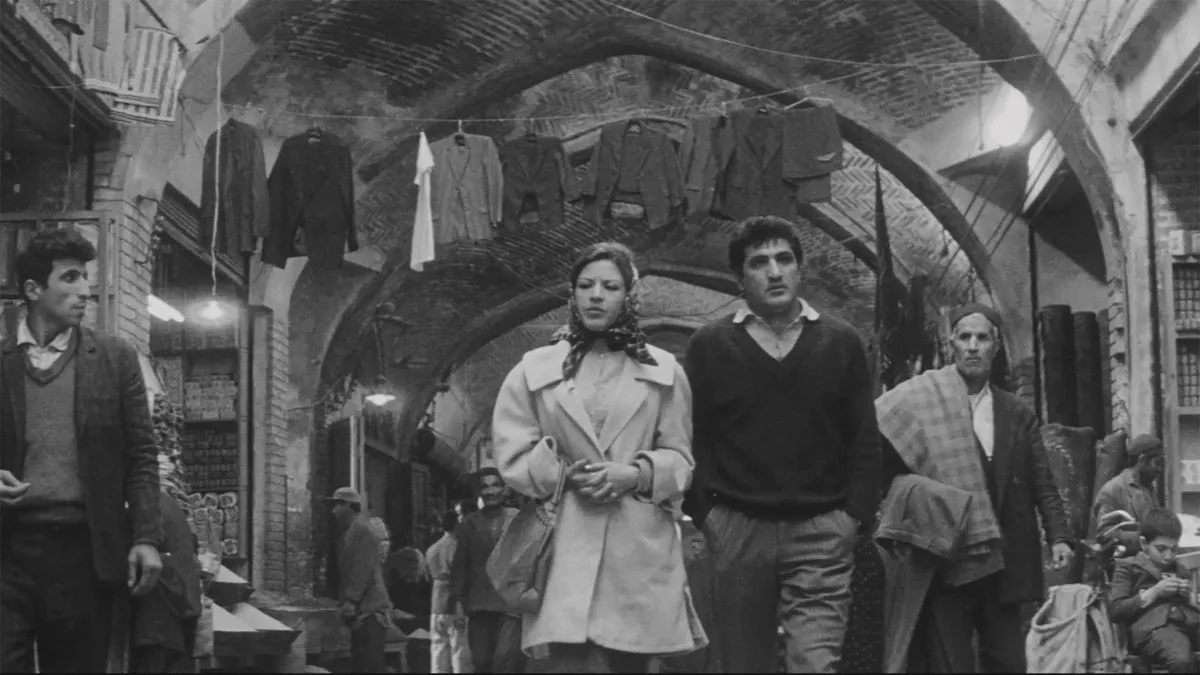
Golestan’s recruitment ethos purposely avoided established figures within the commercial film industry. He allied himself with family and friends, such as his brother, the cinematographer and director Shahrokh Golestan, but also with writers and workers who had either limited filmmaking experience or were entirely new to the form. Soleiman Minisian, the cinematographer for Golestan’s debut feature fiction film, Brick and Mirror (1964), was a day laborer, while Fereydoun Rahnema, who would go to create one of the most idiosyncratic bodies of work in Iranian cinema, was a production assistant. Several poets also joined the collective, most notably Forugh Farrokhzad. Possibly the most renowned Persian poet of the last century, she started in the workshop as a secretary and in a short time was working as an editor and director in her own right.
The outfit set up by Golestan in 1957 is often referred to in English as Golestan Film Studio, but that’s not an ideal translation. Golestan wished to consciously avoid the norms of film studios as typically conceived and run by both state or private interests.
Commissions from Golestan’s former employer helped sustain the Golestan Film Workshop. One of their first major productions, A Fire (1961), was written, directed, and narrated by Ebrahim Golestan, shot by Shahrokh, and edited by Farrokhzad. It charts the eruption of a fire at a refinery near the city of Ahwaz, and the systematic process of quelling the flames which raged for over two months. The film is a work of blistering directness and wry poetics and politics. It could easily have been a straightforward encomium of the oil industry, capital’s domination, and the consumption of nature, but its mix of realist and mythic tones point in different directions: on the frontline workers' grit and the fire as a remorseless, elemental beast.
Shakrokh’s photography situates us at ground-level, so that not only the different tactics and efforts of the workers are made immediate but the danger too. When the fire is at its most intense, this cinema verité approach dissolves into abstraction, as dark figures twist and scurry across an ochre canvas. Farrokhazad’s editing skillfully combines the systematically laid out firefighting process with striking poetic montages, like a close-up of welding which triggers a montage of fire and water, the human hand extending into the elemental domain. Golestan’s narration is more sparse and not quite as florid as in his later films. Still, it’s a text of careful, pointed stylization, didactically explaining the sequence of events while its delivery and asides modulate between awe at human gusto and unromantic descriptions of a pitiless nature.
The oil industry was a prime subject for Iran’s present, the Workshop was also concerned with Iran’s past—its intensely rich, and infinitely moldable history and cultural heritage. Fereydoun Rahnema’s Persepolis (1960) marked the beginning of his lifelong inquiry into the Achaemenid capital and cinema as twinned conduits for understanding past and present Iran. Its mesmeric sequence shots canvas the imposing beauty of the ruins without eliding the intrusion of the present, such as a wall plastered with fresh graffiti. There’s also the Ebrahim Golestan-directed The Hills of Marlik (1963), where Minisian’s luscious pastoral imagery and Farrokhazad’s complex montages reframe the relics of antiquity as vital and virile objects.
One of the Workshop’s most controversial films, The Crown Jewels of Iran (1965), is history told as a tapestry of precious stones, royal largesse, and rot. Reminiscent of Ferdowsi’s epic historical poem Shahnameh but if its grand scope was boiled down to a biting, bitter pill. The film was a commission from the Central Bank of Iran on the crown jewels, which were amassed during the Qajar Dynasty before put in the custodianship of the Central Bank under the Pavlavis. The film begins with these glittering objects of power neatly arranged behind glass displays. We hear words of admiration and awe, in Persian and foreign languages, which build to a crescendo. Miniasian shoots the jewels in carefully framed, extreme close-ups, always emphasizing their intricacies and the considerable skill of a multitude of artisans. It is Golestan’s narration provides the counterpoint, beginning as a song of praise but then excoriating the jewels as shiny distractions masking the wild goose chases, corruption, and outright tyrannies of Shah after Shah. The scene shifts from the central bank’s cushy mausoleum to a black box space, a vacuum representing an immense inner vacuity, a “time of empty words.”. Golestan contrasts the emptiness with the people they supposedly represent—an interlude of a farmer tilling his field, an image as lush as any of the jewels we see.
The GFW’s status as rebellious free agents is complicated by their reliance on state patronage and a web of royal connections. Shahrokh was the Shah’s “official film-maker” making numerous newsreels following the royal family’s travels, and in support of the White Revolution and its mission of “syncretic modernization,” wedding Iranian tradition with free-market capitalism. His career would culminate in the feature-length encomium Flame of Persia (1971), documenting the star-studded celebrations surrounding the 2,500th anniversary of the Persian Empire, with rosy narration from Orson Welles. Another notable example is the Farrokhazad-directed The House is Black (1963), a poetic evocation of a leper colony which was publicly praised by the Empress Farah Diba and given a wide domestic release, but also became a symbol for many artists critical of the Shah and subsequently, the Islamic Republic.
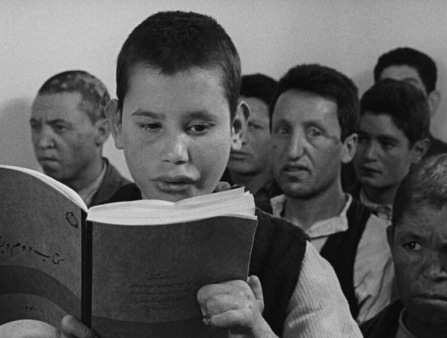
The House is Black.
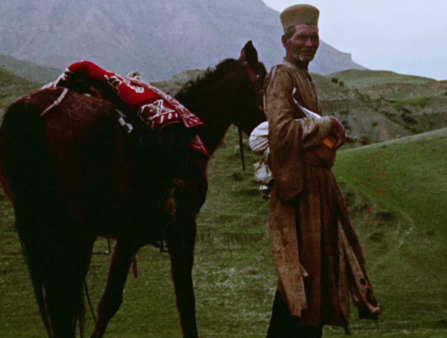
The Crown Jewels of Iran.
If at first Golestan exploited his connections to the Shah, the oil industry, and American imperialism to his advantage, he found them increasingly difficult to outmaneuver. Unlike his royalist brother, Ebrahim’s politics were further left. He was often an open critic of the Shah’s regime, in his work and on public record. His membership in the communist Tudeh party, for which he edited its newspaper Mardom, lasted only a few years in the 1940s and ended in acrimony. But he would remain tethered to leftist ideas and antiauthoritarianism until the end of his life.
Ebrahim Golestan’s decision to close down the Workshop in 1966 and leave Iran for several years was born out of several factors. Grief—from Farrokhazad’s death, who was not only his collaborator but his lover, in a car accident. Frustrations with the film industry—Brick and Mirror, though highly influential in the long run, had poor box office returns and a divisive critical reception. The most serious obstacle, however, was state censorship—The Harvest and the Seed (1965) was banned and The Crown Jewels of Iran was only narrowly saved from the same fate.
In his multi-volume The Social History of Iranian Cinema (2010-12), Naficy elucidates the complexities of the state’s involvement in pre-revolutionary Iranian cinema.Within Iran’s long tradition of arts patronage, factionalism between the various organizations and powerful individuals involved with the commissioning, production, and distribution of cinema created cracks for criticism and artistic experimentation. With The Crown Jewels of Iran, Mehrdad Pahlbod, the Minister of Culture and a draconian figure who Golestan openly despised, initially banned the film. The Central Bank and Amir-Abbas Hoveyeda, Prime Minister from ’65 to ’77, who had a policy of calculated leniency towards many critics and radicals, intervened and allowed the film a limited release.
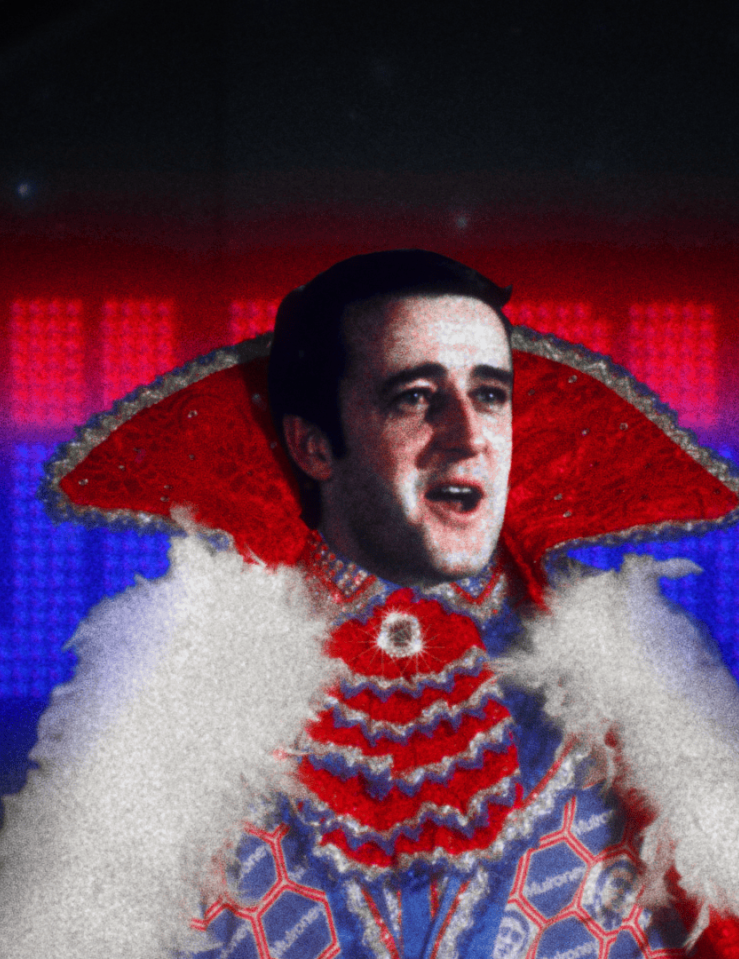
But Golestan pushed this largesse to the limit. His second feature and final film, The Ghost Valley's Treasure Mysteries (1974), was a political satire whose dressing down of the country’s elites is so blunt and bitter that the film was quickly banned. Shortly after its suppression, Ebrahim visited his friend Fereydoun Hoveyda, a diplomat, critic, co-editor of Cahiers du cinema and brother of Amir-Abbas Hoveyda. When Ebrahim arrived, he was surprised to find Amir-Abbas present. Tensions between them flared when Amir-Abbas mocked Ebrahim’s “disheveled” appearance, with Ebrahim retorting by tearing off his shirt, throwing it at Amir-Abbas and stating, “smell it, it has the sweet smell of conscience… not the stench of someone who has sold his soul.” Later that year, Golestan departed Iran permanently.
In the years following the end of the Workshop, the Iranian New Wave grew and flourished. These films were also rooted in documentary or realism, and often took the task of critiquing the state which financed them, even further. Prominent examples of this influential work include Kamran Shirdel’s social documentaries Women’s Prison (1965), Women’s Quarter (1966/80) and Tehran is the Capital of Iran (1966/80), all of which were funded by government-affiliated organizations, and were subsequently suppressed by the government for their exposure of systemic poverty and misogyny. And there’s the Institute for the Intellectual Development of Children and Young Adults, commonly known as Kanoon, a frequent well of support for idiosyncratic artists, including filmmakers Abbas Kiarostami, Amir Naderi, Noureddin Zarrinkelk and Bayram Beyzai. These seeds of such vital work were planted with the Golestan Film Workshop.
This piece was first published in Documentary’s Fall 2023 issue.