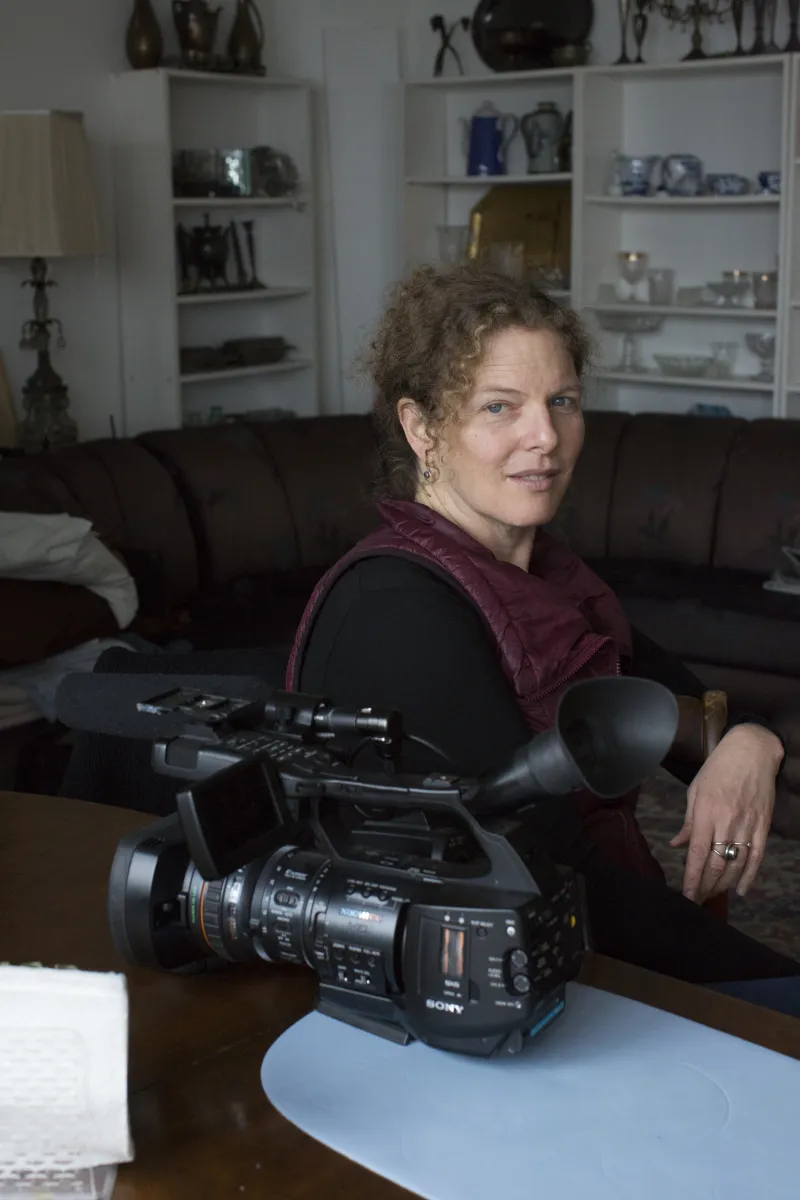
Deirdre Fishel
Deirdre Fishel is a social issue filmmaker whose work focuses on lives that have remained largely invisible. Her films have premiered at the Tribeca Film Festival, SXSW, and Sundance, been funded by ITVS, the MacArthur and Ford Foundations, and been broadcast in 35 countries worldwide. Deirdre is currently in post-production on Ask Joan, a documentary short about Joan Price, an 81-year-old senior sex expert whose unapologetic sexuality, humor, and flat-out refusal to accept society’s limiting of her options represent a radical stand against gendered ageism. Deirdre’s latest documentary, Facing the Wind (2024), about two women whose lives are irrevocably changed by their husbands’ diagnoses of dementia, will premiere on PBS in June 2026. Deirdre’s earlier work includes Women in Blue (2020) about women officers working to reform the Minneapolis Police Department in the years leading up to the murder of George Floyd, broadcast on PBS’ Independent Lens and Care (2016), which looks at the lives of elder care workers, their clients, and how America’s care system is failing both, broadcast on America Reframed. Other projects include the groundbreaking documentary, Still Doing It: The Intimate Lives of Women Over 65 (2004), Suicide on Campus (2007), a web documentary produced in conjunction with The New York Times Magazine, and Risk (1993), a dramatic feature that premiered in competition at Sundance.
IDA: You have had a long career as an educator and filmmaker. Can you tell us about some of your work?
DF: I have always wanted to pull back the curtain on lives and situations that have remained largely invisible. I wanted to focus on observational documentaries that could have an impact. My children were born at the same time, so I also decided to get an MFA to get a full-time teaching job. In grad school, I started work on Care, which looks at elder care through the eyes of overworked, underpaid care workers and elders and their families going broke paying for the care they need. The central story is about Vilma, an undocumented worker, who lovingly cares for Dee, a once-independent businesswoman with dementia whose only family lives 3,000 miles away. In Women in Blue, I wanted to investigate what women could potentially bring to policing. I went to Minneapolis because the Chief, Janeé Harteau, was working to elevate progressive women into leadership, including the central character, Sgt. Alice White, who came to policing because of the police brutality her friends and she had experienced. Three months later, Harteau was fired, and the department snapped back to male leadership like a rubber band. The film follows four women officers in the years leading up to the murder of George Floyd.
For ten years, I have also been a professor and the director of the BFA in film at the City College of New York, one of the most diverse schools in America. Most of my students are the first in their families to go to college. They have important stories to tell, and mentoring them to find their unique voices is a privilege that energizes my own work.
IDA: Can you tell us about your upcoming film, Ask Joan? When did you begin working on Ask Joan, and what drew you to the project?
DF: When I turned sixty my life was better than ever, yet I couldn’t deny a creeping sense of shame about aging. Then two years ago, I met Joan Price, 81, a charismatic author and sex advice columnist on a mission to help seniors, especially women, grab all the sexual pleasure they can. Joan’s unapologetic sexuality, humor, and refusal to accept society’s narrowing of her options is an inspirational portrait of what older life can be. I was compelled to tell her story.
Ask Joan, my first documentary short, explores Joan’s long and adventurous life and her profound impact on her followers. One, A 74-year-old Christian widow, wanted to share how, with Joan’s influence, she found the courage to go into a sex shop, buy her first vibrator, and become a sexual being again. She was hesitant about her community knowing her story, but felt good about sharing her story anonymously. I have long wanted to use animation in a documentary, and with it, I could protect her identity while visualizing her internal awakening. Animation now plays a vital role in the film’s storytelling. Six animated sequences of Joan and her followers’ intimate experiences will foster empathy and bridge the gap to a subject often ridiculed or dismissed as taboo.
With a recent New York Times feature and a Modern Love podcast, the cultural appetite for Joan’s story is clear. Women over 65 make up 10% of the U.S. population, yet they remain dramatically underrepresented. Joan’s story celebrates older women, and I believe it will inspire an essential conversation about the right to be seen, heard, and valued at any age.
IDA: What is your goal for Ask Joan? What impact do you hope the film will have?
DF: Joan has a wonderful, almost childlike joy in being alive. She’s wickedly funny, so I want the film to be funny and fun. I also want it to portray Joan’s poignant losses and ongoing reinvention and to challenge ageist constructs.
Margaret Mead wrote about “menopausal zest,” the way many older women come into their power, and we need to be unapologetic about who we are. This isn’t always easy in a country that sells youth, along with the idea that new is always better.
I want the film to be screened at film festivals, broadcast, or streamed, and seen in classrooms and community centers nationwide, and potentially abroad. Older women and younger women, who are terrorized about aging, need to see the truth that much of what we’ve been taught about our future romantic lives, as Joan says, “has been fed to us by society, by advertising, by a sex negative culture.”
So many things are worse than the way they are portrayed. Here’s one thing that’s better. I want the film to celebrate what’s possible in our futures.
IDA: For our members who are eager to stay connected with your work, and Ask Joan, what’s the best way to stay connected and follow your upcoming projects?
DF: The best way is to visit Ask Joan’s website and join our mailing list. We are in postproduction, and I’d love to keep other IDA members abreast of the film’s journey.
IDA: Looking ahead, what’s next for you? Anything you can share with us?
DF: As an older woman, I want to make films about older women; that’s my community now. It’s a little scary to acknowledge that, but it’s true. And there is so much to explore. I want to direct films that inspire, but also films that examine how ageism and gender-based inequalities can lead to poverty and social isolation. But for now, I’m focused on editing and raising money to get Ask Joan into the world.