

As a documentary filmmaker working independently and most frequently within the commercial space, Drew Denny has followed climate change refugees in the Maldives (for a multimedia performance at the New Bedford Whaling Museum in 2013), NASA scientists working on Operation IceBridge in Arctic Greenland (for Great Big Story’s Operation Ice: Melting the Heart of Man, 2018), and abortion care providers on the day their Texas clinic is shut down (for Broadly’s Ovary Action: The Abortion Pill, 2015). But with her feature doc Second Nature: Gender and Sexuality in the Animal World (2025), she went wild for the unexplored kingdom of queer animals.
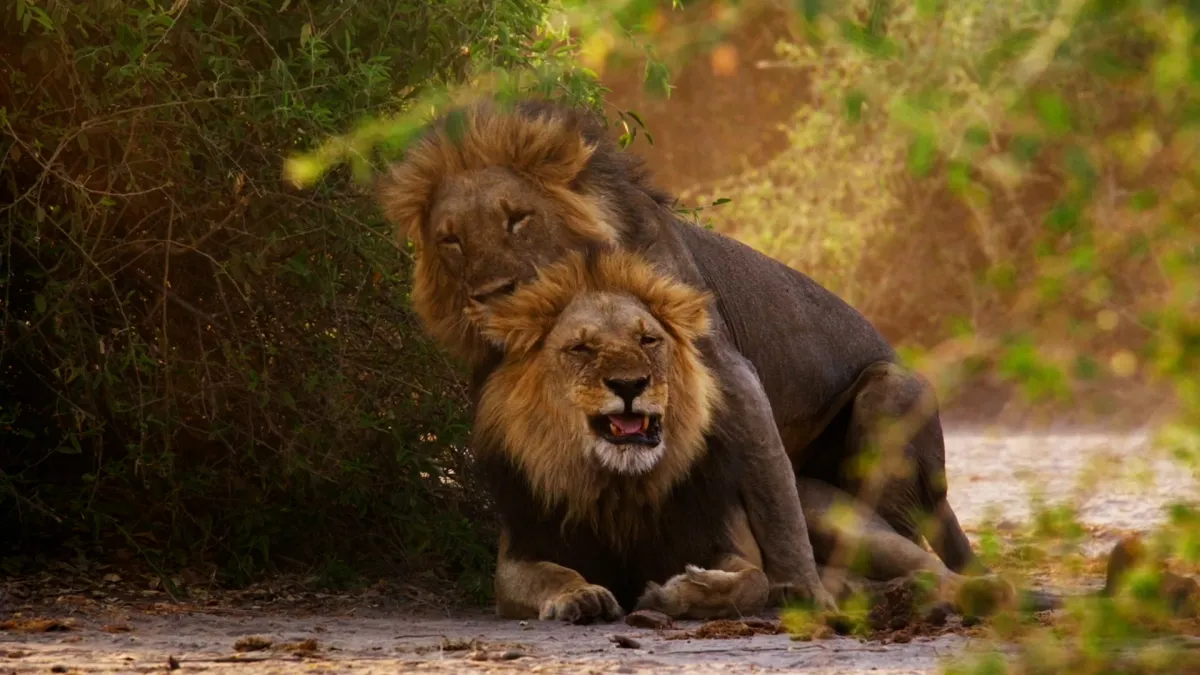
Growing up gay in Texas, Denny got kicked out of two different high schools for being “unnatural,” so when a creative partner turned her onto evolutionary biologist Dr. Joan Roughgarden’s book Evolution’s Rainbow: Diversity, Gender, and Sexuality in Nature and People in 2015, it hit the storyteller in her sweet spot. Over the next 11 years, Denny brought in Dr. Roughharden and other leading experts to detail what biology books omit and what nature documentaries leave on the cutting room floor. Taking cameras to three countries across two continents, Denny turned her focus on the gay bonobos in the wild, Sapphic swans parenting in pairs, gender-fluid clownfish—a sampling of the more than 1,500 animal species that engage in same-sex sexual behavior and other forms of non-“normative” practices around the world.
Bolstered by the support from producer Megan Ellison and Annapurna Pictures, as well as the name recognition of actor-producer Elliot Page, who narrates the doc, Second Nature had its premiere at SXSW EDU in 2026. But in conversations following the festival bow, Denny kept hitting the same roadblocks in distribution that she had while fundraising for the project. She kept hearing that the subject matter was “too niche,” despite the heart and humor audiences were connecting with at every screening.
No stranger to doing it herself, Denny took a nontraditional route and, in partnership with It Gets Better and the Trevor Project, began self-distributing the film herself, prioritizing spaces and communities eager to welcome her documentary. Screenings have been hosted by demand in churches, law schools, non-profits, hair salons, senior citizen homes, book clubs, and even a zoo. Anyone can go to the film’s website to host a local screening, and Denny is more than happy to make Second Nature—a smart, educational, and radically funny documentary about the innate queerness of the natural world—readily available to any mammal with a brain.
Documentary spoke with Denny and Second Nature co-producer Jennifer Steinman-Sternin ahead of a theatrical run at Firehouse Cinema in New York City beginning June 26. This interview has been edited for length and clarity.
DOCUMENTARY: I don’t want to call this an “anti-nature” documentary, but it’s also very different from most traditional nature docs that viewers are used to. Did you have any working reference points on what you wanted to replicate or stay away from with Second Nature?
DREW DENNY: It’s funny because people would ask us for comps, and I kept being like, “I’m sorry, but it’s not like any movie you’ve seen—because it’s a nature documentary, but it’s hilarious.” That made it really hard for people to wrap their heads around. To this day, I’m like, Please, I want to see the other films that are like this. Where are the other hilarious science films?
There’s very serious content here. There’s a very serious question that we’re answering, which is “Why didn’t anybody tell us [about all of this same-sex behavior in the animal kingdom] before?”, including filmmakers. Why did no documentarians tell me this before? Why did they always frame it out, cut it out, pretend it wasn’t happening? That would have been really super helpful to me, in all the nature documentaries I’d watched in my life, if somebody had acknowledged this was happening.
We did have to use a lot of archival, obviously, because we couldn’t be on every continent filming every species, but something that came up time and again was that this same-sex sexual behavior is often not filmed, or you’d see a glimpse of it, and the camera pans away.
JENNIFER STEINMAN-STERNIN: For the things that we really wanted to make sure the audience understood, they needed to be illustrated. We wanted to illustrate the history of Darwin. That was a complicated section that took us a while because we felt like it was important information and backstory, but we didn’t want it to feel boring.
Drew did a lot with the sound that I thought was brilliant. She had so many funny, great sound ideas, and some of them happened on the last day of our sound mix in the booth. Some of the funniest parts of the movie happened on the fly like that.
Credit: Caitlin Craggs.
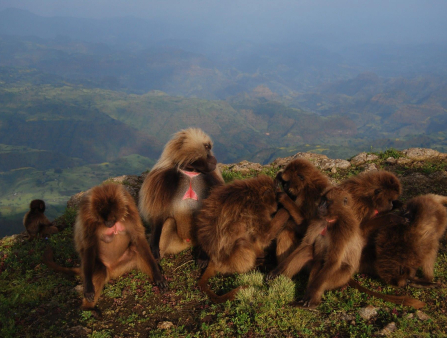
Credit: Dr. Marcela Benitez.
D: You said that when you first pitched this film, the feedback you kept getting was that the subject matter was “too niche.”
DD: I think that’s anything queer. An easy way to dismiss [this kind of content] is to say it’s too niche, and one thing I love about our film is that, so far, it’s sold out all its screenings and everyone’s laughing. If we just do the math, it hasn’t only been to gay film festivals. Now we’ve had screenings in churches, with college students at a gender-affirming hair salon in Nashville, and at a book club. That’s quite a diverse range of communities and audiences that it’s being shown to all around the world, of different ages, including a screening at a senior residential facility for LGBTQ seniors. They loved it. They lined up to do a second screening. I have never had a film that was so universally enjoyed by such a wide range of people. It just makes that “niche” excuse so transparently—I think even calling it homophobic is boring—just unimaginative.
It’s been really amazing to see that, even without a single bit of support from the film distribution machine or any distributor, channel, or otherwise, we are getting so many requests every day to screen the movie that we almost can’t keep up. On any given day, I can look at our spreadsheet and see where we’re playing, and we’re playing in multiple states and cities in multiple types of venues for different age groups and different cross-sections of the population. And so far, 100 percent of those who’ve filled out our [post-screening] survey say they love the move.
JSS: It’s kind of indicative of what all documentary filmmakers are struggling with right now, which is the end of the risk-taking curator, who used to exist, who used to say, “Hey, this movie’s kind of weird, but I’m gonna try it out.” A lot of that has gone by the wayside now, replaced by algorithms. So a lot of streamers are basing their choices on what’s happened before; the algorithm has told them what’s been successful, so that is what will be successful in the future. Unfortunately, most of us are struggling to get new things made for that reason.
D: How did your theatrical run come about?
DD: We tried the original route of getting the film into a festival, then hopefully you’ll get it distributed, but that didn’t work. We just started doing it ourselves. I’m really grateful we’re partnering with Samantha Curley at Level Ground Productions. She came on after the film was done to help me produce our independent distribution, and she connected me with Dara Messenger, the programmer at DCTV, which runs Firehouse Cinema in New York City. I wanted to shout her out because she’s the person Jennifer is saying we need more of. She asked a few questions, I sent her the link, and the next day, I got an email in all caps that said, “YES, YES YES! I’ve been waiting for a movie like this!”
I feel really grateful that we did find one of these rare programmers who is still willing to look at something that didn’t come through the typical pipeline. There’s not an easy comp for it, but she had her reaction to the movie, she knows her audience at her theater, and so, I feel really lucky that we get to have a theatrical run. I didn’t think that would ever happen for this movie—or maybe for anything I ever make.
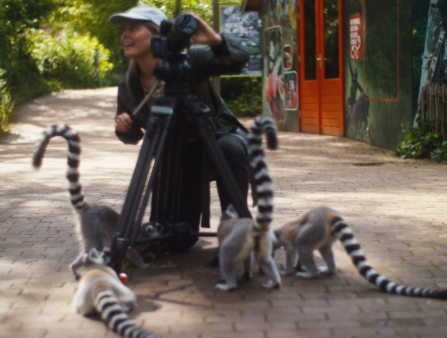
Director Drew Denny on set. Credit: Tani Ikeda.
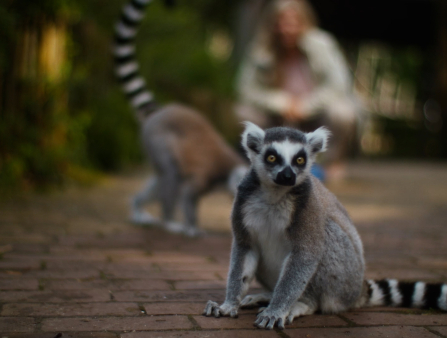
Credit: Tani Ikeda.
D: You’ve mentioned that research in the film was used in the Supreme Court case Lawrence v. Texas to overturn a law against homosexual sex, and now you are organizing a legal tour where the film will be screened for legislators, judges, lawyers, and legal advocates/non-profits.
DD: The APA [American Psychological Association] wrote an amicus brief for that case that cited same-sex sexual behavior in chimpanzees and bonobos, and said we know that we are primates, and our constitution guarantees us the right to life, liberty, and the pursuit of happiness. So if we observe our closest relative primates, and can see that they have same-sex sexual behavior, that this is a way that they form bonds, that this is a way they form families, and that through these bonds and families, they survive, then we can say that humans need to be able to have this behavior as well. It would be unconstitutional to deny us the right to engage in behavior that creates social bonds and family structures that permit us to live and to have even a chance at life, liberty, and the pursuit of happiness. When that case was argued, one of the angles used to support overturning that law worked.
We’re trying to get this information in front of lawyers, legal advocates, legislators, and anybody who can help to protect people who are being legislated against, as we’re seeing in so many states, to better defend the laws that we still do have in place, and then to also make sure that we continue to go on the offensive, when there’s a law we need to overturn or change because this research actually can be quite useful. And it seems a little silly that animals could change the Supreme Court’s decision, but they can.