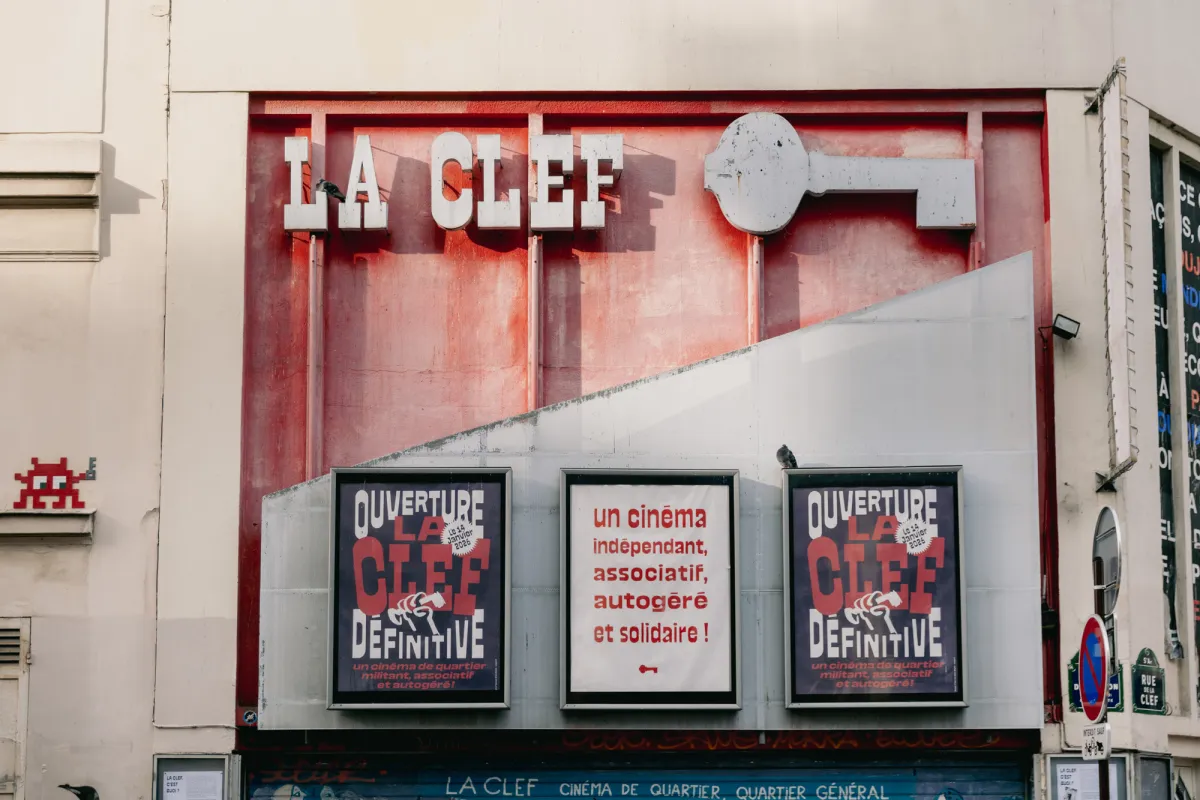


After an eight-year struggle that began with an illegal occupation and passed through legal battles and a mass fundraising campaign, Paris’s La Clef cinema reopened in January 2026, bought by the collective that had squatted it. Thousands of donors, a network of activist groups and nonprofit organizations, and prominent filmmakers made the purchase possible. With audiences pouring into screenings with curiosity and enthusiasm, La Clef’s future looks bright.
What the collective was building, though, was not a simple rescue but a guarantee to secure the building’s long-term future as a cinema. La Clef’s history can be told in a sequence of administrative impasses that fractured the continuity of vision and experience across management teams. That discontinuity partly contributed to the cinema’s precarity under its previous owners.
The guarantee works through the legal structure of an endowment fund, whose statutes grant whichever collective that runs the cinema—the current one or a hypothetical future one—every right of ownership except the right of resale. A future sale requires approval from the endowment fund’s administrative board, and even then only on the condition that the building remains a cinema and that no one profits from the transaction.
This “lock and key” structure, which both separates and secures the ownership rights, might protect the cinema from future buyers. But it doesn’t dictate how La Clef Revival, the nonprofit now running the cinema, recruits new members, what it programs, and whether it survives its own inner conflicts and exhaustion.
“What Was Invented Inside These Walls”
La Clef was founded in 1973 as a three-screen movie theater by Claude Frank-Forter, then 28, financing the venture with capital from his parents’ children’s-clothing manufacturing business. It operated as a conventional arthouse theater, distinguished through more affordable ticket prices—especially for students—and a commitment to new auteurs. The business ran smoothly for seven years, before falling into financial difficulties from which it could not recover.
In 1981, the Works Council of the Caisse d’Épargne d’Île-de-France, a French savings bank, purchased the building from Frank-Forter and converted one screening room into a cultural center, preserving the other two. Although the cultural center was initially intended for employees and their families, over the years the council rented the other spaces to partner works councils as well as social and cultural nonprofit organizations.
In 1990, under that rental model, Sanvi Alfred Panou took over the two remaining screening rooms and renamed them Cinéma Images d’Ailleurs (Images From Elsewhere), after the nonprofit he had founded in the late 1960s for theater productions. By the time he shifted his focus to audiovisual exhibition, Panou was a true jack-of-all-trades. He had acted in a handful of films, including Jean-Luc Godard’s Weekend (1967); adapted texts by the likes of Aimé Césaire and Frantz Fanon into protest theater; and released a proto-slam and rap single with the Art Ensemble of Chicago on the renowned French jazz label Saravah. The Beninese-Togolese artist would also venture into filmmaking, production, and distribution across the nearly 20 years he ran Images d’Ailleurs, which became the first arthouse cinema in Europe dedicated to Black cinema and the cinemas of the Global South. Operating outside the conventional theatrical circuit, it programmed everything from auteur cinema to Blaxploitation films, combined with an annual film festival called États Généraux du Cinéma Noir, and built a distinctive political and cultural identity that outlasted Panou’s management.
Panou now lives in Benin, and despite his very approachable and kind nature, he is difficult to reach; after three weeks, he answers on Whatsapp to reminisce about his days at Images d’Ailleurs. The cinema’s mission, he says, was not merely to screen films but also to serve as a space for debate for movies from diverse cultures that weren’t distributed in France. “We didn’t program films for entertainment. These films carried urgent, important messages that couldn’t reach the general public in Parisian theaters.” He is extremely proud of the programming, even when only three or four people attended. What he values most is what he calls the theater’s “pluriculturalism”—screening rare films in their original language, which drew foreigners in transit. “So many people told me they had never heard an actor’s real voice before, since the films used to be dubbed,” he says. One of the most memorable films shown at Images d’Ailleurs was Ousmane Sembène’s Camp de Thiaroye (1988), banned in France for many years. “We were the only cinema that showcased the film through professional screenings,” he adds.
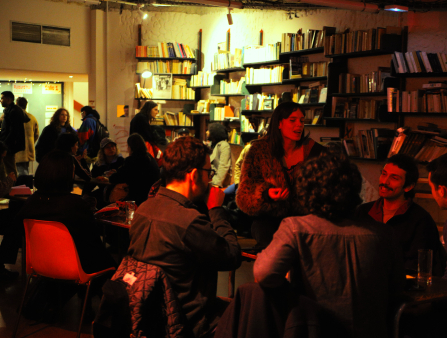
The bar at the movie theater after the official reopening in January 2026. Photo by Victor Guthmann. Courtesy of the photographer
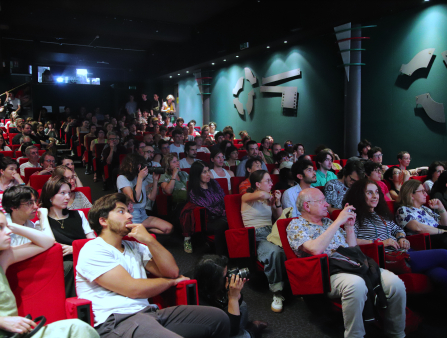
Audiences at La Clef's reopened screening room. Photo by Victor Guthmann. Courtesy of the photographer
La Clef Revival inherits Panou’s vision by treating programming outside the conventional film circuit and its rhythm as a political act, allowing dissident, minor, and underrepresented voices to be heard. But the collective is concerned with preserving not only the curatorial mission but also the nonprofit management structure. La Clef is often called the “last associative cinema in Paris.” In France, an associative cinema is often used to describe ones run by a nonprofit organization. But the term carries legal weight. Similar to 501(c)3 organizations in the United States, an association in France can receive tax-deductible donations while operating on a membership basis, much like IDA (which publishes Documentary).
Over the years people have come and gone, and collectives have formed and dissolved at La Clef, but that associative structure remains. In 2009, Images d’Ailleurs’ programming ended, when the Works Council of Caisse d’Epargne moved to evict the nonprofit over unpaid rent due its financial troubles—a conflict that eventually led to its legal dissolution. One year later, the cinema reopened under the management of the nonprofit L’Usage du Monde (a nod to Nicolas Bouvier’s eponymous book, The Way of the World), presided over by Raphaël Vion and Isabelle Buron.
In 2015, the Works Council of Caisse d’Epargne—by then the Social and Economic Council of Caisse d’Epargne (CSECEIDF)—put the building up for sale. Amid the real-estate speculation in the neighborhood, the cinema’s value rose from €1.5 million to €4 million by 2018, the year Cinéma La Clef–L’Usage du Monde bid farewell to its audiences. Former employees attempted and failed to take over the building.
The effort to save La Clef took a decisive turn in 2019, when a group of cinephiles, film professionals, and regular audience members occupied the premises illegally. United under the banner “Home Cinéma,” they resumed screenings despite the ongoing legal battle with the owner and the constant threat of police intervention. The occupation gained wider recognition in national mainstream press through demonstrations, artistic interventions, and exhibitions. Then, in 2020 the pandemic closed cinemas worldwide, which could have deprived the collective of the activity that gave the occupation its meaning.
When the collective began projecting films onto the building’s walls every Friday, the gesture joined a wider repertoire of pandemic-era cultural and artistic “resistance.” La Clef began to attract international attention, but in the English-language press it was primarily known for the outdoor screenings rather than through the occupants’ struggle to save the cinema. In France, this shift in the narrative proved double-edged. The collective gained support from figures like Martin Scorsese and Quentin Tarantino, but for quite some time, the discourse surrounding La Clef revolved around celebrity philanthropy rather than collective resistance—which ultimately left the collective arguing against accusations of selling out.
In 2021, while the collective was still debating its future ownership models, the Home Cinéma association split. Some of the founding members—including president Derek Woolfenden—left and dissolved Home Cinéma.
Stemming as much from personal conflicts as from diverging ambitions regarding the future of the cinema, the departure of Home Cinéma’s founding members was far from a simple passing of the torch. It prompted the remaining members to reorganize by founding a new nonprofit organization, La Clef Revival. Later, Woolfenden and members who supported him formed another nonprofit, La Clef Survival, which sued La Clef Revival for parasitism and lost in 2024.
Survival’s public criticisms concern the number of weekly screenings and the editing studios Revival rents out. This split is the kind of crack that opens when a collective cannot acknowledge either its own evolution or the changes that transmitting knowledge and struggles might inevitably bring—changes that proved unavoidable once eviction was imminent. At that point, the collective began pursuing legal routes to repurchase.
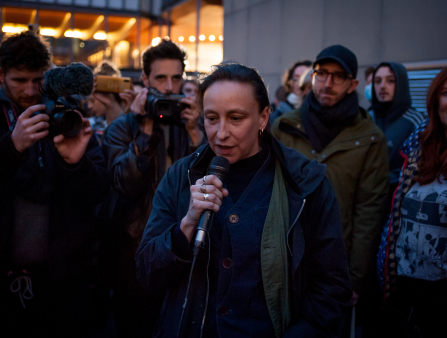
Filmmaker Céline Sciamma (now a member of La Clef Revival’s board) speaks at a 2022 rally in support of the occupation. Photo by Claire-Emmanuelle Blot.
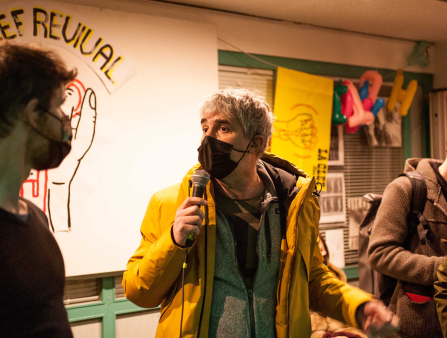
Filmmaker Alain Guiraudie supports La Clef Revival during the occupation. Photo by Claire-Emmanuelle Blot.
In December 2021, La Clef Revival received an eviction notice from CSECEIDF. In 2022, the collective replaced the one-film-a-day model they had adopted during the occupation with a “permanent festival” that ran dusk to dawn for five weeks, from January 24 to March 1, 2022—the day the police carried out the eviction. The extraordinary efforts the collective devoted to this period were met with strong support from audiences, as well as from filmmakers such as Frederick Wiseman, Wang Bing, Claire Denis, and Leos Carax.
Between the start of the occupation and the eviction, the collective organized 655 screenings amounting to 1,060 films, including shorts. One hundred nine of those took place during the permanent festival, drawing 79 guests and 9,000 attendees. Valérie Massadian’s Nana (2011) was the first film screened after the eviction deadline passed. An occasional audience member under previous management, Massadian became invested in its preservation once the prospect of a wealthy buyer became real. “My contribution was very little,” she says of the 6:00 a.m. screening on February 1, 2022. “But to see what cinema could create on a human level was really beautiful. The police would pass by the theater every day, and it irritated them to see a long queue of people waiting to watch a film before dawn.”
Chloé Folens, now responsible for communications and administration at La Clef and a board member of the endowment fund, joined during the occupation as a volunteer. She worked at the ticket desk and the bar for years before becoming one of the collective’s senior members in terms of experience. In the early months, she says, the occupants wanted only a guarantee from the building’s future owners that it would remain a cinema. The daily work of screenings changed that desire as the collective built an internal structure and came to value programming films that were rarely shown commercially. Folens notes, “The idea of buying the cinema emerged, not only to preserve the building but also what had been invented inside its walls.”
To make this idea a reality, the Cinema Revival endowment fund was created one year into the occupation. Purchasing the theater still felt like a distant dream, Folens recalls, as the collective’s immediate concern was maintaining the occupation against Groupe SOS, a potential buyer in a far better position than Home Cinéma’s crowdfunding campaign, which signed a preliminary sales agreement with the owner in October 2020.
Groupe SOS is not an obvious villain, as it is a nonprofit that describes its work as “initiatives for ecological transition, regional revitalisation, responsible businesses, and access to culture.” The collective’s opposition stems from a broader distrust of the social-washing strategies through which corporations commodify activism and squatting. Kira Simon-Kennedy, who contributed to the collective’s fundraising efforts in the United States, and after moving to France helped oversee the construction work and the internal administrative reorganization of the collective, points to the example of Plateau Urbain, an urban cooperative that collaborated with Groupe SOS on the creation of Coco Velten, a third space in Marseille. Such projects can have positive impacts, Simon-Kennedy and Folens say, but temporary occupation contracts leave nonprofits at the owner’s mercy. When a rental contract ends, it is the owner that captures the cultural and economic value the occupants created.
La Clef Revival thus understands its victory—against both the speculative real estate market and the social-washing practices that feed on it—as a case other nonprofits can use. Assisting other organizations that run cinemas or cultural spaces to acquire their own buildings is a stated future goal of the endowment fund—another form of passing on what they have learned.
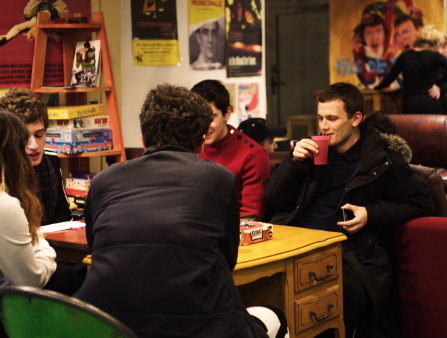
Scene at La Clef during the occupation. Photo by Victor Guthmann. Courtesy of the photographer
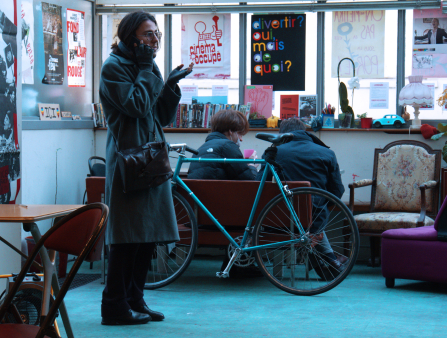
Scene after a screening of Jacques Demy’s The Umbrellas of Cherbourg (1964) during the 2022 occupation. Photo by Victor Guthmann. Courtesy of the photographer
The Lock and the Key
On March 1, 2022, the day of the eviction, Groupe SOS announced that its numerous attempts to build a project had failed and that “due to lack of a peaceful atmosphere,” it would not renew its bid. With the corporate threat eliminated, the collective could finally negotiate with the owner. Meanwhile, La Clef Revival resumed its screenings—one screening every Sunday—at DOC!, an artistic space also occupied by another nonprofit organization.
What distinguishes La Clef’s revival is how deliberately the collective drew inspiration and expertise from activist groups and networks in both French and international contexts, such as ZAD de Notre-Dame-des-Landes, Foncière Antidote, and Le Clip. Le Clip in particular offered an interconnected network of mutual support and governance, and La Clef Revival considered joining the network. But the scale of the purchase, the urgency of the timeline, and the financial instruments needed to reach these goals were incompatible with those of Le Clip, whose properties cost a fraction of La Clef’s.
La Clef Revival now had an internal deadline and a concrete goal. In 2022, the collective turned to fundraising and long back-and-forth negotiations. A year later, it signed an initial agreement with a bid of €2.9 million, considerably lower than the list price of 4 million. In 2024, the price came down to €2.35 million, but with notary, architect, engineering, project ownership assistance, and legal fees included, the cost of purchase came to €2.7 million—plus a minimum of €600,000 to renovate the space so that it would be up to code and they could obtain authorization to reopen.
One of the main tools that the members of La Clef borrowed was the endowment fund, modeled on Foncière Antidote. Founded by the nonprofit Les Passagères de l’Usage, Foncière Antidote exists to remove properties from the real estate market and hand ownership rights to collectives through an emphyteutic lease, a long-term contract in French civil law.
An endowment fund is a mix of an association and a foundation—as noted on La Clef’s website, “a not-for-profit legal entity which can collect tax-deductible donations to carry out a mission of general interest.” Of the €2.7 million required to complete the purchase, two million were collected through crowdfunding, and 800,000 came from bank loans—400,000 from Crédit Coopératif and 400,000 from La NEF, an ethical-finance lender. Borrowing from a cooperative rather than a standard lender was a deliberate choice, so the money couldn’t be lent onward for harmful purposes. The collective also needed €600,000 to complete the renovations that made the cinema operational again.
The fund could be used to raise the money, but it couldn’t, on its own, guarantee that the cinema would stay associative. That’s the work of the propriété d’usage, or substantive right of use, which the members adopted with Antidote’s guidance. The model separates and also makes codependent those who use and take care of the space and those who own its walls. The nonprofit operates independently of the endowment fund but pays it rent, and the fund uses the rent money to pay back the loans.
This legal arrangement resembles the mechanism of a lock and a key, and a similar logic governs the composition of the endowment fund’s administrative board. It is also divided into two colleges; one of users—six members who are involved in the management of the theater—and the other four of professionals, currently composed of filmmaker Céline Sciamma; Jean-Marc Zekri, former director of Reflet Médicis Cinema; Laurent Tenzer, who is a member of Cinema Nova in Brussels; and Eric Arrivé, a researcher and a substantive rights of use specialist who is a member of Le Clip. A resale requires a majority in both colleges, and even then the statutes allow it only if the building remains a cinema and the resale generates no speculative profit.
Crowdfunding closed in 2024, with more than 5,000 donors. The prominence of some of them raised questions about the independence of La Clef Revival, most insistently from La Clef Survival. The group claimed Revival had received financial support from Netflix through Pascal Breton, a donor who had produced Netflix projects, and that this would jeopardize the independence of programming. However, the members of La Clef Revival contested the sell-out narrative by emphasizing the principles of the endowment fund. “An endowment fund is different from an investment fund, where you give investors back money with interest,” Simon-Kennedy says. “We gave nothing back. There’s no leverage over our programming, economic model, or decision making in any way.”
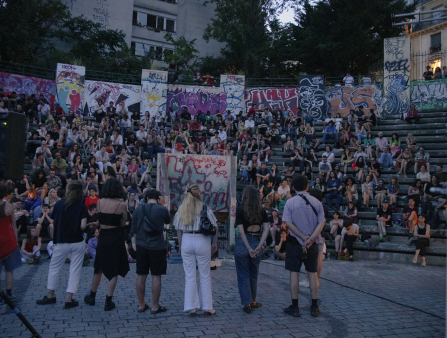
Outdoor screening at the Parc de Belleville’s Belvédère organized by La Clef Revival, Braquage, and Documentaire sur Grand Écran in June 2023. Photo by Victor Guthmann. Courtesy of the photographer
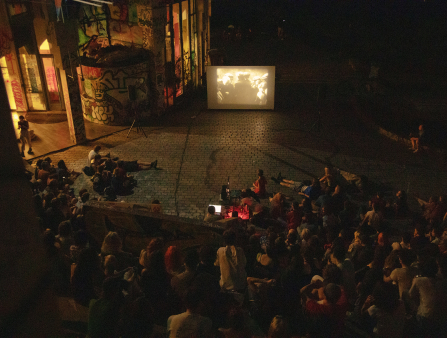
The screening at the Parc de Belleville’s Belvédère featured the short documentary Beppie (dir. Johan van der Keuken, 1965) alongside Ménilmontant (dir. Dimitri Kirsanoff, 1926). Photo by Victor Guthmann. Courtesy of the photographer
“The Collective Itself Is the Object of Its Own Reproduction”
Dismantling La Clef’s legal structure seems quite improbable. So are there any flaws in this mechanism?
For Eric Arrivé, who sits on the endowment fund’s board, the risk lies less in the mechanism itself than in the collective. According to Arrivé, a collective is a living organism, and it can stop functioning for various reasons—exhaustion, weariness, open or latent conflicts, or simply because its members might want to do something else. “A collective should be aware of its own evolution and consider all the reasons why it might dissolve,” he says. No matter how a collective tries to minimize the external risks posed by tax authorities or legal statutes that might endanger its future, La Clef’s past proves that the greatest risk actually comes from within. “The collective itself,” Arrivé confirms, “is the object of its own reproduction.”
These questions became more important in January 2026, once the theater reopened after the 2024 purchase and a year of renovation. The collective needed time to settle into a rhythm and see if pay-what-you-want (PWYW) would meet their monthly projections. From a financial perspective, the long-term goal is to pay back the bank loans within 16 years. According to their calculations, the nonprofit must earn roughly double the loan payments to run the cinema—with the main expenses being building maintenance, electricity, screening fees, and the salaries of two full-time workers, with a recently opened third vacancy. Revenue comes from membership fees, the ticket desk and bar, rental of two postproduction studios and two screening rooms for press or test screenings, donations, and public subsidies.
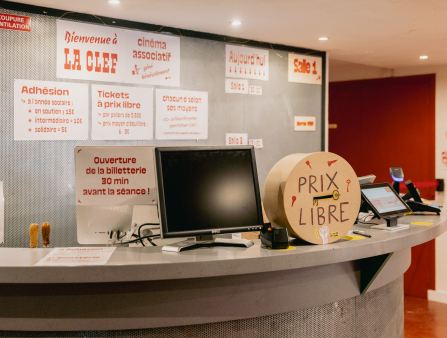
All screenings at La Cléf are “prix libre” (pay-what-you-want). Photo by Joséphine Brueder/Ville de Paris.
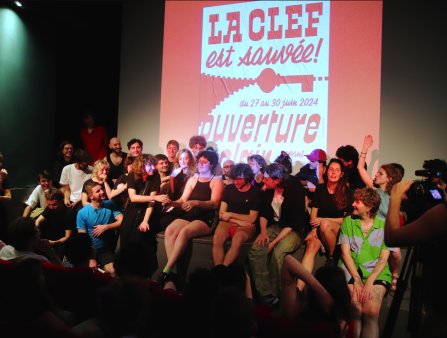
The collective of La Clef Revival celebrates the brief reopening in 2024 of the cinema (“La Clef is saved,” the screen reads). Photo by Victor Guthmann. Courtesy of the photographer
The pay-what-you-want model was something the collective really wanted to keep. But it is a bet, especially once the enthusiasm of the first months post-opening slowly started to wear off. “With an average ticket price of €5.50, ticket sales are slightly higher than we anticipated,” says Simon-Kennedy, comparing the results to their pre-opening predictions. Arrivé argues the risk of insufficient revenue exists under any pricing structure, and that PWYW proved its reliability and efficiency during several years of occupation. The real challenge was to make PWYW compatible with the requirements of the French National Centre for Cinema and the Moving Image (CNC). The CNC is funded by taking a share of every theatrical admission in France, and conventional theaters’ ticketing systems deduct it automatically because prices are fixed. La Clef had to negotiate with the CNC by making a case for the average ticket price—first projecting attendance per screening—to yield an estimated average revenue per screening for calculating the deduction.
La Clef is open Wednesday to Sunday, with an average of seven screenings per week—a smaller programming volume and frequency than most conventional arthouse movie theaters that run a full-day program. In La Clef’s case, the uniqueness of each screening contributes to sustaining attendance—which sometimes goes much beyond what’s expected if a guest like Apichatpong Weerasethakul or John Wilson is present. Increasing the number of weekly screenings is one of several future goals of the collective, especially through other nonprofit organizations which, after they join the collective and go through training on running a projector, fire security, and emergency exits, can organize their own screenings. Nonprofits like Le Chien Qui Aboie (The Dog That Barks), which focuses on Latin American cinema, and La Branlée, which organized a film festival dedicated to pornographic films in April, are the first; both widen La Clef’s audience as well as its programming.
While its historical value as a movie theater is often highlighted, the story of La Clef is marked more by interruptions than by continuity. It’s a fact that is neither automatically good or bad, for which La Clef Revival is sometimes held responsible, though none of these past interruptions were theirs.
What they are truly responsible for lies in the future. It is in their hands to make continuity possible. “We often say the human factor is elusive and unpredictable, but there are patterns, and as a collective, you can anticipate,” says Arrivé.
Which is why volunteers matter to La Clef’s future. After several years of administrative and legal battles that brought many members to the verge of burnout, Folens welcomes the fresh energy. “We want to be able to take a step back and see the new generation take over and bring in new ideas and bring in new films and do new things that perhaps we haven’t thought of,” she adds.
Every now and then, a key can get rusty, old, or stuck, so there’s no harm in changing it—and in La Clef’s case, as long as it opens onto an independent, autonomous, and collectively run movie theater.
This piece was first published in Documentary’s Fall 2026 issue.