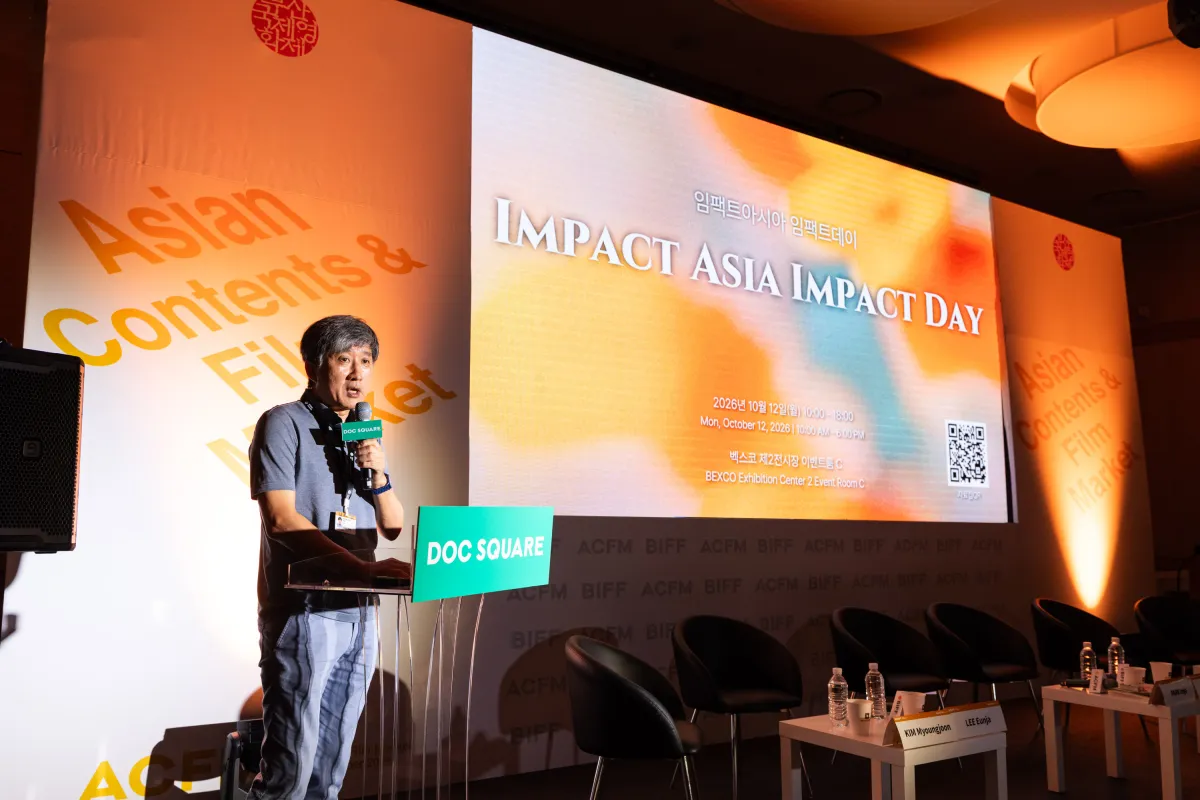


“Our film didn’t lead to the president apologizing,” Tomoaki Fujino said during Impact Asia’s Impact Day case studies program at last month’s Busan International Film Festival, “so I don’t think it qualifies as an impact documentary.”
The room laughed. The film being discussed was Fujino’s What Should We Have Done? (2023). A deeply personal and searching documentary tracing his family’s denial and eventual acceptance of his older sister’s schizophrenia, it played in over 100 theaters and additional community screenings in Japan to total revenues of over ¥257 million (approximately US$1.6 million).
The film was released by TOFOO FILMS, which honored the director’s prohibition on home video and streaming to protect his family’s privacy; the distributor was represented on the panel by Miho Mukaitsubo and Sonoko Hayasaka, two of TOFOO’s four-person collective. Earlier in the Impact Day program, a Korean case study panel included director PARK Bongnam, whose 1980 Sabuk (2024) resulted in an April 2026 resolution by Korean lawmakers to demand an official apology—delivered the same week as the panel by President LEE Jae-myung—for state violence against the Sabuk miners and their families. Though pitted against each other by Fujino’s quip, the many distinct paths for impact documentaries in East Asia were highlighted all throughout the day’s panels.
The Impact Day program was the most prominent spotlight on documentary at Busan this year (October 6–15, 2026), which was accredited as an “A-list” festival by the International Federation of Film Producers Associations for the first time. Long known for its fiction and red-carpet focus, the festival had record turnouts after a rocky few years of political suppression, leadership scandals, and South Korea’s tumultuous relationship with China. Asian Contents & Film Market (ACFM) is held in the middle of the festival, from October 10–13 across several floors in the BEXCO convention center. The main hall is full of distributor, sales agent, and national film development booths, a Nespresso-sponsored cafe, meeting areas for projects supported by its various schemes, and a seating area where films available in the online screening room can be watched in person. ACFM head Ellen Y.D. Kim led her second edition, returning to the market she helped launch after her most recent post as head of Bucheon, Korea’s leading genre film festival.
Since 2025, documentary has had a dedicated space at ACFM called Doc Square, a small (and square-shaped) seating area and stage, where panels and conversations on the business of documentary filmmaking take place. Alongside an invite-only showcase for grantees of the Asian Network of Documentary (AND) projects, the Doc Square space amply creates a gathering point for documentary filmmakers. There were several panels addressing the latest updates on financing, including “Current State of Documentary Co-Production: Asia,” moderated by Korean producer Sona Jo. Taiwan’s cultural funders like the Taiwan Creative Content Agency (TAICCA) are eager to spread money abroad, “maybe because of geopolitics,” said director and producer HUANG Hui-chen (dir. Small Talk, 2016); TAICCA had a booth on the floor. Berlin-based Filipino director Alyx Ayn Arumpac described the Film Development Council of the Philippines’ support of up to US$97,000 for documentary co-productions, with a bonus for Southeast Asian co-productions—and a condition that funded films cannot portray the Philippines negatively. Former NHK producer Kenichi Imamura noted that Japan has few public funding bodies and has long leaned on NHK, but that as public broadcasters lose power, the state is investing in “content” as an export industry through the Creator Support Fund, regional film commissions, and new cultural investment programs from established entities like the Japan Foundation.
Every panelist stressed the same practical point: Find a local producer with documentary experience and spend time establishing a true partnership. “It’s hard to find a partner in one meeting,” said Gugi Gumilang, producer and longtime head of pitching forum Docs by the Sea. “A lot of Asian documentary budgets will be made over five to seven years, so it’s important [to consider] when to work with someone. For me personally, I like to come to work with Europe at a later stage, when I need post-production money or distribution. If I could do it beforehand, inside the region for production, I think that’s good.” Beneath the regional-solidarity language the panelists espoused, they also cautioned filmmakers to be aware of the expectations of production money from Asian states—soft power, export strategy, national image—coupled with finishing and sales money from Europe, which often require spending that funding abroad.
ACFM also hosted individual project support. BEXTO’s third floor screening rooms hosted the Asian Project Market and Documentary WIP showcases—and, too, Impact Asia’s Impact Day series of panels. I was on the jury for the Impact Asia awards, which awarded US$5,000 to three projects, as reported elsewhere. The projects presented, sponsored by various film organizations such as Taiwan Docs and J-Docs Hub (Japan), were varied and most had festival or commercial appeal.
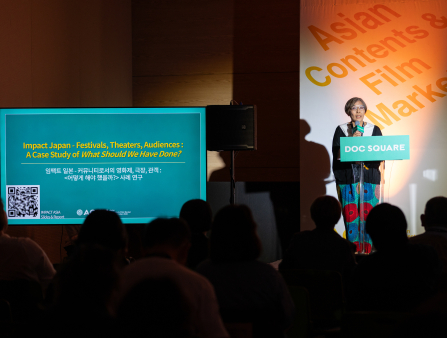
Vice-chairperson of YIDFF, FUJIOKA Asako, moderates a conversation about the theatrical success of What Should We Have Done?

What Should We Have Done? Courtesy of Nikkatsu
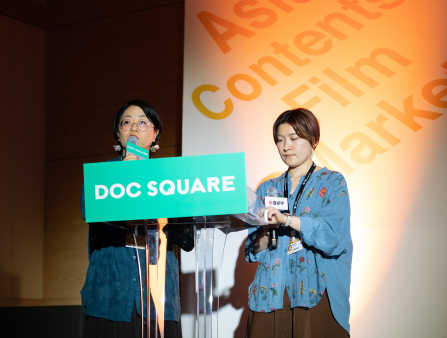
MUKAITSUBO Miho (L) and HAYASAKA Sonoko (R) of TOFOO FILMS discuss the release of What Should We Have Done?
Grassroots
Impact Asia’s Impact Day was the most intellectually stimulating of Doc Square’s activities, drawing U.S.-based funders and presenting original research. Organized by Sona Jo and collaborators Nungcool and KWON Ohyeon, two members of the feminist documentary collective PINKS, Impact Asia released a 200-page research compendium that was disseminated on Impact Day. The report covered the state of documentary distribution and impact activities across Taiwan, South Korea, and Japan. Jo, Nungcool, and Kwon also organized three panels that followed the report’s case study structure, inviting documentary participants, local organizers, NGO and educational collaborators, researchers, theater operators, and film distributors into conversations around their country’s conditions for documentary releases and impact.
As implied by Fujino’s statements, one of the day’s key questions was how to define “impact documentary” for the Asian filmmaker attendees, who were previously largely unfamiliar with the term, despite its rapid professionalization and the presence of a cadre of consultants in the Western world and at documentary film festivals. But while the label might have been new, the research and panels made it clear that its real, acute practice was passed between Korean and Japanese filmmakers and audiences a generation earlier. When BYUN Young-joo’s production company Boim began The Murmuring (1995), the first of her trilogy on survivors of Japanese military sexual slavery, Shinsuke Ogawa’s Ogawa Productions supported it with equipment. With no distributor or release support then available to Korean independent film, Boim distributed it themselves. They raised money through “100-feet memberships,” in which supporters paid for film stock 100 feet at a time, and through badges and other merchandise. They then opened the film for five weeks in three Seoul theaters—the first official theatrical release of a feature documentary in Korea. In Japan, civic groups from the postwar compensation movement organized some 120 self-run screenings of it, the same jishu jōei model that audiences had built around Ogawa’s and Noriaki Tsuchimoto’s films from the 1960s through the 1980s. “I think these were impact documentaries,” Yuko Iwasaki, secretary general of the Japan Community Cinema Center who conducted the Japan case study in the Impact Asia report, said of those earlier films.
The report and panels’ most distinctive takeaways connected audience development and community support to distribution support. In Korea, the historical pivot came from PINKS’ Two Doors (2012, dirs. KIM Ilrhan and HONG Jiyou), which reconstructed the 2009 Yongsan disaster from police testimony and surveillance footage. Its release was enabled by some 834 people who joined an “audience distribution committee” whose contributions paid for the release, and once the film opened, viewers rented theaters themselves and filled the seats, while the team posted daily showtimes for every theater on Twitter. Aiming for 10,000 admissions, as previously covered in Documentary, the film reached more than 70,000, making front-page news and garnering widespread sympathy for five activists imprisoned for their role at Yongsan. That model has been carried forward into the current day. For HWANG Yun’s Sura (2023), on the Saemangeum tidal flats, a bird-watching bookstore owner was unable to watch the film herself and so planned the audience campaign “See Sura, go to Sura,” and a “100 Theaters” crowdfunding drive that drew 1,106 backers. The crowdfunding campaign supplemented the distributor’s release in indie cinemas, helping Sura pass 60,000 admissions in its release year—in traditional impact metrics, the film was also submitted as evidence in the lawsuit against a new airport on the flats.
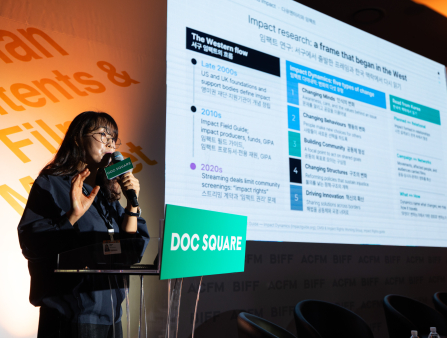
PARK Chae-eun, co-founder of Indie & Impact Media Lab during the Korea panel on Impact Day
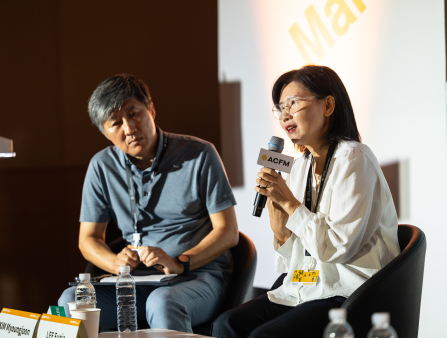
Moderator KIM Myoungjoon (L) and LEE Eunja (R), CEO of ABLEWE during the Impact Day panel focused on Korea
The filmmaker- and audience-led drives can also be applied by other entities, such as distributors and theaters. In Taiwan, House Wang of Light Year Images, Small Talk’s theatrical distributor, crowdfunded the release’s P&A from 772 backers, raising NT$1 million (about US$33,000 at the time). Researchers HSIEH I-hsuan and TU Wei-hua describe those backers as “the film’s first audience and shareholders.” Polepole Higashi-Nakano, the basement-level single-screen theater where What Should We Have Done? had its longest run in Japan, was represented on a panel by programmer Shohei Ishikawa and owner Takahino Otsuki, who described how the theater works with distributors and directly with filmmakers to release independent documentaries. Their most compelling example was a partnership with Tokai Television, a Nagoya broadcaster, which had been commissioning award-winning documentaries that aired regionally late at night and sought broader audiences and acclaim. Polepole committed to releasing not one, but an ongoing series of at least three of them before knowing whether a theatrical audience existed: in effect, they committed to a pre-buy (Polepole now also distributes a very limited number of documentaries a year to other theaters). TOFOO handled the releases in the rest of Japan and turned two of them, Yakuza and the Constitution (dir. HIJAKATA Koji, 2016), and Life Is Fruity (dir. FUSHIHARA Kenshi, 2017), into national hits. (Life Is Fruity, which opened at Polepole in January 2017, sold 277,000 tickets and is still screening on the anniversary of its theatrical opening nearly a decade later.)
Taiwan’s strong public production support lets documentary develop outside market logic, the Taiwanese researchers noted, but at the cost of separating production from distribution: A filmmaker’s next grant depends on festival selections and awards, not on whether audiences saw the last film. Korea has supported theatrical releases through the Korean Film Council from the 2010s through 2024, but compared to Japan, it lacks independent venues that screen documentary films—40 arthouse cinemas versus Japan’s 147 mini-theaters, though Japan’s mini-theaters receive almost no public funding at all.
Polepole’s Otsuki considers the absence of public money a strength: without it, no one oversees what his theater screens. (Otsuki spoke in the context of TOFOO spending four years defending a lawsuit brought over its release of Miki Dezaki’s Shusenjo (2018), on “comfort women,” by conservative commentators who denied their existence on camera in the film. The courts ruled for TOFOO.) Otsuki worried that mini-theaters were being treated as something to be preserved, like the performing arts, and instead described Polepole as a shop run by movie shopkeepers who sell things good for their customers, like a bakery or a grocery. “The scariest thing in a shop is when there’s nothing to sell,” he said to the audience of filmmakers. “So please bring it with you. Just show me your films.”
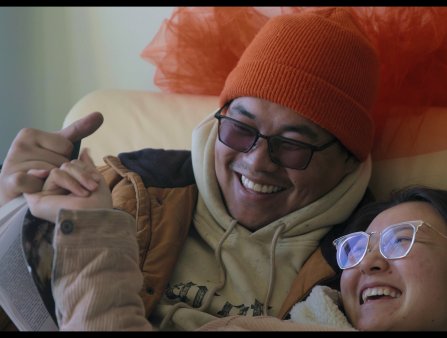
Agaar.

Can I Talk to You?
Of Consequence
This visit was my second time attending Busan, and the audience enthusiasm matched my hazy memories from 2018—every screening was full, even early in the morning in the multiplex venues that opened before the malls they were situated in. Those theaters were a short walk from the large crowds that thronged the evening screening at the Busan Cinema Center’s 840-seat Haneulyeon Theatre or 4,000-seat outdoor BIFF Hill and plaza, a must-visit for any festivalgoer. Every screen is state-of-the-art and comfortable, and they are a short shuttle ride or two metro stops away from Haeundae Beach, where sponsored parties and dinners are held every evening and filmmakers casually gather for post-party hangouts on the boardwalk. The weather was beautifully mild; no typhoons this year.
At Busan, documentaries are placed in the Wide Angle section featuring shorts, animated, and documentary films, with multiple competition sub-sections. The Best International Documentary award went to the Chinese-French coproduction Agaar, a first feature from YANG Bo. The premise is gold: following several years in the life of Agaar, an ethnic Mongolian shepherd, after he returns to Inner Mongolia from a career hosting evening shows on cruise ships. Self-taught in English and newly married with a young child, he decides to parlay his linguistic and digital acumen into live streaming and social media influencing, making video content about traditional Mongolian practices for a modern-day audience. The mix of ethnic traditions and entrepreneurship, coupled with the financial scrambling of a young family trying to climb the capitalist ladder of self-improvement, should make for vivid watching. But the choppy nature of this film’s access and edit, while observational, never quite manages to rise above direct address to the camera or bite-sized bits where the onus of recognition falls squarely on the viewer.
At 9 a.m. mid-festival, I hustled to one of the multiplexes for YI Seungjun’s Can I Talk to You?, a character-driven yet systemic examination of South Korea’s juvenile justice system, which turned out to be the most accomplished of the documentary premieres. The film centers on three teenage girls convicted of minor crimes, whose daily existence revolves around a judge’s specialized family courtroom; a social worker assigned to plead their cases; a youth group home, their housemates, and its staff of therapists. The system’s peculiar reward and punishment mechanisms are aimed at rehabilitation but still seem to cause numerous episodes of emotional distress and good intentions gone awry. The protagonists are all assigned protective “disposition” at the beginning of the film, and if they violate the group home’s rules—going to school and no fighting, smoking, running away, or committing self-harm—they are reported back to the judge for a “change in disposition,” which can result in an increase in their disposition rating and stints in a youth detention center.
Going into the film, I was wholly unaware of the details of the juvenile justice system. There are no info dumps, but the film ably weaves together both personal stories and larger conclusions about the system’s mechanisms. One of Korea’s most critically lauded documentarians abroad, Yi builds on the startling intimacy of his IDFA winner Planet of Snail (2011), the investigative lens of the short In the Absence (2019) on the Sewol ferry disaster, and the impacts of bureaucracy on individuals in Shadow Flowers (also 2019). Yi protects his teenage protagonists’ identities through a blurry focus, shots from behind, and animated drawings of their faces during key intimate moments, created by one of the protagonists, a talented artist. As an entrant into the social documentary sphere, Can I Talk to You? is a broadly balanced and meticulous one. Whether it engenders government apologies or policy change or not, this social-issue documentary can be an impactful one.