
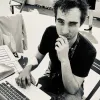
Ten years after Ulrich Seidl’s first film, The Ball (1982), his influence in Austrian cinema started to become apparent in the work of Nikolaus Geyrhalter. Like Seidl and the late Michael Glawogger, Geyrhalter’s work demonstrates what George Orwell once described as “a power of facing unpleasant facts,” a steely-eyed engagement that can be confused with simple provocation or misanthropy. Where Glawogger’s work tended to use a more active, fluid camera, Seidl and Geyrhalter prefer a locked-off camera, often rendering the world in wide-angle static shots whose symmetrical stylization is inherently if sinisterly humorous.
Following his first feature, Eisenerz (1991), Geyrhalter moved into documentary filmmaking, where he’s remained ever since. Throughout his career, he’s documented crisis zones—Bosnia after the war in The Year After Dayton (1997), Chechnya in Pripyat (1997), Vienna during COVID in The Standstill (2023)—or traveled more widely to explore a concept: the meat industry in Our Daily Bread (2005), Europe at night in Abendland (2011). But starting with 2016’s Homo Sapiens, a consistent throughline has emerged: mapping the global climate change crisis as it manifests in increasingly far-flung locations. Homo Sapiens—a series of static shots of abandoned structures, envisioning the post-human Anthropocene within the present—was followed by an examination of mass soil displacement in Earth (2019), trash disposal in Matter Out of Place (2023) and changing snow patterns in last year’s Melt.
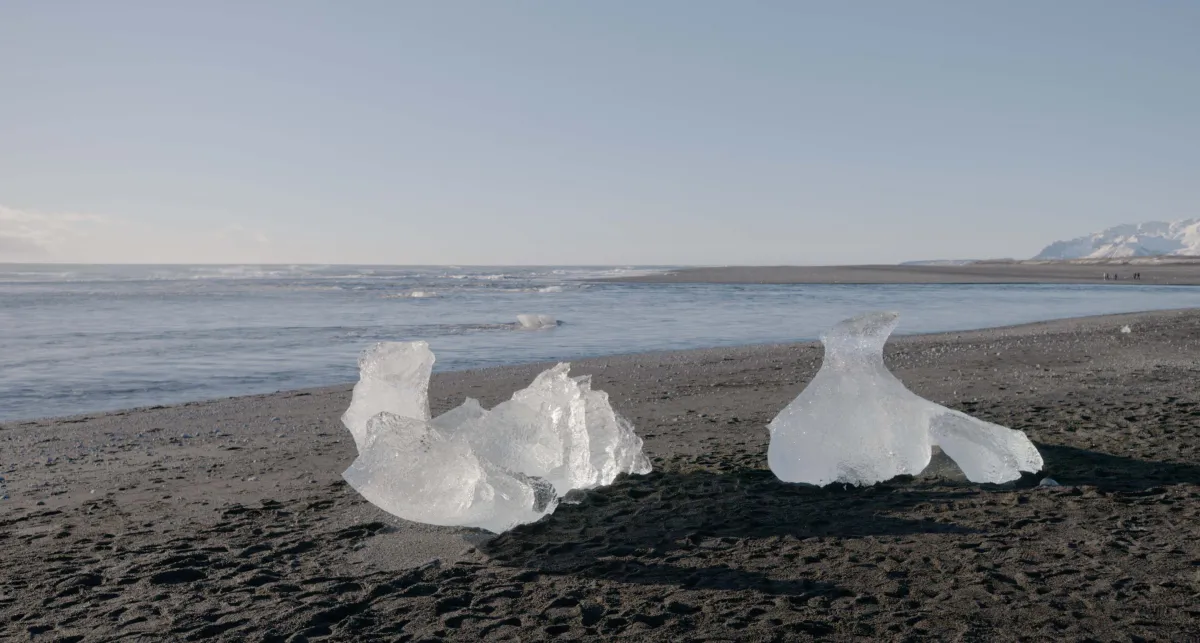
In nine segments shot between 2021 and 2025 across Japan, Switzerland, Canada, Austria, France, Iceland, and Antarctica, Melt alternates spectacular shots of snowy landscapes once again showcasing Geyrhalter’s background as a photographer with interviews of locals testifying to changes they’ve observed in precipitation patterns. Eliding the behind-camera questions as much as possible, these interviews—with civilians, scientists and those whose livelihoods are tied to snow management—cut to black between responses unless the responses would be incomprehensible otherwise.
The morning after Melt’s Swiss premiere at Visions du Réel, I sat down with Geyrhalter—whose work I’ve been watching for over 20 years now—to learn more about his larger body of work. This interview has been edited.
DOCUMENTARY: I was talking to someone last night who said that in a European context, there aren’t many nonfiction films about climate change, which was interesting to me because in America we have so many. Your work has been increasingly focused on various aspects of climate change over the last 10 years—not exclusively, but since Homo Sapiens that’s become a recurring throughline. So, I’m wondering if you think about your work in that context.
NIKOLAUS GEYRHALTER: Not at all.
D: But presumably these projects do work together and you’re shooting them around each other on the same timeline.
NG: Maybe they do work together, but I don’t look at them that way. I just make films which I believe should be done. Those films are about people, and often people interacting with the environment, and automatically you end up with those topics. Because what we do is fascinating and in a way it’s wrong, and we all know it.
D: But for example, Homo Sapiens is explicitly about the concept of the Anthropocene.
NG: Yeah, but Homo Sapiens was an experiment. I wouldn’t consider it a documentary, it’s just a film.
D: Do you consider any of them to be documentary films?
NG: All the others, yes, but not Homo Sapiens, because we were treating the locations, buildings and structures like they were actors. We were not just filming abandoned spaces: we were altering them, influencing them, sometimes changing things in post-production. No second of the soundtrack is original sound, because it wasn’t possible. These buildings are abandoned in an area which is not necessarily totally abandoned; there is traffic around and airplanes and dogs and everything. So, I couldn’t call it a documentary. But for me, Homo Sapiens is not necessarily a film about climate change. It’s a film that could make one think about how fragile we are and how fragile everything is. Nothing is for granted.
Maybe they do work together, but I don’t look at them that way. I just make films which I believe should be done.
—Nikolaus Geyrhalter on his films since Homo Sapiens
D: I mean, the Anthropocene is a concept directly related to climate change.
NG: Yes, of course. Earth was more related to the Anthropocene, in my point of view, than Homo Sapiens.
D: How so?
NG: Because the thesis of the film was one of the theses of the Anthropocene: We are moving more soil as the human race than nature does, which never happened before. This is stated as the first sentence, so this is the entrance to the film.
D: These are long-form productions that take place over multiple years, so you’re presumably overlapping shooting parts of them.
NG: Yes.
D: But you know which footage is for which project?
NG: Of course. You write the concept, you get the funding, then you shoot and every single day of shooting is related to this budget and idea. When I’m shooting, usually I’m finishing one film, in the middle of shooting another and developing one. There might be overlapping in shooting, but more overlapping in ideas than shooting days.
D: There was also a COVID disruption, which you made a film about as well in the middle of this period. Do you remember what the order of all of these was?
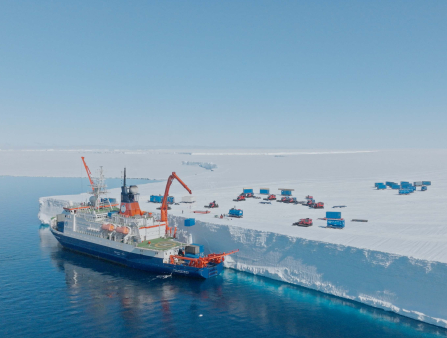
NG: We were working on Matter Out of Place, and at the end were already developing Melt. Matter Out of Place got quite delayed because of COVID, and Melt as well. The research station in Antarctica didn’t let anybody in during COVID, then there was such a long list of media representatives who wanted to go and we were not the first ones on the list. This was one reason why it took years to get there.
D: How does scouting for all of these films begin? Has that changed since Google Maps?
NG: I can’t even remember the time before Google Maps. Of course this makes it easier. Usually when you apply for funding, there is very quick and dirty online research to make a sketch about the idea of the film. This is what I sometimes do along with some colleagues based on Google, not deep research. Research starts when we get the funding, when we know the project is going to exist. Then, the research is not done by me anymore but by my colleagues. With this film it was Sophia Laggner, who was also recording sound. We are working closely together for many years.
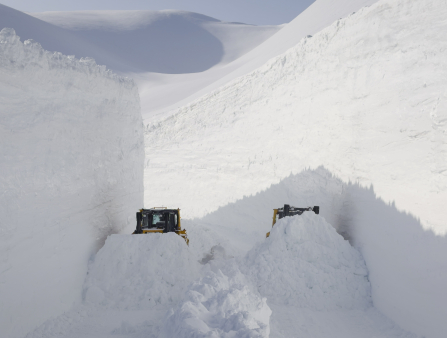
It’s not only about finding locations, it’s finding topics, and we realize them in different locations. In the beginning we thought, “We want to show a lot of snow and life with snow, how snow affects people and what kind of a culture would get lost [without it]”—because to live with snow is just a different way of life than if it wouldn’t be there anymore. Then, we were looking for locations and Sophia came up with Japan. Japan is the area with the most snow in the world. We shoot the first two or three episodes, start editing, see what we’ve got. It’s like you’re hunting and collecting, and it more or less will never end until there is the feeling that either we really want to finish the film or the film is filled up.
When we started Melt, we had an idea of what I would like to film. But we didn’t know about many of the locations we ended up with. It is really a process. This is what people usually don’t believe. There is not much of a concept—it’s a theme, several weeks of shooting time and a budget.
D: When you go to a location, is there generally an average amount of time that you’re there?
NG: If it’s abroad, it’s around a week, because that’s the amount of days where we can usually find protagonists and get close to them. Usually we work with people who live there, a fixer or location scout. The first few days are usually a bit stressful because we have to meet people and also be prepared for the possibility that it might not work out, and then we have to find other people. It’s a headache, but it works. It’s like adrenaline; you have this week and there’s no way around it.
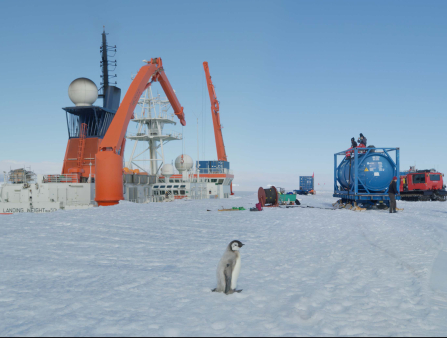
Sometimes it’s easy to come back; for example, in Tirol, [Austria,] this wasn’t a week, just three days of shooting. We could just drive there and knew we could come back anytime, so this was easy. But even in Antarctica we had just one week. This was one of the very few locations where we had contact with protagonists before, because this was organized by the press department of the Alfred Wegener Institute, because we couldn’t just travel there on our own. They were asking the station, “Is there anybody who would be willing to participate?” We had video conferences with them, because it was so expensive to get there and a big effort, so we needed to be sure that we would be welcome. We can’t travel there and then everybody says, “Hey, it’s nice that you’re there, but we don’t want to talk to you.” But usually we don’t prepare.
D: Do you ever do casting sessions when you get to a location? Have you tried it?
NG: Well, what is a casting session?
D: You put up a sign, you say, “We’re looking for this person.”
NG: No, no, no. We walk around and talk to people.
D: Do you normally do the talking or someone else?
NG: It depends on if I understand the language. In German- and English-speaking countries, it’s me. In other countries, we work with fixers or interpreters and I brief them to allow them to conduct the whole interview—which should not be an interview. I don’t want interruptions, I don’t want them to translate to me after each sentence. We talk about topics, directions that could be interesting, then I leave it up to them. In Japan for example, I believe that the people we filmed may have thought that I’m the camera operator and not the director, which doesn’t matter to me. I take care of the images and the other people talk.
D: So they have a conversation and when they’re done, do they translate it for you right away or do you find out what they said later?
NG: Usually I get a very rough summary before we stop the interview, Then maybe I say, “Let’s go this direction or ask more about this.” Then we get the material in the evening.
D: Has your approach to interviews you conduct yourself changed at all? Have you become more comfortable?
NG: I was always comfortable talking behind the camera. I would never like to appear in a film but I like to talk to people.
D: It often seems like you’re cutting out your questions unless the person starts answering in such a way that you can’t.
NG: Yes, I’m looking for statements that would ideally reflect the question, where you don’t need to even hear the question.This doesn’t always work. The idea is, the camera is framing reality as a kind of stage, and on the stage the protagonists are presenting themselves. But this is unpredictable. Sometimes it works well, sometimes not so much.
D: When it doesn’t work, is it salvageable or do you just let it go?
NG: It depends. There are interviews we don’t use. Sometimes this leads to looking for another protagonist. Sometimes we can save it. It really depends on how important it is. There is no rule, but usually it works because we don’t rush people. In the first 10 minutes, everybody’s nervous, then it becomes clear that we don’t have stress. We just want to listen to you, so take your time. People never forget that there is a camera, because they talk right into the lens—actually, some centimeters below the lens—and never really see the person asking the questions.
D: They never see your eyes because…
NG: Within this construction of camera and tripod, there is a very tiny spot where I can see the pupil slightly below the center of the lens. So, this is not a dialogue from human to human; basically, they’re talking into a machine. And still it works very easily, which surprises me.
D: Why does it surprise you?
NG: Because I think I couldn’t do it. I never tried, but I think it must be very strange.
D: Has there ever been a topic that you were interested in filming, but that once you pursued it seemed like it would not be sufficiently visual to realize?
NG: Of course, many. Digital topics, artificial intelligence—all this kind of stuff which is very important to talk about. I couldn’t do it because I wouldn’t find the images.
D: Would you ever generate images to deal with these topics that you can’t otherwise capture in reality?
NG: I don’t think so. That’s a very different style and other people could do this better.
D: I was curious about the role of VFX in your last few movies. You have a longtime collaborator, Sebastian Arlamovsky. He used to be your assistant cameraman. On Melt and the previous film, he’s credited as special effects.
NG: He’s also a family member.
D: Which part of the family is he?
NG: He’s my stepson. He grew up with me.
D: So, what is the role of special effects in these films?
NG: Removing microphones which sometimes come into the frame. We shoot on 5K, and sometimes I shoot a little bit wider than necessary because I know we will have to adjust in the end. [VFX] is very much about stabilizing, drone shots especially.
D: When did you first start using drones?
NG: Whenever they were good enough. I worked so many years with cherry-pickers and cranes and really heavy machinery to just get one shot. This was very limited.
D: Because you can only go so high.
NG: Not only this. You cannot just park wherever you want. I mean, there are trucks you can park on the street, but you can’t go in the middle of a field, you have to ask somebody to allow it—which we even did sometimes, but then you have to discuss with the farmers and pay, then the truck gets stuck and all this kind of stuff. This was really complicated compared to how easy it is now.
D: The only thing about drones is potential airspace violations, right?
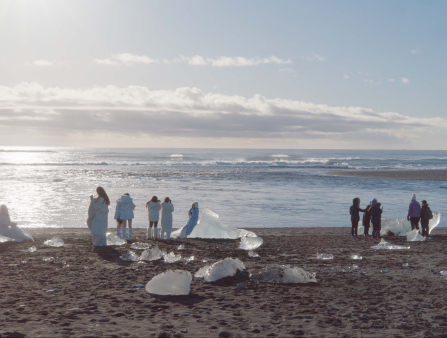
NG: Yes, of course. This is becoming more complicated. You can’t use them in towns in Europe, so we still use other means. But, for example, in Antarctica the drone was a very important tool, because we could fly to the icebergs and do a lot of nice aerial shots very quickly that there wouldn’t have been any other way to do.
D: Is the drone shaky at all?
NG: It depends on the weather. Sometimes they are quite stable, but never as stable as they are in the film. This is also what Sebastian does. And since they are wide-angle lenses, this is not so easy, because even if they are just moving a little bit in the corners, you will see. He has to separate layers and do a lot of magic .
D: I’m also curious about your work with Atmos, in part because I’ve never been able to see one of your Atmos-mixed films in an Atmos-equipped theater, but I can hear in my mind why that would make sense and how it would work. How do you work with Atmos, and do you know how many theaters can actually show your work in Atmos? Because it seems almost theoretical. For example, in New York, your work often shows at Anthology Film Archives, which isn’t Atmos-equipped. In fact, I think the only Atmos theaters in New York are multiplexes, and there aren’t that many of them.
NG: It’s better in Europe. It’s really becoming a standard, and it works well. Wherever we can, we record normal sound with the MS mic and radio mics and all this kind of stuff. Then we have a surround rig parked behind the camera which records in all directions. Even if this is very often not usable in the end because it records too much disturbing noise from the backside, it is a very good guide track for the sound designers to hear how it should sound ideally without the disturbing noises. A lot of sound has to be created in the post because you need so many different bits of sound to make Atmos work. If you only work with the original sound the tracks don’t make sense; it would be the same sound coming from all of the tracks. For example, the shots of snow falling, I think it’s 20 different tracks from sound archives of snowflakes.
I mean, it’s just technology, but I think people going to the theater are used to perfect sound from commercial productions, and in a way they expect it. If we present the documentary in Atmos, they wouldn’t notice, but they would notice if the sound would be boring, so it’s just an expectation the audience has, and if you want the film to work you have to work on this level.
The idea is, the camera is framing reality as a kind of stage, and on the stage the protagonists are presenting themselves. But this is unpredictable. Sometimes it works well, sometimes not so much.
—Nikolaus Geyrhalter
D: For some filmmakers, the part of filmmaking they like most is when they get to travel. Do you enjoy coming up with topics that let you go to places you would want to go by yourself or are you just doing what you have to do for the film?
NG: I have to do it for the film. I mean okay, I was happy to to be in Antarctica but I couldn’t enjoy it, because I was just working and this takes so much of my energy. I didn’t take any private photos. And flying around with the equipment, it’s always annoying and boring. Privately, I’m not traveling a lot.
D: When you travel, how big is your core crew? I saw in the credits that some people you obviously hired there.
NG: Yeah, we try to do this more and more for many reasons. The crew traveling is two to three people.
D: And how much equipment is it? Is it a lot? Because that would be expensive.
NG: Well, we became professional in repacking all the camera equipment without heavy cases, in normal luggage. We have two normal suitcases with private stuff and all the camera stuff wrapped in plastic foil with bubbles. It’s not about flying: you end up there, you need a taxi and so on. When I was shooting Elsewhere 25 years ago, we had seven aluminum boxes, like three pallets of stuff. It wasn’t possible at that time to do it any different way. For every tripod you had a big box. Now I’m using a very small simple tripod that fits into the suitcase. This makes us more flexible, it makes travel easier and cheaper and from an ecological point of view it’s better, but it ends up in chaos because you have your private stuff there. So, it’s not the perfect solution yet. That’s why I don’t like to travel. I like to be in other places, but I don’t like the process of traveling, especially with equipment.
D: Do you ever shoot on an iPhone?
NG: Yes. [In Melt], we did shoot, I think, 10 minutes of the footage, especially in Japan and France. In Japan, the camera died up on these mountains, and we were prepared with the iPhone, because the iPhone never dies. There is this app which records in 4K and ProRes, and if you have an ND filter you can adjust the shutter. It only works with the normal iPhone lens, which is very wide, which is the lens I usually use. Once you want to zoom in or do anything else it doesn’t work, but with this basic setting you can get pretty far. So, we finished the whole episode with the iPhone.
In France we were a team of two shooting this episode before going to Antarctica, and we had to take some shots on the slopes. I didn’t want to take the big camera on my shoulder because I was afraid to fall, break my leg and not be able to go to Antarctica. So, most of the outdoor shots in France were shot with the iPhone as well. Also, people don’t take you as seriously. You’re just a YouTube blogger or somebody. This was helpful, because people did not react to us very much. I don’t want to say that the iPhone is the solution, not at all. I don’t want to work with the iPhone my whole life. But it helped us out in some ways, especially with typically problematic situations like hot and cold, snow and water. It just doesn’t care, much less than the big cameras do. Also, several times when the big camera died, we set the drone on the tripod. This also works.
D: The movies are often funny, and the humor is in the composition or in the juxtapositions of the cutting. You sit next to people and hear them laugh at a cut, and they don’t even really know why they’re laughing. It’s just a rhythm thing. How do you think about the role of humor in your films?
NG: I like if people are laughing, but sometimes I realize that they are afraid. Especially when it’s a premiere, they don’t dare to laugh because it’s such a serious thing. Usually when it’s just a regular cinema, people laugh much more. It’s important, because it helps.
D: Do you think your films have gotten funnier over time? I feel like they might have.
NG: Are they?
D: I mean, Melt is funnier than Our Daily Bread, right?
NG: Yeah, maybe. Our Daily Bread is so way back for me.
D: Well, it was the first of your films that I saw and at the time I was thinking of it in the framework of you, Michael Glawogger and Ulrich Seidl—all filmmakers that are kind of funny in their way, but humor is not necessarily the primary goal.
NG: It’s true. Ulrich Seidl was really influential for me and Michael. This kind of Austrian documentary cinema was very new when Ulrich invented it, then Michael and me followed. We were never working together, but we were always seen as a trio doing a similar aesthetic thing.
D: Do you think that was accurate?
NG: Yes, it was. When I did my very first movie, I was 22 years old, very much influenced by Ulrich Seidl and shot it on 16mm with a wide-angle lens. In the end, I even called him and talked to him: “Sorry, you don’t know me, but I just made a film which really looks like a film of yours. I hope you don’t mind.” And he was totally nice: “No, it’s great. Come on.” Since then we know each other. And then, it was a coincidence that when I was shooting The Year After Dayton, I had to buy another camera. The film business in Austria is not so big, and I accidentally bought the camera on which his previous films were shot, with the same lens. I shot two more films with the same camera and wide-angle lens. Of course, the rhythm is similar, but it didn’t matter. I think the way that we appeared on the international market, as an unspoken trademark, made the position of the three of us altogether stronger.