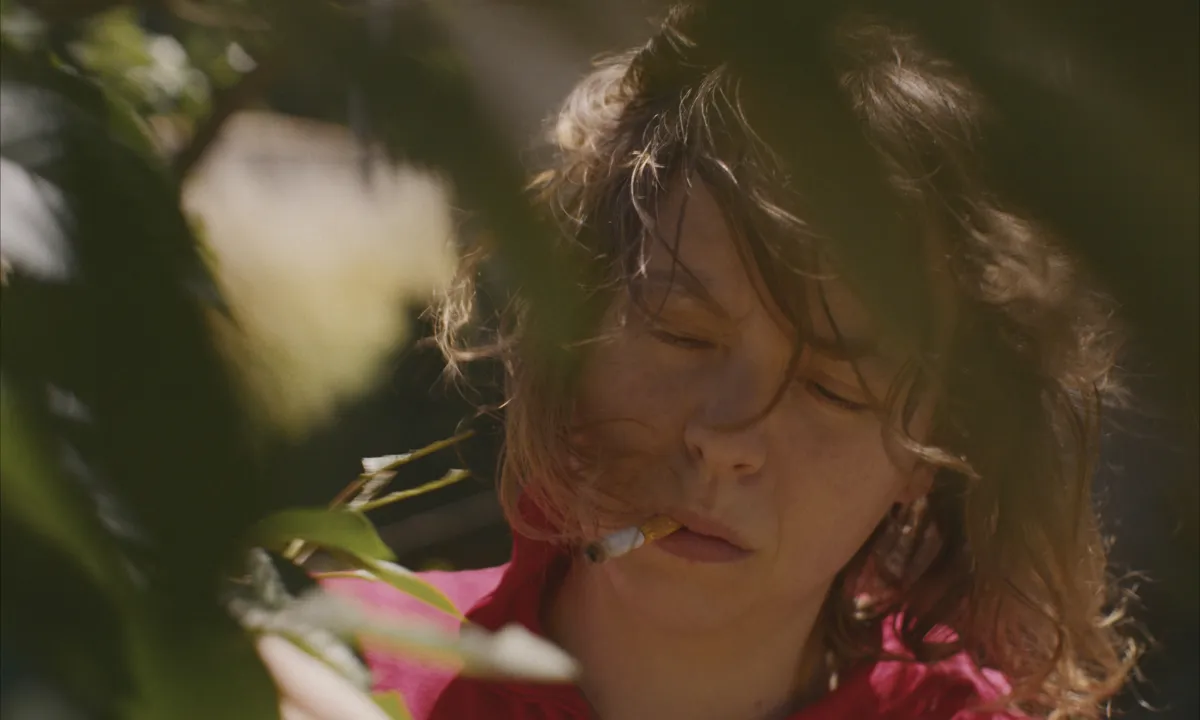

Premiering in the Tiger Competition of this year’s International Film Festival Rotterdam (January 29-February 8), La belle année is a delicately layered documentary-essay in which Swedish-French filmmaker Angelica Ruffier revisits memory, desire, and grief through a form that moves freely between observation, reconstruction, and staged performance. Framed by a return to her childhood home in the south of France after her father’s death, the film unfolds as a personal journey that gradually opens onto broader questions of self-narration, longing, and emotional inheritance.
Rather than offering a linear autobiographical account, Ruffier embraces a hybrid structure that allows the film to oscillate between documented encounters and moments of solitude re-enacted for the camera. At its center lies a teenage infatuation with Sylvie Bresson, a French high school teacher—never acted upon, never declared—which becomes a prism through which past and present selves quietly converse. The result is a work that resists closure, privileging process over resolution and emotional texture over narrative certainty.
We sat down with Ruffier in Rotterdam to discuss the project’s long gestation, its autofictional strategies, the role of collaboration in shaping such intimate material, and the delicate balance between exposure and protection when turning the camera inward. This interview has been edited.
DOCUMENTARY: Could you touch on the inception of the project—when and how did you start working on it?
ANGELICA RUFFIER: I started working on La belle année in the autumn of 2021. The idea had been with me for some time before, but in 2021 my father passed away, and that event also became the premise of the film.
D: So that event really prompted the actual start of the project?
AR: Yes, exactly. Suddenly, there was a lot happening emotionally that I could build the theme upon. The film is basically about me going back to the south of France with my brother to empty our father’s house. It’s a strange house, but also my childhood home. And there, I find a diary I wrote in high school, when I was 16.
D: How did you begin developing the project from that point? Were you already thinking about appearing on camera yourself and working with autofiction, or did that emerge later through the research process?
AR: In the very beginning, the film had a more classical form, with a written “I” speaking over images. But after my father passed away, and once I had gathered a team, I wanted to try another form. That meant making myself the main character, present throughout the film. I also had a cinematographer who could follow me constantly, which made that possible.
D: Who were the first people you gathered around you?
AR: Anna Eborn, my editor; Simon Averin, the cinematographer; and quite early on, Leo Svensson-Sander, the composer.
D: One very specific choice in the film is that scenes involving multiple characters are purely observational, while moments where you’re alone shift into reconstruction or abstraction. How did you arrive at that decision?
AR: It was quite a pragmatic choice. I wanted scenes where I was alone in the house, but if you’re alone, you don’t have someone filming you. So if there is a camera and you still want to be alone, you have to remember how it felt when you were actually alone, and then try to embody that again. None of the scenes involving interactions were written in advance. Since it’s a documentary, I wasn’t going to script those moments as they happened.
D: Looking at the finished film and the whole process, it’s very rich in references—mostly cinematic, but also literary and visual ones that viewers might not immediately catch. Could you talk about those influences and how they shaped your work?
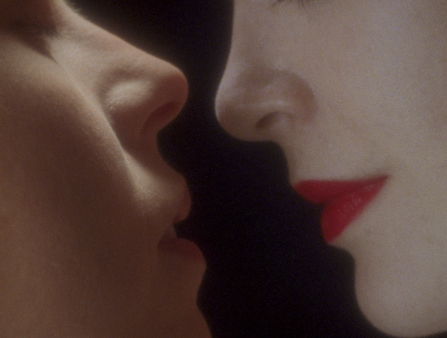
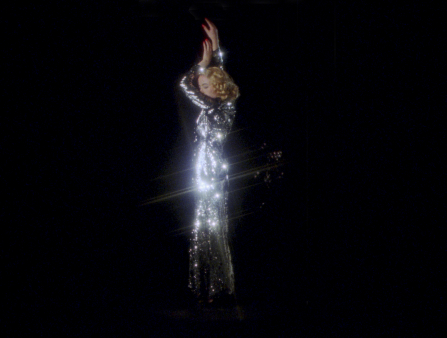
AR: I think the film really wants to show how multiple influences shape you. Some references are directly present in the film. There’s Louise Brooks in Georg Wilhelm Pabst’s films, because I associated Lulu with this teacher I had strong feelings for. There’s also Daughters of Darkness by Harry Kümel [1971], a lesbian vampire film from the 1970s set in Ostend, with Delphine Seyrig. I saw it when I was 16, and I was very struck by its aesthetics and sensuality. While writing and thinking about the film, I read a lot of Annie Ernaux, Édouard Louis, and Jeanette Winterson—authors who work with autofiction. And visually, my cinematographer and I looked a lot at Chantal Akerman, especially for the more choreographed parts of the film.
D: Were you quite independent in the development, or were you open to input from your collaborators? I imagine one challenge was balancing memory, archive, and what was unfolding in your life at the same time.
AR: I was very open to their input. I’ve been working with my cinematographer and editor since the beginning, and it’s through their eyes—through how they interpret what unfolds in my life—that I can construct the film and understand the scenes. It’s very much a collective dialogue.
D: So that external eye was important throughout, including post-production.
AR: Yes. In documentary, those phases aren’t really separate. It’s “waves” of production and post-production.
D: How long did you work on the edit?
AR: The editing lasted around 30 weeks spread over four years. The later post-production stages, such as sound mixing, were much shorter.
D: Working so intimately with yourself can be emotionally heavy, even risky. Did you put any mechanisms in place to protect yourself?
AR: You try to protect yourself, and sometimes you go a bit too far. But that’s part of the process. You open things up, and then, in order to make them into a film, you slowly close them down again. My editor was the first person I shared these feelings with, so she was a huge companion and pushed me to dig deeper.
What I hope to give the audience is a way back to feelings they might have lost for a long time, and a sense of consolation—‘compagnie,’ in French—during difficult moments.
— Angelica Ruffier
D: The film has now premiered in Rotterdam. What impression did you get from the audience, and what do you hope the film offers viewers?
AR: We had a beautiful premiere. I was very happy and also surprised by how many young people were in the audience. I received a lot of feedback afterwards. My youth was 20 years ago, and the world was different then—no social media, slower communication. Everything feels much faster now, especially in relation to queerness and love. People were very taken by the form of the film, which was really touching. I also read a review on Letterboxd where someone wrote that they expected a film about a simple crush, but then it became something much deeper, touching many different aspects of life.
D: It’s interesting how often Letterboxd comes up now. Directors read it more and more often to get a sense of the film’s reception.
AR: It didn’t exist before, and now it’s very direct feedback—sometimes harsh. This is actually my first film released since Letterboxd became so big, so I was very curious. What I hope to give the audience is a way back to feelings they might have lost for a long time, and a sense of consolation—“compagnie,” in French—during difficult moments. I also wanted to address everyone who once had someone who deeply inspired them, without that person ever knowing.
D: But that kind of crush—especially on a teacher—is extremely relatable.
AR: Yes. It can even save your life sometimes—having such an intense feeling when you’re in a very difficult situation.
D: As long as it doesn’t become toxic.
AR: Exactly.
D: Looking back now, has this whole process changed your perception of grief and creativity?
AR: I haven’t really thought about it in those terms. It was a huge experience. I’d never done something of this scale before, and I was also living in Greece at the time, which added another layer of challenge. I’d never experienced the grief of losing a parent before, so I can’t really articulate how it changed me. But creativity, for me, is definitely about sustained teamwork over time.
D: Looking ahead, do you feel the need to continue working with personal material or to move outward?
AR: I completely feel the need to go outward. Totally. I’ve done this, and if I ever return to other parts of this story, I need something in between. Before this film, I also worked on something that wasn’t about me at all. For the time being, I have another documentary set to be released this spring, about a group of Swedish climate activists. It started as a collective project with three directors, but the structure changed over time. I worked on the cinematography, sound, and original idea.