

What Recife is to Kleber Mendonça Filho, Ouro Preto is to João Dumans: not just his Brazilian hometown, but a site for repeated cinematic investigation. Co-directed with Affonso Uchôa, Dumans’s 2017 feature debut Araby was a hybrid road trip across Brazil that ultimately returned homeward. In doing so, Dumans and Uchôa were circulating territory explored in Brazilian classics like Jorge Bodanzky and Orlando Senna’s Iracema (1975) and Ozualdo Candeias’s The Option (1981), both films in which fictional truck drivers interact with nonfiction subjects to better observe brutalities being visited on them.
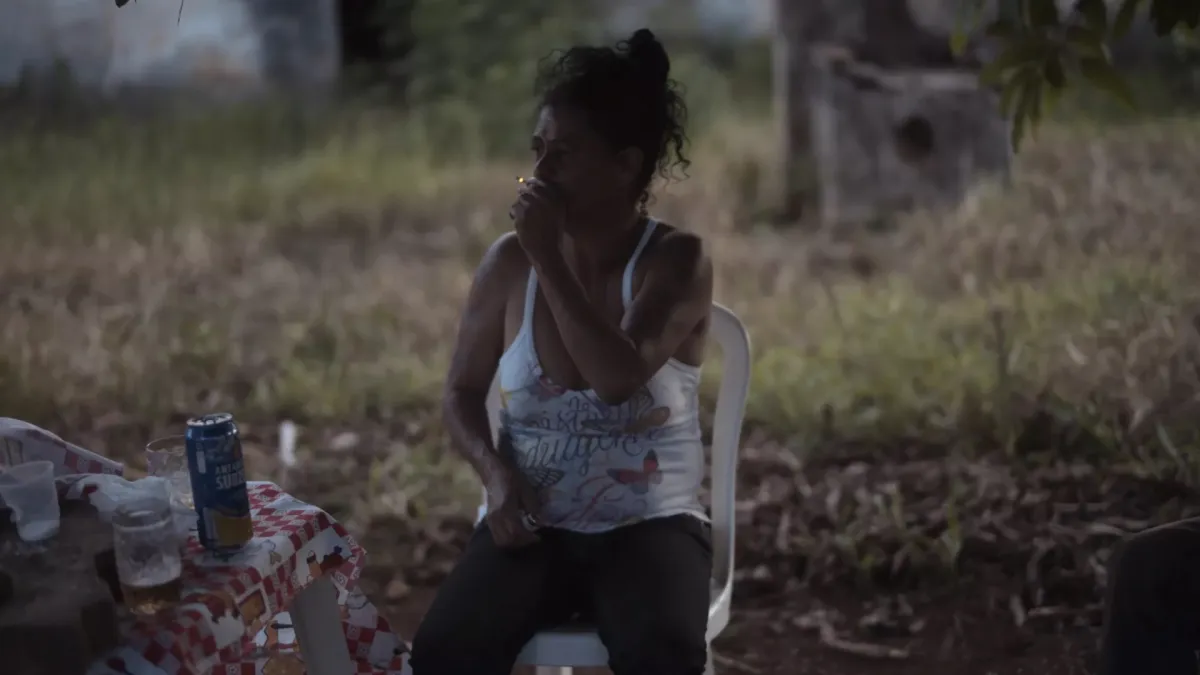
With his new feature, The Night and the Days of Miguel Burnier, Dumans explores neighboring surroundings without fictional scaffolding, delving into the rapidly shrinking community of Miguel Burnier, whose population has shrunk from 600 residents in 2005 to 80 in 2025. Shooting from 2019 to 2022, Dumans adopts a classically vérité approach to a town whose citizens are being dispossessed by an iron ore mine. The mine’s expansion is a symptom of growing and unsafe mining practices in Brazil, which in recent years have led to two dam collapses—one resulting in the death of 19 people and widespread river pollution in Mariana in 2015, the other in the death of 270 people in Brumadinho in 2019.
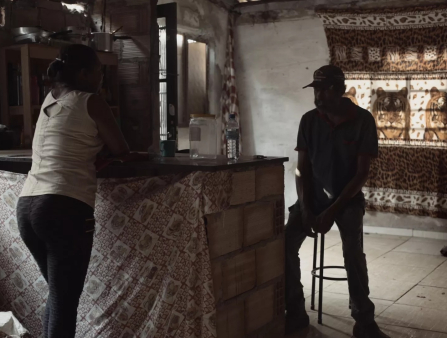
With Uchôa serving as editor, Dumans floats through alcohol-sodden purgatory alongside the citizens; in one late scene, two women discuss their heavy drinking while making dinner, transforming the subtext of their sublimated pain into text. Several ruptures disrupt the film’s otherwise unified visual language, including one sequence juxtaposing a present-day Passion Play parade with still photographs of a carnival parade from 2010. Twice, the film steps away from people altogether to depict the mining factory’s operations in long, elegant landscape shots that slowly dissolve into each other, a break both visually and editorially. At the climax, visual discipline is necessarily lost when, while filming, Dumans is confronted by security guard representatives from the mine, pointing his camera towards the sky while explaining what he’s doing there. In doing so, Dumans demonstrates what his subjects are saying: their ability to circulate in their home is being increasingly snuffed out by the factory’s total control over the area.
I spoke with Dumans following his film’s premiere at Visions du Réel; I had questions for him and, to my surprise, he also had some for me.
DOCUMENTARY: You’re from the area. Did you always have a desire to make a film about it, or did this come about because of events with the mining company?
JOÃO DUMANS: I live in Ouro Preto, but it has lots of small districts and I live in the central part. The city has a history with colonization. The Portuguese came in 1500. In the 18th century, they extracted a great deal of gold from Ouro Preto; this gold went to Portugal and financed the Industrial Revolution. The city is marked by this heritage. Nowadays it’s a tourist city: people go there to visit, eat in the restaurants, see the monuments and museum. But actually, this story continued in the small districts—the theme of land extraction is a permanent question in the place where I live, [the state of] Minas Gerais. This has become a more serious issue since the 2000s, when we in Brazil began to intensify mining activities. More recently, we experienced two massive mining-related disasters, one in Brumadinho, the other in Mariana. Both are next to the place where I live.
I’ve lived between Belo Horizonte and Ouro Preto for 42 years but never been to Miguel Burnier. I went for the first time because someone said in a Q&A of Araby that the film reminded him of Miguel Burnier and I said, “Fuck, I’ve never visited this place.” When I arrived, I was struck by how the factory had taken over the area.
There was a security booth there. I asked: “Where is the Miguel Burnier district?” And the guard asked me: “Which district? There is no district here.” That answer made me make the film. The people working at the factory didn’t know they were in the district; to them, the district no longer existed. I said, “I have to start filming things to try to help.”
D: So, how did you set this in motion? Did you just show up?
JD: I was teaching film in Belo Horizonte and felt the urge to buy a camera, a Sony A7S II. It’s a very small camera, and at the time was considered good for low-light situations and all that, so I could handle it all by myself. I had never filmed anything before; it was the first film I ever shot. The crew was me and another friend making the sound. What’s curious about it is that this friend was the character of the first film that we [premiered] here in Visions du Réel—he started his career in documentary as a character of [Uchôa’s] film Seven Years in May, which was screened here in 2019. After that, he began working in cinema, and I invited him to handle the sound recording. He had struggled a lot, like any young boy brought up in the suburbs in Brazil. His presence was crucial in terms of establishing relationships with people there—after all, he had his own stories, his own difficult life.
We started visiting the location once a month. We would stay two, sometimes three days at a time, every single month, for perhaps a year and a half. In the beginning, I didn’t have a focus; I thought that I should document what was going on there and that if I observed reality for a long time, I would capture something of the effects of the factory on the lives of people, because I wanted to do a film about mining that was not from the perspective of the land. The films I had seen about mining were shot using drones, focusing on the terrain. I wanted to make a film that delves deep into the perspective of the people actually living through this.
That is difficult, because the damage is often more subtle in the lives of the people inhabiting that landscape. 270 people died in Brumadinho; you had strong images of this catastrophe. But in Burnier, it was not a catastrophe but something that was going on very slowly, like a poison that was destroying people’s lives. It was more difficult to see it as an image.
I was filming everything they did, and that was a way of connecting with them. So if they were doing something that had nothing to do with mining, like repairing a piece of equipment, I would film it. If they were hanging up laundry, I would film that too. I stopped a little bit because of the pandemic, but I returned for two more years, then started editing the material. That was another difficult process. There are many aspects of the community that I document.
Ultimately, I decided to focus on the theme of alcohol, of drinking, and the ambiguous meanings surrounding that. You can find very similar situations in different types of communities—specifically, how the presence of a corporation within these communities affects people.
D: When you’re filming people who are drinking a lot, then sitting and watching that footage for a long time afterwards, is that emotionally draining for you?
JD: The sensation you’re describing isn’t something that happens during editing; it happens while you’re filming. Several times, I had to stop the camera, because the reality is far worse than what we see in the film. When I arrived on set, sometimes I’d see that the guys were in a really bad state. The most important thing for me is the scene featuring the two women in the kitchen, where I feel they express their awareness of the process they are going through. I didn’t ask them to say anything; they said it because they wanted to. But in doing so, I think the film clarifies that the protagonists are conscious of the process they are living through and aware of the film’s central theme. This made me feel more comfortable with the rest of the film, because they are expressing the problem.
D: The film has a classical vérité language for the most part, but there are the two exceptions, which are the scenes maybe more explicitly about the subject of mining, and they’re linked by slow dissolves. What was the thought behind that? It’s a very clear break in the visual language of the movie.
JD: During editing, when the landscape images had a more regular presence within the film, there was something that was a bit schematic, because we were always watching this contrast. I decided to intensify the contrast. When you stay with the characters for a while, you could forget you were in a mining site. Eventually, you have to be reminded of it. That was how we felt the structure worked best: it allowed us to better perceive the contrast while remaining with the people. Obviously, there is a contrast between the life of the machine that’s going on 24 hours a day and the vulnerability of people there. So, it was a little bit of a solution to concentrate these shots of the operation of the factory that exists around the village.
D: Tell me about the dual parade sequence, the present-day Passion Play march alternating with a montage of carnival photographs from February 2010.
JD: That was the last time that [Passion Play] parade happened, actually. They couldn’t do it anymore. These events are very common in Ouro Preto and Minas Gerais. It’s a very religious city, so it was kind of the theater of the villages. And Carnival for me is a little bit the same, actually. There’s no difference. That’s why I put them in a sequence, because the same people there praying for god are praising the craziness and drinking on the next day.
Those photos come from one of the characters featured in the film. He is a community leader and shared those photos with me. He documented the village for a long time, he took photos, and was one of the guys who was most concerned about the fact that the community lacked understanding when the factory established its plant in 2005. For me, it’s also saying, “Now is bad, but it’s always been like this.” We have the feeling that the place in 2010 was already suffering some damages. What do you feel about it?
D: I was thinking about what you might think your film’s relationship was to Brazilian cinema. I saw Iracema earlier this year; when you were talking about the landscape, I was thinking about those landscapes and about Cinema Marginal, like The Option, the Ozualdo Candeias movie. It feels like your movie is not in conversation with those, it’s a smaller project.
JD: Iracema is a very important film. It was forbidden when it was made and shown years after that, and I have great admiration for [Jorge] Bodanzky. What I feel is that they are completely different. There is a long tradition—and I, too, feel I am part of this struggle—of attempting to create our own narrative cinema without detaching ourselves from our reality. So, the challenge lies in how to incorporate elements of Brazilian reality—a chaotic reality, an impoverished reality—into narrative cinema. That is the problem I believe Bodansky faces in this specific film. Fiction and documentary are interwoven within the characters. So, you have [Paulo César] Pereio—a superb Brazilian actor hailing from the world of cinema—who is acutely aware of his role as a driver that represents the country and its development. And you have Iracema, this indigenous girl—very young, very innocent—playing herself. So, what he’s displaying is a meeting of reality and fiction, and the film is made of that tension.
That was not the purpose of this film. I’ve worked with a hybrid approach. Araby, for example, features a character who is not a professional actor yet inhabits fictional situations. But in this film, I didn’t want to invent anything, I didn’t want to stage anything. I simply wanted to observe—to watch. That became the film’s modus operandi: simply watching. You could rightly say that it draws much more inspiration from cinéma vérité, particularly if we look at American cinema of the 1960s and ’70s. I started a little bit inspired by Wiseman and films like Belfast, Maine.
I wanted to create a space where the viewer could empathize with the characters and what they were going through—to place them, in a sense, within that environment—rather than making the film about the process itself.
—João Dumans
D: When you say a film is made “in collaboration with,” what does that mean to you?
JD: When I arrived there for the first time, they were always saying “You have to film this, you have to film that.” For me, that’s the main rule; I would never leave anything in the film that the character doesn’t want. During the process I was always showing the images to them and trying to understand what they felt comfortable with, what they wanted me to show. I was also serving a little bit as the photographer of the community for private events, so the film was developing in that sense, with me being there and trying to understand what I could do. And also understanding that in part of the community there is a process against the factory to try to get some compensation for the destruction. I thought I was also making a film that could help that process.
But finally, when I showed it to Paulinho, who was responsible for this process, in the end it was my point of view. I don’t think that he [got] what he expected, actually, but I’m okay with that. Maybe he expected something more controversial, more explicit, with more anguish directed clearly at the factory.
D: Earlier, you were talking about classical vérité. It doesn’t really apply to the films of Wiseman, because his thing is, “I don’t affect what’s happening.” But in many films by the Maysles, for example, there’s always a scene in which the camera operator acknowledges their presence or has it acknowledged. Did you always know that you wanted to have a scene in the movie where you are explicitly acknowledged, or is this just a thing that happened and you decided to use it?
JD: In the beginning, I wanted to be a bit invisible with the camera, because I feel there are very strong tendencies nowadays to talk about yourself and what that process means: The first person narrator, “what’s my stake in this,” etc. I was a bit tired of that. Perhaps I wanted to create a space where the viewer could empathize with the characters and what they were going through—to place them, in a sense, within that environment—rather than making the film about the process itself. But ultimately, it became inevitable; after all, though I was operating from a very different perspective, I also lacked permission from the factory to film. I think it was important to stress that the camera was also part of the problem that was going on, in the sense that I was not protected by being invisible or being a filmmaker. Not that I’m not saying that there’s danger or anything, just to say that it’s kind of a proof of what they are saying: they cannot circulate.
D: I want to know about the title, and I specifically want to know about the difference between the singular and the plural.
JD: We always say that there are nights and days, and that one day follows another. But perhaps there is a night for that place, one that will have no subsequent day. So, it is, in a way, about this night that is approaching, that is settling in, and that may well signify the end of the place. It is, to some extent, something you can already see on the horizon—something visible when we speak with people there, as well as with those who study the place, visit it, and are involved through other approaches—anthropologists, politicians, legal experts. Even people in the village, for some of them, the game is over. There’s a point of no return. We can never say that, because people are living in this place, as long as there are people there, there is life. To me, the film is about people who are driving life forward in a place that rejects it—a place where life is unwanted.