

Lucas Gallo’s December (2025), an archival documentary made entirely of in-the-moment found-TV footage of Argentina’s 2001 financial meltdown, looks within its vast corpus for images that show a pointedly different reality than what they at first seem to offer.
The December lodged in Argentine memory will not be found in the images of carefree politicians that open the film. The group of elegantly dressed men and women next to Carlos Saúl Menem—Argentina’s president at the time—is gathered around an immaculate dining table adorned with bottles of water and crystal-clear wine glasses, which glint like flashes of light against their beige, pristine suits and lacquered blonde hair. Quickly, though, the image of these politicians who squander their money and goodwill gives way to images far more inconclusive, personal, and, at times, even abstract. Immediately after, we see a sand truck with its rear end swallowed by a sinkhole that opened mid-highway. The camera circles it slowly—its front end hanging suspended in the air. Something about the shot baffles; the camera pans across the crowd (police officers, passersby, traffic officers) as they observe and discuss the condition of the truck, pointing out its enormous size, the trapped monstrosity. It carries the tension that even the ground beneath our feet—seemingly solid, seemingly permanent—is capable of giving way.
The open crack beneath the truck presages the collapse of thin economic ice that Gallo’s film will navigate. Argentina had defaulted on nearly a hundred billion dollars of sovereign debt—the largest in history at the time—as a decade of fixed exchange rates and IMF-backed austerity finally buckled under its own weight. The ground, as it turned out, had never been solid. And those who fell were the people, as the government froze bank deposits, stopped paying salaries, pensions, and welfare, and barricaded itself in, decisions that threw the nation into freefall. Image by image, media coverage tried to keep pace with the representation of a country coming apart: crowds gathering outside banks, desperately searching for a response from the wrong people; transportation strikes; walkouts; retirees confronting the police; public demonstrations of rage; bonfires in front of buildings.
Organized in real chronological order of appearance, from December 1, 2001, to January 3, 2002, December is a reassembly of television’s archive of injustice stripped of all cinematic mediation except the cut.
December. All stills courtesy of the filmmaker
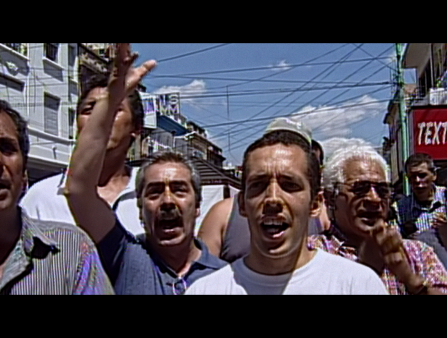
Television cannot help but flatten everything like a meat grinder, blurring faces and identities into a single, manageable euphemistic phrase (“the people”), but Gallo insists on showing us how the tools of cinema can help tear those images apart. If the revolution will, in fact, be televised, it will do so by seeking out the weight of difference that makes a face irreducible to the crowd it belongs to. Through its editing, December presents a recomposition of the crowd on- and off-screen, engaging with specific audiences who try to imagine a mediated collectivity while still remaining individuals, brought together by injustice and precariousness, whether on the streets or in a movie theater.
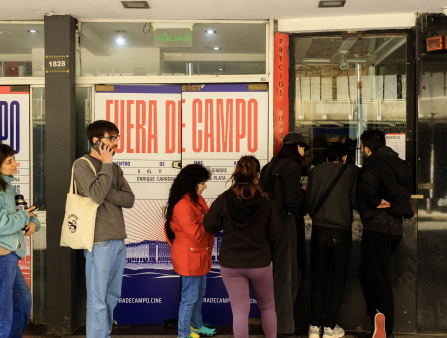
Although December had its world premiere at IDFA late last year, Gallo screened an earlier cut in Buenos Aires in November 2025 under rather unusual circumstances. The screening was part of Fuera de Campo, a political initiative committed to showcasing Argentine cinema—entering its second year—which aims to nurture a new kind of national moviegoing audience. To screen a film about 2001 in 2025, in a country where the same economic logic is once again being applied to the same people, is to feel history as a live wire. When Domingo Cavallo, the economy minister responsible for the 10 years of debacle that went into frozen bank accounts, appeared on screen, you could hear the surreptitious “hijo de puta” comments and you would find yourself expecting them. When the mounted police charged at the Abuelas de Plaza de Mayo, the women who pioneered the fight for human rights in Argentina by seeking to identify the children who were abducted during the last civil-military dictatorship, the silence that followed was the kind that takes up space.
Fuera de Campo is organized by a self-convened, unpaid collective of directors, producers, critics, programmers, and film technicians to which I am proud to belong. [Editor’s note: The author will represent Fuera de Campo on a panel at Getting Real ’26.] It emerged in 2024 in direct response to the dismantling of the INCAA (the National Institute of Cinema and Audiovisual Arts) under Javier Milei’s administration. The new controller of the entity, Carlos Pirovano, a businessman, took office by implementing structural changes driven by the redefinition of cinema as a market failure rather than a public good: 600 layoffs, halted funding, and the perceived erosion of the work, prestige, and independence of the Mar del Plata International Film Festival. For decades, Mar del Plata’s festival was the largest showcase for Argentine cinema and Latin America’s only Class A festival, and even as its budget shrank year after year, it stayed afloat thanks to the efforts of workers who remained faithful to the principle of cultivating critical and independent viewers. But since 2024, as its mandate shifted toward screening films that conformed to market logic, forcing all veteran workers to resign, Mar del Plata has seen its shine all but disappear. Last year, the festival drew a total of 9,000 attendees (compare that to the crowds of 150,000 it had gathered just a few years earlier).
Fuera de Campo. Photos by Sofía Martín. Courtesy of La Pobladora Cine/Nevada Cine
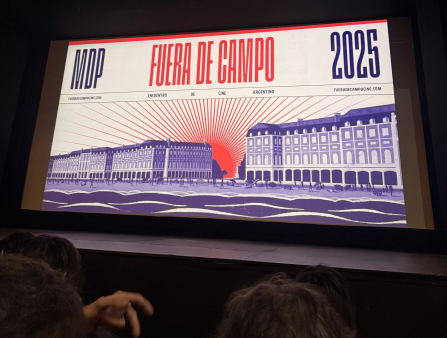
Against that context, Fuera de Campo believes the relationship between Argentine cinema and Argentine viewers has not been irrevocably broken—just briefly interrupted. That’s why the collective’s programming decisions were related to the terms in which the Milei administration chose to frame the debate against Argentine cinema. When the government moved to suspend all state support for the INCAA in early 2024, its Human Capital Ministry issued an official statement declaring that “the time when film festivals were financed with the hunger of thousands of children is over.”
The sentence did its work. It recast public film funding not as cultural policy—let alone as an economic one—but as a moral obscenity: money stolen from the poor and handed to a privileged caste of filmmakers making movies nobody watched. The accusation landed quite effectively in a country with a 50 percent poverty rate. What it omitted was that the INCAA is funded not by the general budget but by a self-sustaining system of levies on cinema tickets and broadcasting—and that, according to the industry’s own studies (EAN), every peso withheld from film production costs the Argentine economy 5.4 pesos in lost output and destroys thousands of jobs, the majority of them outside the audiovisual sector entirely. December, in fact, is one of approximately 200 projects that were initially approved for public funding but were canceled following Pirovano’s appointment (Gallo’s project was rescued by two Uruguayan funds, the Minority Coproduction Fund and the Minority Postproduction Fund, both administered by ACAU). The surplus the INCAA proudly accumulated under Pirovano was not savings. It was, in part, being invested in Treasury bonds. The children’s hunger remained. The films were neither made nor watched—unless, as in December’s case, they were rescued by other forces.
At only one venue, with 300 seats, no institutional infrastructure, and in almost half the time of Mar del Plata, Fuera de Campo gathered 6,000 spectators and created space for convening and conversation. During the Fuera de Campo talks—which took place every morning in a small bookstore that quickly transformed into gatherings of 100 to 200 people, some standing on the stairs just to hear—there were raised hands offering strong self-criticism, not only regarding the way films had been financed all these years, but also regarding the fact that the majority of Argentina’s population remains unwilling to defend the films that represent them more vigorously. Of INCAA’s three funding pillars—promotion, distribution, and preservation—the first always received the lion’s share of the budget; the neglect of distribution, in particular, has resulted in a public that feels disconnected from the national cinema it seeks to represent. Fuera de Campo gathered a small crowd—much like those who today fill the streets of Argentina’s major cities week after week, protesting against the government’s dehumanizing policies—that aimed to think closely and collectively about the power of what Argentine cinema is and could be. As a striking truck driver who blocked the highway in December says, “All we have is stubbornness.”
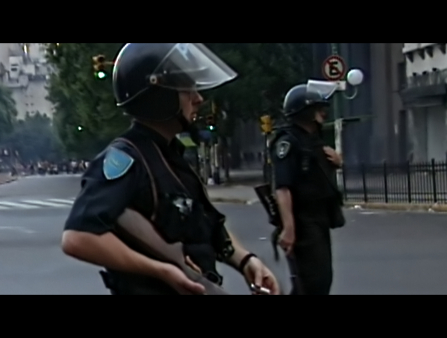
December is awash in scenes of crowds.
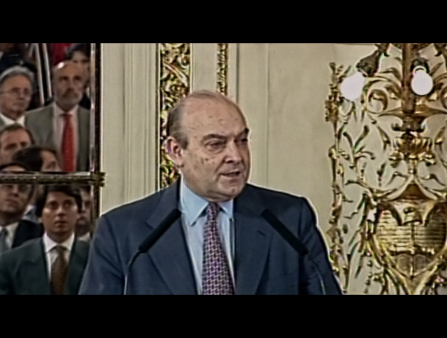
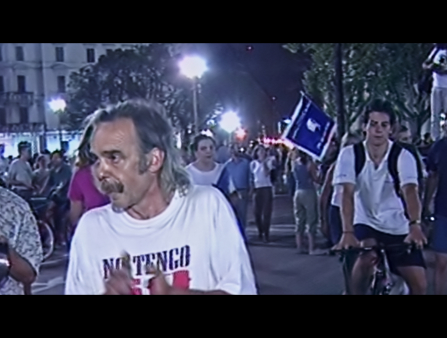
Gallo uses television to push back against notions of the indivisible crowd.
To watch December at Fuera de Campo was to understand that Gallo’s film was not being received as history. It was being received not only as a warning but mostly as a mirror, because it involves watching footage about one crisis in the midst of another crisis, and the way those images are arranged and perceived reminds us that the economy is not just a bunch of words bluffed out by a couple of guys in suits, but a tangible reality. Cracks have a trickle-down effect. Untouchable numbers can be real people.
After the scene of the sinkhole opened by the truck, the editing strikes like an axe blow to a conversation in an office between a man holding a walkie-talkie and a man pointing a rifle up at his own face. Gallo zooms in on how close the walkie-talkie is to the armed man and, pixelated as it is, how the man’s own lower lip caresses the rifle. As he talks and moves the rifle, the camera also wobbles. “After having exhausted every possible way to ask for help, I don’t think I need it anymore” are the last words of the man as we leave him behind, without seeing whether he pulls the trigger.
While some may know what happened next, it’s a cue to the shared collective memory that Gallo is drawing on. Including the suicide of Matías Bello at the office of the mayor of Tandil—a single man, a single act of desperation—in the first five minutes of the film before the crowds, the strikes, the bonfires, is what sets up a premise that will guide the images Gallo selected when he delved into the archives of Crónica TV, a channel whose slogan was “Standing with the people.” They had moved away from the static nature of studio television and tried to keep pace with the speed of events on the street with reporters’ microphones in hand, approaching passersby, migrants, looters, picketers, metalworkers, teachers, and retirees. The working cameramen who shot this footage made images without getting names, designed only to register, not to last.
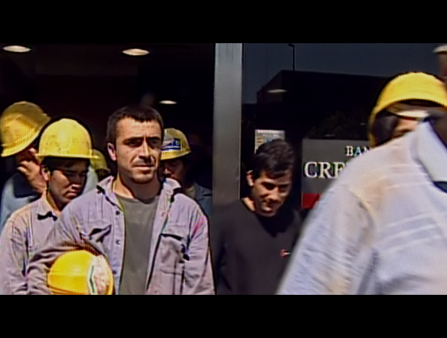
December is awash in scenes of crowds. But the film observes them closely, rearranging and singling them out through montage, allowing faces to bloom from those very same unmediated crowds. At one point, we see a shot of workers wearing hard hats and work clothes leaving the bank, having failed to collect what is owed to them. They don’t come out one by one, but rather in groups of three or four, and as the door lets them through, they don’t miss the chance to acknowledge the camera by briefly waving at it or making gestures of defiance: a clenched fist raised high, a rolled-up newspaper thudding against a palm.
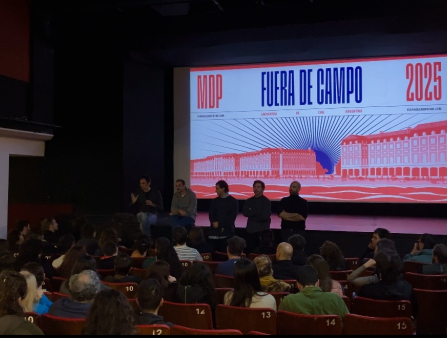
December screening at Fuera de Campo. (L to R) Director Lucas Gallo with producers Sebastián Muro, Andy Sala, and Alex Piperno. Photo credit: Sofía Martín. Courtesy of La Pobladora/Cine Nevada Cine
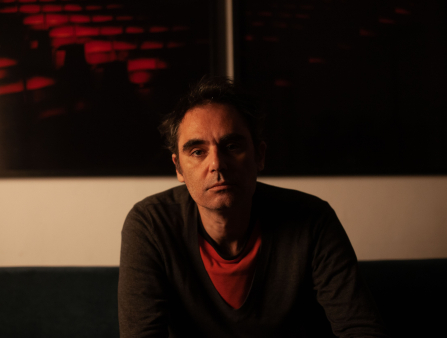
Lucas Gallo. Photo credit: Paulo Fast
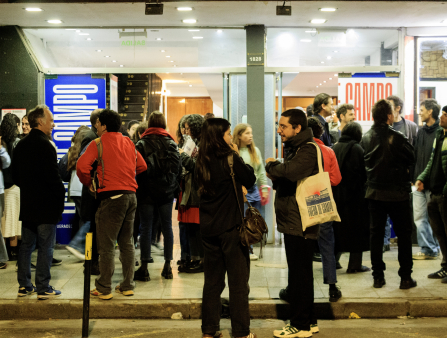
Fuera de Campo. Photo credit: Sofía Martín. Courtesy of La Pobladora Cine/Nevada Cine
In his eagerness to be a sort of second cameraman, Gallo zooms in and reframes gestures the Crónica TV cameramen were unwittingly capturing, erasing the mediation between the people and the camera, keeping microphones and reporters off-screen. This not only destroys the 4:3 aspect ratio, a stoic hallmark of television, but inevitably brings us closer to the faces, allowing “the people” to transform themselves into individual carriers of the economic crisis.
In constant dialogue with, yet utterly unlike the workers with whom the Lumière brothers pioneered cinema, these workers know that they are being recorded, even as we watch their faces unfold before us. The same happens when the camera pans across multitudes of piqueteros blocking the roads, preventing anyone from passing. The scenes of police brutality don’t dwell on the blows but rather follow with the camera as someone is taken into custody, managing to state their name and ID number, just as others did during the dictatorship. Those taken away shout fragments of their story, keep complaining, and comfort those around them. They are granted the dignity of a voice, even if it is one of fury and anger.
“People in that moment speak without certainty,” Gallo tells me, “mainly because they were in the middle of history.” What they were going through didn’t yet have a shape. His own experience of the catastrophe was shaped by distance: his family was living in Europe at the time of the crash, and he followed the crisis as a spectator, watching it unfold on television. Far from home, he recalls wanting to be there—and it is precisely that distance that allowed him to return later, to search for the images he had only retained as memory.
For Gallo, working with archival footage carries something almost ritualistic, a way of turning the tools of power against themselves, of extracting something useful from a medium he simultaneously resents. To use television against itself became the guiding logic of every editorial decision he made. “But I wasn’t really interested in revisiting what the media thought,” he says, a statement that brings to a close the chapter he began with his first film, 1982 (2019), which examines the national media’s coverage of the Guerra de las Malvinas (the Falklands War). “I didn’t have a thesis to prove.” The fact that he wasn’t there, that his relationship to these events was always mediated by a screen, might, for some, disqualify him from recounting what happened or handling that archive. Yet it may be precisely his position as a viewer, rather than a witness, that enables him to see more in those Crónica TV outtakes. Perhaps only someone who was never there could bring himself to destroy them.
Television, by nature of its flow and its referential function, treats faces as interchangeable units of a larger event. On the contrary, cinema has always known how to privilege faces amidst a crowd. In December, the editing sustains the hypothesis of a communal portrait while still preserving a sense of individuality among those participating: reframing dissolves the mass into singular presences, while the cut recomposes them into a shared historical experience.
In December, the editing sustains the hypothesis of a communal portrait while still preserving a sense of individuality among those participating: reframing dissolves the mass into singular presences, while the cut recomposes them into a shared historical experience.
In Crowds and Power (1960), Elías Canetti wrote that the discharge, the central event of any crowd, is “the moment when all who belong to the crowd get rid of their differences and feel equal.” It is a useful category for reading what Gallo’s film captures: a country mid-discharge, the moment when rank, status, and property have been swept aside not by solidarity but by shared catastrophe. The crowd in the streets consists of people who have been made equal by loss. But Canetti also warns that the discharge is an illusion: those who feel equal have not really become so, and will eventually return to their separate houses, their own beds, their possessions, and their names.
The editing of the sound throughout December performs this contradiction. Voices gathered in the heat of the riot and voices recorded at other moments are collapsed into a single present—the film makes us feel that everything is happening at once, that the mass speaks with one breath. They seem united by the slogan “All should leave!” the rallying cry of the 2001 uprising against the political class. But when given the chance to speak, the “me” finds its way into their words: “myself,” “my family,” “my business,” “my job.” The voices do not always correspond to the faces of those speaking; they float, begin as part of someone at a microphone, and are superimposed over images of riots, looting, and police brutality. The sound editing reproduces the logic of the discharge—and then, quietly, undoes it. One face, one voice, one loss at a time. What is lost in the crowd does not stay on screen. It extends into the conditions under which these images are seen—or not seen at all. The crowd, in other words, is not only in the archive. It is also in the theater, or in its absence.
The decision to have December open Fuera de Campo had as much to do with the exquisite way it captures an emotional landscape as with the fact that no other film of its kind so comprehensively addressed the precarious circumstances to which the Argentine people are subjected, both materially and discursively. What links the government on the screen and the one in power today is not only economic logic, but also the way they both address “the people” as a single, manageable phrase, deaf to particular circumstances. It is also a shared failure of attention to the face, the name, the loss that December insists on restoring to the frame, one body at a time, even as those bodies move together through the streets.
Although the subject of December did not cause its loss of funding, it is an example of a kind of filmmaking that poses a genuine risk to a government that views cinema as nothing more than comfortable entertainment; a way of crafting that desperately seeks to take root in the eyes of those who perceive it as part of their own history. As of this writing, December has yet to have a theatrical release date confirmed in Argentina. The Gaumont Theater, required by law to premiere Argentine films, now screens only Oscar contenders and foreign streaming releases. Gallo’s film lives, for now at least, in the memories of those who watched it at Fuera de Campo, at IDFA, or via a pirated link. If years go by, it may come up at a bar table, somewhere in a conversation about 2001, or 2025, or the next time the ground gives way. But what that viewer will be remembering is not a crisis. It is a specific person—a metalworker, a retiree, a picketer—caught midsentence by a camera that wasn’t looking for them, pulled from the footage by a filmmaker who was. One loss, one face, understood not as something that stands out from the crowd as one, but as something that finds its own uniqueness precisely because it is part of something larger than itself.
This piece was first published in Documentary’s Summer 2026 issue.