

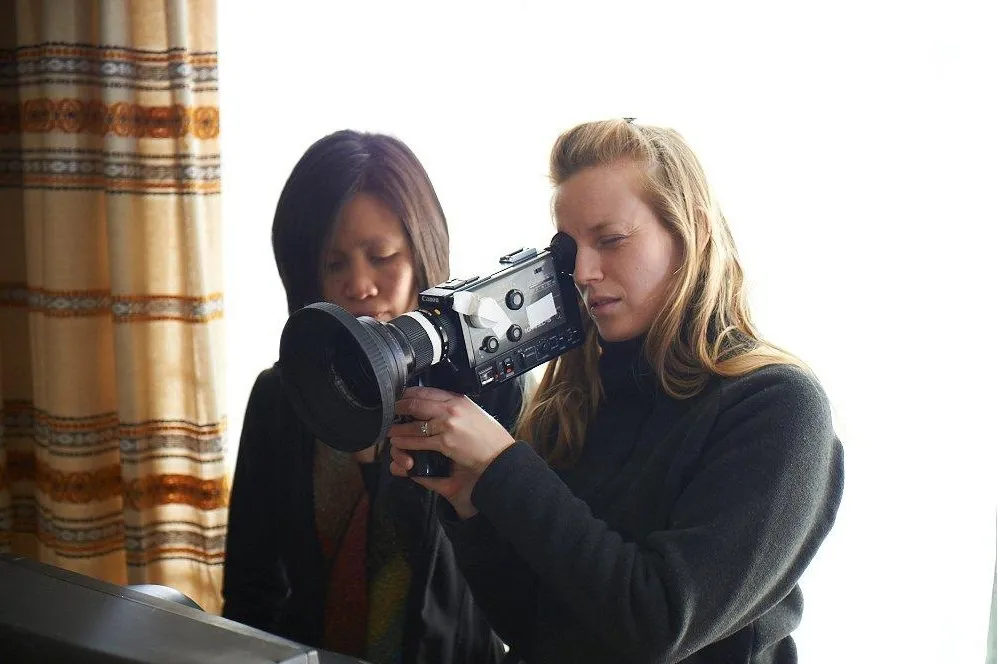
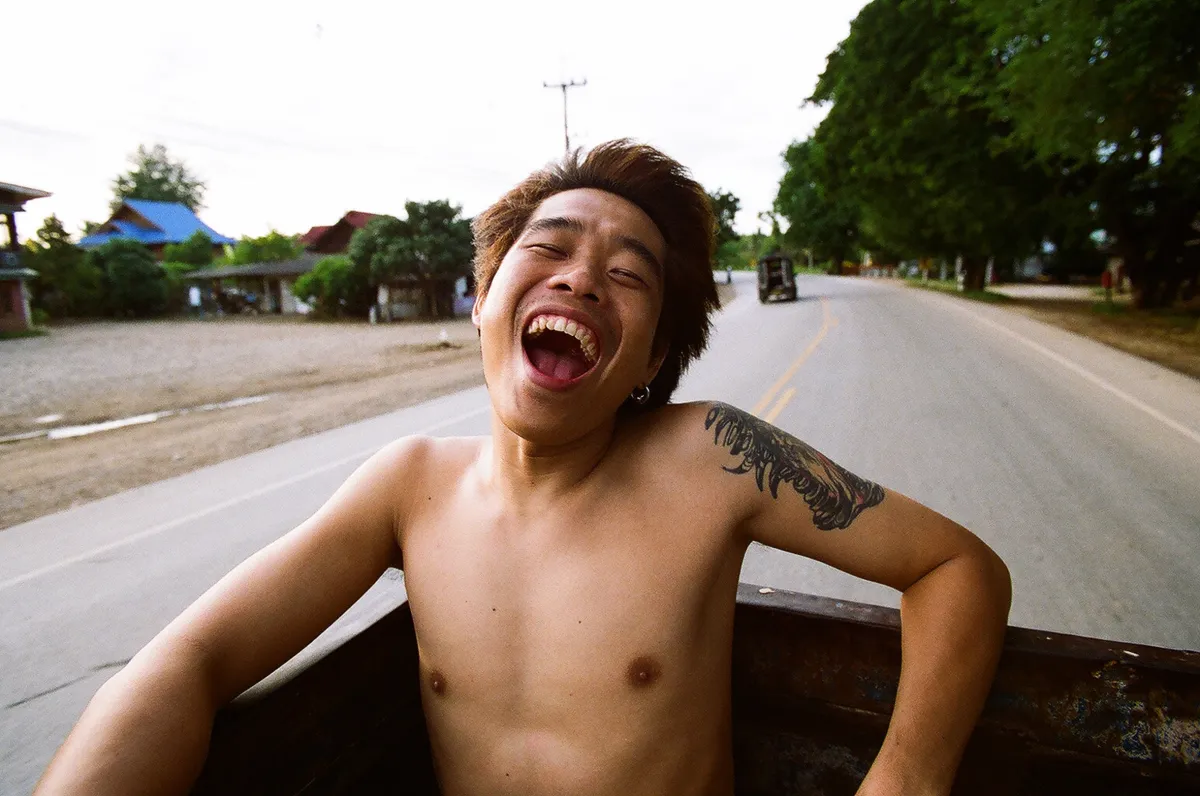
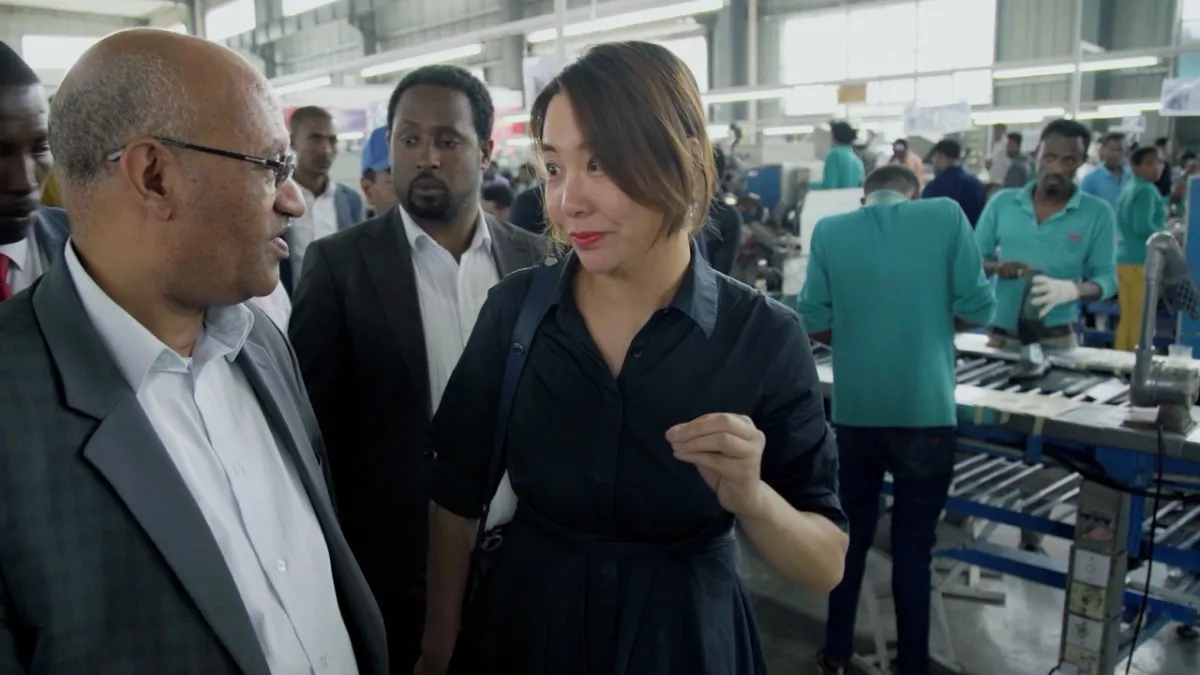
Image credit: Max Duncan. Courtesy of Hard Truth Films
In Made in Ethiopia, filmmakers Xinyan Yu and Max Duncan tackle a topical behemoth through the intimate lens of three women on the precipice of change. The documentary closely follows Beti, a factory worker struggling with the demands of her job; Motto, a manager navigating the complexities of overseeing workers; and Workinesh, a farmer whose way of life is threatened by impending change. Through their eyes, we see the daily operations of factories, the cultural exchanges and tensions between Ethiopian workers and Chinese management, and the broader implications of foreign investment in the region. The film intimately documents how an industrial park impacts their lives, families, and communities, providing a multi-layered look at globalization and economic development. An IDA Enterprise Documentary Fund Grantee, Made in Ethiopia investigates modes of urbanization without offering a neat moral resolution. Instead, it invites viewers to consider subjects who are seldom granted agency and dimension in Western depictions.
Made in Ethiopia explores the complexities of the characters’ search for prosperity, while also reflecting the filmmakers’ own quest for balance in telling a nuanced story. In a conversation with Documentary, directors Yu and Duncan discuss how they navigated these challenges. The film embraces complexity as a strength, offering a multifaceted view of the impacts of modern economic development. It powerfully captures the emotional toll of colonial legacies disguised as progress, showcasing the privilege of immersive storytelling that includes diverse perspectives.
Documentary spoke to Yu and Duncan—longtime collaborators who met working at the BBC in Beijing, China—on the tail end of a hectic festival run that began at Tribeca 2024. Made in Ethiopia will next be broadcast on PBS via POV on July 14. The co-directors discussed their collaboration, how their shared journalistic background shaped the story, and the process of discovering the emotional threads that connect seemingly disparate lives. This interview has been edited for length and clarity.
DOCUMENTARY: How do you think your backgrounds in journalism impacted the way this film was made?
MAX DUNCAN: There are a couple of ways that a journalistic background affected the way that I thought about balance in the film. One of them is that accuracy, balance, fairness, and hearing different sides of the story are a fundamental part of good journalism. That was ingrained into my practice. I started working at a news agency, Reuters, and there you couldn’t really put something out if you didn’t have the other side of the story. That said, I think in the time that I worked in China, we did see so many stories that seemed simplistic. People have a tendency to go for David and Goliath narratives, hero and villain. What I saw was that the complexities of industrialization are both good and bad, both positive and often very painful. The great thing about documentary is that you have a platform to be able to look at all of the complexities of a situation.
XINYAN YU: There are many aspects of the film that need a balancing act. I think the way that we approached the story—emotional truth versus factual truth—is such a delicate dance. Do you focus on the more epic narrative with its very abstract topics? How do you ground them? We have these two very rich, complex cultures that are involved—how do we balance the perspectives of both?
D: And the balance between literality and ambiguity.
XY: That was the beauty of the film: the ambiguity and the gray area. We were constantly asking ourselves if we were over-explaining. Sometimes you have to give people a handle to hang on to when they’re looking at certain facts.
MD: We had a lot of different voices pulling us in different directions. We were lucky to have such a long period to edit, because I think we came to our own sense of what needed to be told, and what didn’t need to be told. Looking back on it, I’m actually really impressed with the amount of stuff we got into a film that had to deliver basic information to an audience, and introduce characters and multiple themes.
D: With all the film packs in, how do you find the emotional thread and which stories to follow?
XY: We were driven by curiosity, like all journalists are. Ethiopia is a very unique place, and a lot of people kind of compare it to China two to three decades ago. How do you lift your country out of poverty? It’s a real question that the entire Global South is asking. China provides a blueprint for a possible pathway—one at the expense of environmental degradation, and an entire generation of Chinese people working 30 years in a factory. People like my parents.
With that curiosity, we went to Ethiopia and saw a diversity of people. In the end, we were really excited by Motto. Her drive was very infectious, and she kind of embodies an abstract Chinese development philosophy: You have to put a generation of people to work first, so that your next generation can enjoy the fruit of their labor. We also noticed that the majority of the workers were very young Ethiopian women. They come from remote places, usually poverty-stricken and war torn, in search of prosperity. In a way they share Motto’s vision, as a part of that generation that’s being put to work. They hope that maybe this will change the course of their lives. They embody the tension, the hope, the despair that was going on.
MD: One interesting thing about the emotional development of the story and the arc is that we [started filming] at a time when everything was very positive. Ethiopia was growing very fast. There was so much enthusiasm, and a lot of hope. What we witnessed between 2019 to 2023 was going from hope to real disappointment.
The protagonists are very different people, but they’re united by this desire to better their lives. It was also interesting to see how they reflected off each other in that process. If you look at Workinesh and Motto, for example, one is a very successful mother who’s left her daughter 10,000 miles away, in China. And the other one is a woman who keeps her daughter very close to her. Both of them are providing for their daughters in very different ways. In that reflection and the contrast, people start to naturally think about these big questions, “Why do we work? Who do we work for?” As we started to put these stories together, the emotional threads that bind them together started to kind of come out.
D: Can you discuss some of the implications of working together as co-directors and introducing multiple perspectives?
XY: I don’t think we realized the implications when we first started. I think in our case it worked out really well, because we have very different personalities. It benefited the project a lot. The fundraising process was so difficult, that I cannot imagine doing it [without each other]. The reality of the industry is that if you’re just by yourself, it’s really hard to get started. I’ve heard stories of how people have fallen out after the production finishes—it’s very common to have creative differences. But I think in our case, it worked really, really well.
MD: I think there’s always compromise, especially when it comes to the edit. But our overall responses tended to be quite aligned. We have quite a lot of overlapping skills which I thought might be a problem. But it’s actually great having two people shooting. Being able to both be flexible, both be able to do a bit of editing, both be able to plan and produce.
D: What are you hoping that audiences take away from the documentary?
MD: In the end, the film is looking at modes of development: what is the development model that society wants to choose? We’re not saying that development or industrialization or urbanization is bad. The important thing is that you do it right. It’s really important that in that process, it’s not just the people at the top who are winning, but the people right down the bottom as well.
XY: It’s asking, “What does it take to progress? What does it take to have prosperity? What do you leave behind when you reach prosperity? What does prosperity even mean, to different people?” It’s not a call to action film, it’s more introducing the idea that people’s choices, and a country’s choices, can be very complex and multilayered. We want to encourage debates, especially in the U.S. where policymakers and media tend to portray China and Africa and its people in a very flat image. I hope that audiences see that people make complex choices, and the image of these countries is not black and white.
Pola Pucheta is a writer from New York living and working in Barcelona. Her work explores themes of emotional connectivity, resilience, and healing.