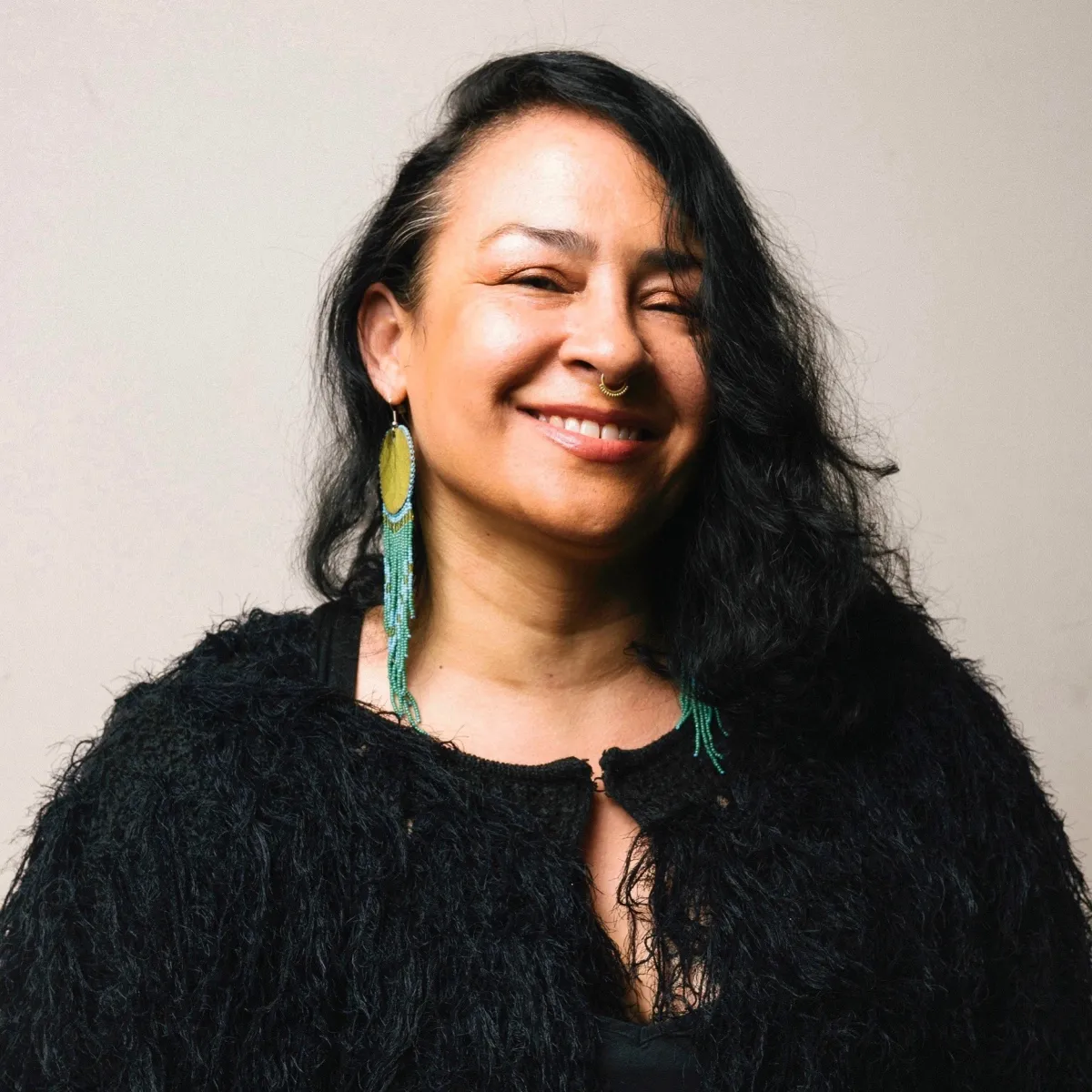
Tracy Rector by Zorn B. Tracy is smiling with medium-length wavy dark brown hair and grey at the temples, beaded leather earrings from a Ghanaian artist, a gold septum piercing, a flowing black wrap, brown skin, brown eyes, and a smile.
Tracy Rector is a mixed heritage filmmaker rooted in the lands of Turtle Island, where her heart is in rhythm with the stories of Indigenous, Black, Communities of Color, and Queer peoples whose voices have long been overlooked. For nearly forty years, she has moved between worlds—as a community organizer, educator, filmmaker, curator, and student of plant medicine wisdom—crafting in collaboration with many on more than 500 films that breathe life into stories of resilience, beauty, and transformation.
Her work moves across screens from Independent Lens to ImagineNative, from PBS to National Geographic, and has graced stages at Sundance, Cannes, and Toronto. Beyond the camera, Tracy spends time on art and justice as a former Seattle Arts Commissioner and through her leadership with Working Films, Multitude Films, the Harvard Kennedy School Advisory Council, and as a co-founder of 4th World Media.
In all she does, Tracy carries a sacred commitment: to uplift collective creativity, nurture social justice, and honor the ever-evolving tapestry of culture and community. She travels the world with curiosity, design, and a deep devotion to the arts and activism that shape our shared future.
IDA: Please tell us a little about yourself and your passions.
Tracy Rector: I was raised in the Pacific Northwest by young, chaotic, alcoholic parents. A lot of my early life was shaped by solitude and a small screen; a black-and-white TV with a foil-wrapped antenna pulling in Star Trek, Wonder Woman, SNL, The Twilight Zone, and old B&W 1940s-1960s films. That’s where I learned to watch closely. To listen between the lines. That’s where my love for storytelling—and for justice—began.
Those early years shaped me into an observer, a reader, and eventually a creative. Over the last 40 years, I’ve tried, despite all my imperfections and mistakes, to stay in service to the community through art, storytelling, and cultural work. My focus has often been on Indigenous sovereignty, Black liberation, social justice, civic engagement, and environmental stewardship.
I believe in art as a tool for remembering, imagining, and building. And I hold onto the hope that my children will feel free to be fully themselves, and that they, too, will find meaningful ways to give back to community and the Earth through whatever paths they choose
IDA: You have been an incredible and inspiring leader for many of us in the documentary community. I would love to know when you first started working in the field.?
TR: Thank you for your kind words, Anisa.
I began volunteering and organizing in Seattle nearly 40 years ago, working with both the Atlantic Street Center and Daybreak Star Cultural Center.
My path into filmmaking began with Dr. Gilda Sheppard, my first media instructor at The Evergreen State College, where we explored the impact of media on communities of color living with HIV and AIDS. That experience deepened my commitment to storytelling as a tool for truth in history, healing, and justice.
Not long after, I found myself tending the garden of Skokomish elder Bruce “subiyay” Miller. Knowing my passion for education and working with youth, he introduced me to producer Katie Jennings, who was making a film about his teachings called Teachings of the Tree People (2006). He asked me to intern on the project so I could learn the craft of storytelling firsthand. I fell in love with the process. It was a deep honor to listen closely, hold someone’s story with care, and work hard to represent their voice and vision with their guidance.
That experience led me to graduate studies at the Muckleshoot Tribal College through Antioch University, and in 2005, I co-founded Longhouse Media with Annie Silverstein. Around the same time, I began collaborating with the Seattle International Film Festival as a programmer and curator, where I still volunteer to this day.
It’s been a beautiful, scary, and wild ride, only made possible through the strength and support of many, many people and communities.
IDA: Throughout your career, you have directed and produced over 400 films while wearing many hats. Do you have any advice for young folks entering the industry or emerging filmmakers who are eager to tell their stories?
TR: Follow your passion. Allow yourself to make mistakes, but just commit to learning from them and doing better next time. I’ve learned that some of the most powerful lessons, live in the hardest or most unexpected moments. Also, remember what goes up will always go down and vice versa, a la the tarot card, Wheel of Fortune!
Personally, I try to show up on time, be impeccable with my word even if it takes extra effort or time, move through the world with compassion, be courageous, ask for help when I need it, and always bring others with me through the doors of opportunity.
What I’ve witnessed, time and again, is that those who flourish are the ones who persist despite the odds. They honor their unique creative vision, follow through on their commitments, have healthy boundaries, and stay open to growth. It’s not about perfection, it’s about progress, presence, purpose, and perseverance. This is the true medicine found in the effort and journey.
IDA: What draws you to films and filmmakers you work with and support?
TR: Over the past 25 years of filmmaking, my deepest commitment has been to those historically excluded from the tools and platforms of storytelling — particularly Indigenous, Black, People of Color, Queer, and Trans communities, with special awareness and solidarity for underrepresented creatives. I believe that everyone holds stories worthy of being told, but not everyone has had access to the resources, support, or visibility to tell them. That imbalance is something I’ve worked to shift throughout my entire career.
About a decade ago, I reached a turning point. As someone of deeply mixed heritage and multicultural identity, I began to reflect more intentionally on what it meant to hold space in both creative and community-centered environments. I understood that my responsibility wasn’t just to tell stories, but to help support and create pathways for others to tell theirs. I chose to center my role as one of service and advocacy, to use my skills, access, and platforms to support others in sharing their truths and narratives with power and dignity.
This decision continues to guide how I move through the world — as a filmmaker, educator, advocate, curator, and collaborator. For me, the work is about listening deeply, making room for complexity, and investing in a future where a wider range of voices can be heard, seen, and celebrated through solidarity and action.
“It is our duty to fight for our freedom. It is our duty to win.
We must love each other and support each other. We have nothing to lose but our chains.”
- Assata Shakur, Freedom Fighter, Author
IDA: Enchukunoto (The Return), which you produced, was one of the 2024 IDA Documentary Awards nominees in the short category. Can you please tell us a little about the film?
TR: In December 2019, I traveled to Kenya for the first time and had the incredible opportunity to visit Maasai Peoples in the north. During a community gathering, our host introduced me to his daughter, Laissa, who shared her dream of becoming a filmmaker. We stayed in touch after that meeting, and when a project opportunity arose in Kenya, I reached out to Laissa to see if she wanted to collaborate and direct the film. She enthusiastically agreed.
The result of our collaboration, along with lead producer Kavita Pillay, is Enchukunoto (The Return) (2024), a story that reflects Laissa’s vision and voice, rooted deeply in her community’s experiences and perspectives.
As the first female Maasai filmmaker, Laissa Malih initially set out to document the land-based practices of her ancestors and the ways climate change is reshaping Maasai communities. Returning to the IL-Laikipiak Maasai village that her parents left when she was a child. Malih experienced a profound epiphany: her own life reflects the complex challenges between Maasai youth and elders, women and men, and the tension between ancestral knowledge and modern education.
In Enchukunoto, Laissa’s unique perspective challenges the familiar portrayals of the Maasai people long seen through the eyes of tourists and outsiders. “Many tourists come to our Maa lands to film the lions, the gazelles,” she reflects. “The camera takes and takes. I wonder what my camera can give my people in return?”
Blending vérité filmmaking with her personal insights, she offers a rarely seen viewpoint—as both insider and outsider, a woman among men, and a filmmaker carrying forward sacred Maasai storytelling traditions in a world marked by uncertainty.
IDA: What is next for you? Are you working on anything you can share with us?
TR: My life feels like it’s at a crossroads right now, shaped by the current political climate and the realities we face. Yet, this year, I’m excited to support the distribution of several powerful films: Remaining Native (2025), Drowned Land (2025), She Cried That Day (2025), Thin Places (2025), and Waska: The Forest is My Family (2025). I’m also really happy to partner with Princess Daazhraii Johnson and her team on a feature documentary about sled dogs in Alaska, due out in 2027/2028.
In addition, I’m proud of the work we’re doing through our podcast Sonic Journeys, produced at 4th World Media with Co-Director Stina Hamlin, and our fellowship initiatives—including the 10-year-old 4th World Media Lab and Indigenous Cinema Alliance Fellowship, plus our newest program, PORTAL, which supports creatives of color interested in post-production. Lastly, I’m honored to be assisting with a new art installation guided by Amplifier Art, out this fall.
Ultimately, it’s a time of challenge and opportunity, and I’m deeply grateful to be part of such meaningful work. I also want to honor all the artists and creatives who are bravely speaking up for justice during these times. Every cell in my DNA resonates with the work of antiracism, anti-oppression, and anti-homophobia, carried alongside a deep care for community and Mother Earth.