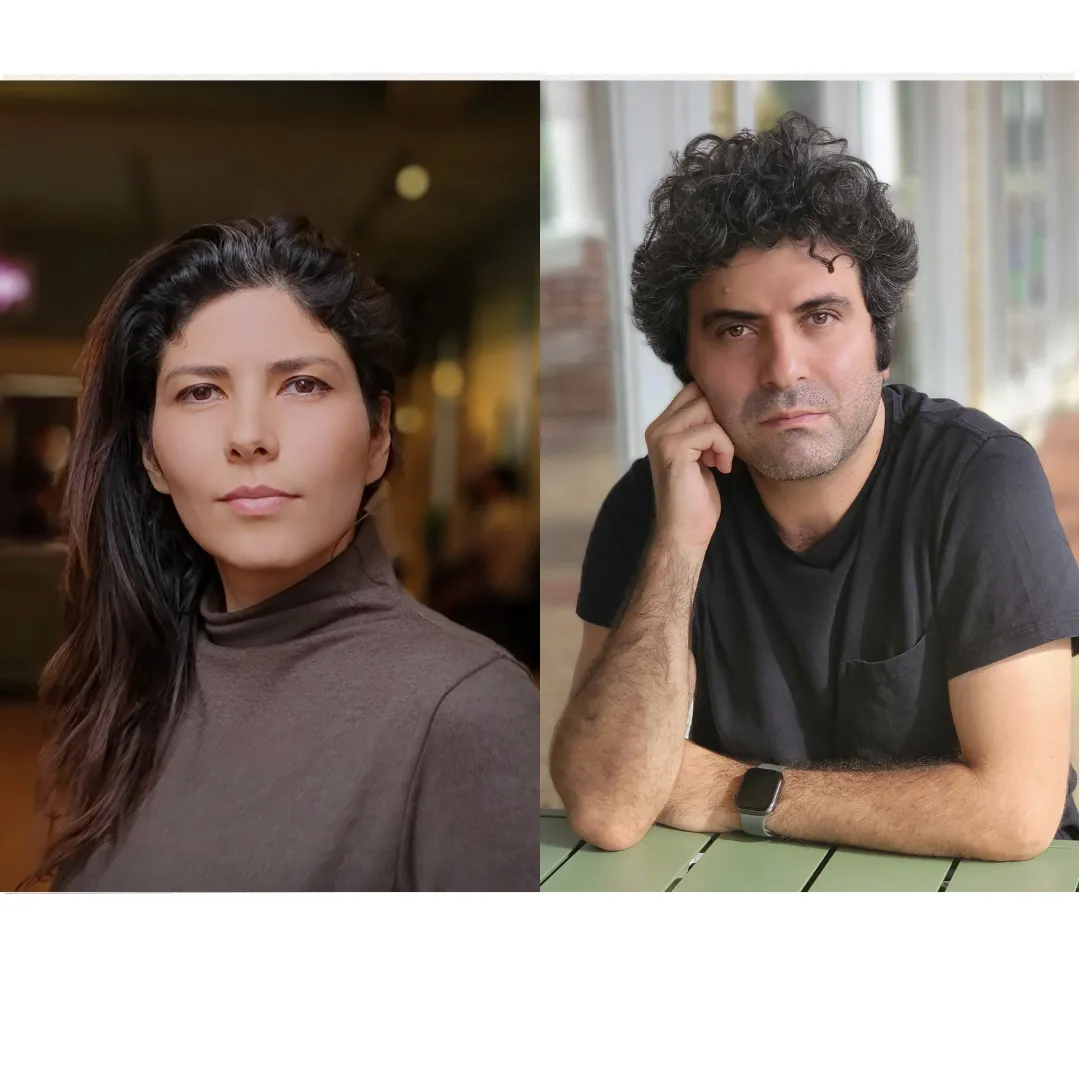
(LT to RT) Sara Khaki & Mohammadreza Eyni
Sara Khaki is a documentary director, producer, and editor dedicated to telling stories that promote gender equity. She is a Sundance Film Festival Grand Jury Award winner, World Cinema Documentary and Visions Du Reél Audience Award winner for her feature documentary Cutting Through Rocks, which follows the first elected councilwoman of a rural Iranian village. The film has been called “a deftly shaped work of cinematic nonfiction” by Indiewire and “one of those profound vérité documentaries that are only possible through the patience and perseverance of the filmmakers” by POV Magazine.
Her short film, Our Iranian Lockdown, is now streaming on The Guardian and has received an IDA Awards nomination. Sara co-directed Netflix Original Convergence: Courage in a Crisis, which was nominated for an Emmy for Outstanding Current Affairs Film. Sara graduated from the University of Maryland, Baltimore, with a BFA in Cinematic Arts and from the School of Visual Arts with an MFA in Social Documentary Filmmaking. A grantee of the Sundance Film Institute, Chicken & Egg Films, and Firelight Media, Sara’s work continues to amplify change on gender equity through the cinéma vérité form.
Mohammadreza Eyni is a director, producer, and cinematographer whose career and cinematic approach aim to bridge boundaries, elevate underrepresented voices, and connect diverse perspectives globally. He is a 2025 Sundance Film Festival Grand Jury Award winner in the World Documentary competition for his feature documentary, Cutting Through Rocks, which has become an audience favorite at Sydney, Hot Docs, Visions Du Réel international film festivals, among others. His cinematic approach has been heralded as “uniquely propulsive,” “practically magical” (Variety) and “precisely lensed” (Indiewire) as well as “delivering simple moments into cinematic poetry” (Hammer to Nail). He was named as one of the top five cinematographers to watch at Sundance in 2025.
His intimate short film Our Iranian Lockdown, streaming on The Guardian, has received an IDA Awards nomination. His co-directed Netflix Original, Convergence: Courage in a Crisis, was nominated for an Emmy for Outstanding Current Affairs Film. Mohammadreza has been supported by Sundance Institute, IDFA Bertha Foundation, Hot Docs Cross Current Doc Fund, among others. He is a Tribeca Film Institute alumnus and graduated with an MFA in cinema from Tehran University of Fine Arts.
IDA: To start, could you each share a bit about yourselves, your background, your profession, or what drives your passion for storytelling?
Mohammadreza Eyni: I’m from the Azeri-Turkish speaking community in the region where Cutting Through Rocks takes place. About 30% of Iranians speak Azeri-Turkish, yet stories from this community are rarely represented on screen. I always wanted to make a film about my community and the untold stories I grew up witnessing. However, as a male director, because of the patriarchal nature of the society, I was not able to gain access. Partnering with Sara Khaki made this possible. Our collaboration opened doors and deepened the story in ways I couldn’t achieve alone.
Sara Khaki: I have now lived equally between Iran and the States. Growing up in Iran, I witnessed countless resilient women fighting for their independence. Later, when I moved to the United States as a teenager, I realized gender equity is an unfinished project virtually everywhere, and that its mechanisms take many forms. When I first learned about Sara Shahverdi — a former midwife who delivered over 400 children and rode motorcycles in a community where that was taboo — I wanted to learn more.
What some viewers may not understand is that Iran is very diverse, with Fars, Kurdish, Lurish, Arab, and Turkish communities, each with different layers of cultural norms around women. In our protagonist’s native Zanjan Province, gender segregation can be especially strict. That made her presence and the way she bridges the gap between men and women in public life even more striking.
IDA: Congratulations on Cutting Through Rocks (2025). Since its award-winning premiere at Sundance earlier this year, it’s been incredible to watch its continued success. For those in our community who might be discovering it for the first time, can you share what the film is about and what inspired it?
SK: Our film follows Sara Shahverdi — a divorced, motorcycle-riding former midwife — as she becomes the first woman ever elected to the local council in her conservative Iranian village. When her bold efforts toward gender equity trigger backlash and raise doubts about her intentions, Shahverdi is forced to confront not only her critics but also her own understanding of who she is.
IDA: Sara Shahverdi is such a magnetic presence on screen, and her journey is deeply moving. How did your relationship with her begin, and what made you want to tell her story?
SK: I came across Sara Shahverdi’s story through extensive research. After months of phone calls, we built a relationship. Eventually, she shared that she was running for a council seat. That’s when I knew we needed to follow her on this journey — and that I needed Mohammadreza’s partnership to tell this story.
ME: Before filming, we spent time in the village building trust. We wanted a genuine connection before turning on the camera. Once Sara Shahverdi and her family welcomed us, we began filming.
SK: We began filming in 2017 and completed production across eight immersive production intervals over seven years, with our longest stretch lasting about three months. While our film follows one woman’s journey, it is also woven into a tapestry of social and cultural narratives. Gaining access to schools, courts, and other spaces took months of negotiation, and sometimes we were only permitted minutes to capture crucial moments.
IDA: What did your collaboration as co-directors look like?
SK: We constantly talked about what the story is and how we can tell it visually in an emotional way, while being patient to observe the progress in Shahverdi’s community and see the impact she’s aiming for. We had extensive conversations together before and after each shooting session, and after filming, we would reflect on the footage together.
ME: From the very beginning, we knew we were faced with a very complex story. Our challenge was to create a cinematic experience in a cohesive way, without compromising its deep layers. It was equally important to have a mutual understanding with our participants, and my daily practice involved walking the village and listening to stories before I ever turned my camera on.
During production, sometimes it was just the two of us: I would film, Sara Khaki would record sound, and with just a glance, we understood what the other wanted.
In the same way, we were patient during the production process; we wanted to patiently work through the edit without pushing ourselves for any specific deadline.
During the editing process, we both edited captured moments, separately, then swapped to refine each other’s cuts. It was a long, deliberate process, but it gave the film multiple perspectives.
SK: In the process of making this film, we got closer to one another and decided to be life partners as well.
IDA: Can you talk about the role of symbolism in the film?
SK: We always thought of the motorcycle as a character in itself. For us, the motorcycle was the symbol of freedom and resilience, and an inseparable element to Shahverdi and her story.
ME: We were very deliberate about cinematography. We never set out to simply capture “beautiful shots,” even though the setting was naturally striking. We didn’t want postcard images. For us, cinematography was about conveying emotion and dynamics, not aesthetics for their own sake.
I remember when I was a child, I grew up with the songs that my mom was always singing. They were the songs women used to sing while weaving carpets. It was a beautiful way for them to express their emotions in communities where women didn’t have a voice or weren’t very active in public. This was their way to express themselves, their hidden desires, and many beautiful feelings. It was interesting that those poems were so visual. I found myself listening to these songs and, in my mind, I would imagine visuals based on those poems.
I tried to use that same quality when we were making Cutting Through Rocks about the community I came from. It’s rare to find films coming from this community, so I felt it was also my responsibility to stay connected to its inheritance and literature and to translate them into the language of cinema.
SK: Another symbol I can think of is when one of the girls in the village, Fereshte, weaves a carpet that comes together throughout the film — it naturally became a motif as it was completed during production. In retrospect, it’s interesting that the image of the carpet that Fereshte is weaving aligned with the similar feeling of freedom that the motorcycle carries.
IDA: Why is telling this story now essential?
SK: This is a film that was made over eight years, involving a lot of risk-taking. At times, we thought we would never be able to finish. The issues in Cutting Through Rocks — gender equity, identity, bodily autonomy — remain urgent, not only in Iran but everywhere. In the US, debates around abortion and women’s rights echo Sara’s battles as her identity is questioned. Her story resonates across borders.
ME: The film is also about leadership. In a world where leaders make reckless decisions that harm ordinary people, Sara offers a different model: one rooted in care, persistence, and inclusion. That feels more vital than ever.
IDA: Where can IDA members watch Cutting Through Rocks or find more information about the film?
ME: We are truly honored by the way our film about one woman’s journey to effect change in a small village in Iran has become a global story. Since its premiere in January 2025 at the Sundance Film Festival, Cutting Through Rocks has screened at over fifty film festivals worldwide and received awards from audiences and juries in the US, New Zealand, Switzerland, South Korea, Italy, and Portugal. Our next film festival screenings will be at Hot Springs, IDFA, Woodstock, Dok Leipzig, Newport Beach, Montclair Film Festival, and Doc NYC.
SK: We are now launching a theatrical run at Bertha DocHouse in London beginning October 17th, at Film Forum in New York City starting November 21st, and followed by Laemmle Theaters in Los Angeles and The Roxie in San Francisco on December 5th. Details can be found on our website at gandomproduction.com/cutting-through-rocks.