
Riding from the Bill and Hillary Clinton National Airport in Little Rock to Hot Springs, Arkansas to cover the 3rd annual Filmmaker Forum at the Hot Springs Documentary Film Festival, I asked the only other industry attendee in the car what he’d be doing at the upcoming event. His response was both startling and perhaps an unsurprising sign of today's federal rescissions times: He didn’t know. A 17-year veteran of Alabama Public Television, Chris Holmes had initially agreed to participate on a panel with other public media reps. Unfortunately, Holmes had also just been let go as Vice President of Production & Digital Studios at APT, thus he wasn’t exactly sure of his role at the three-day filmmaker/industry conference (or job-wise back in Birmingham for that matter). Fortunately, the doc vet would end up being in good company, as grappling with seismic uncertainty proved to be the theme of this year’s event as well.
As executive director Ken Jacobson put it in his opening remarks, “I want to welcome you to the 3rd annual Filmmaker Forum at the Hot Springs Documentary Film Festival, perhaps the most challenging conference that has ever been assembled in the course of human history.” Hyperbole aside, Jacobson knew those in attendance were looking to the still nascent Forum to provide solace and hopefully map a way forward. Over email, Jacobson shared with me his three main goals for this year’s event: to provide a professional development/networking opportunity for doc filmmakers (especially those, but not exclusively, based in the South/Mid-South); to strengthen the connections between independent documentary filmmakers and public media; and to focus on the key issues in the doc ecosystem as a whole.
Surprisingly, given the turbulent climate, the 2025 Forum managed to achieve all three, and at a price that lived up to its “best value of any of the major documentary film conferences” hype. Indeed, US$125 ($95 for early birds) is a bargain—at least compared to, say, a four-day DOC NYC PRO 4-Pass Pack ($456.00). Not to mention most forums are based in large expensive cities. How many regional and rural filmmakers can afford the costs of travel and hotel? This meant that this humble conference in small-town Arkansas ended up attracting filmmakers from all demographics, working class included, which in turn affected the makeup and dynamics throughout the Forum. Camaraderie, not elitism, was the overarching spirit, with the line between panelists and audience members often disappearing during the event’s many informal gatherings.
Divided into 11 sessions, with breaks for lunch and networking, this edition’s slate of panels was a refreshing mix of both nuts-and-bolts strategizing and therapeutic organizing. As Don Young, Executive Director of the Center for Asian American Media, noted during the “Voices from the Public Media Frontier” discussion, “A lot of us have been on these grieving and hugging tours lately.” But Young, for one, claimed he was more excited now than he’d ever been for the chance to both “share stories” and “build community.” Having served at CAAM for three decades, he knew that the next great thing was going to "take a little time to create.”
Indeed, this upbeat, can-do (and counterintuitive) attitude seemed to infuse the entire Forum. There was a sense that the financing and distribution apocalypse had already happened, and thus presented the perfect opportunity to come together to sweep away the current system and reimagine its attendant infrastructure. Some of the panels, which were far from business as usual, exemplified this. Chris Hastings, president and CEO of WXXI Public Media, stressed that public media will not recover from the top down, but from the bottom up. In that spirit, he decided to moderate the discussion by simply allotting five minutes to every speaker to describe how the recent cuts were affecting them. The answers were not only sincerely hopeful but often inspiring.
Emmy Award-winning filmmaker Resita Heavenly Cox mentioned that, as she makes her films first and foremost for her community, she’d always created impact campaigns before seeking distribution. Meanwhile, Ranell Shubert, executive director of Disability Media Alliance, brought up the unsettling statistic that 80% of disabled filmmakers are funding their projects by themselves. In other words, disabled creators have been working outside the system by necessity—so we’d do best to look to them for lessons on navigating the new reality. Only through mutual aid and collective organizing have these media-makers survived.
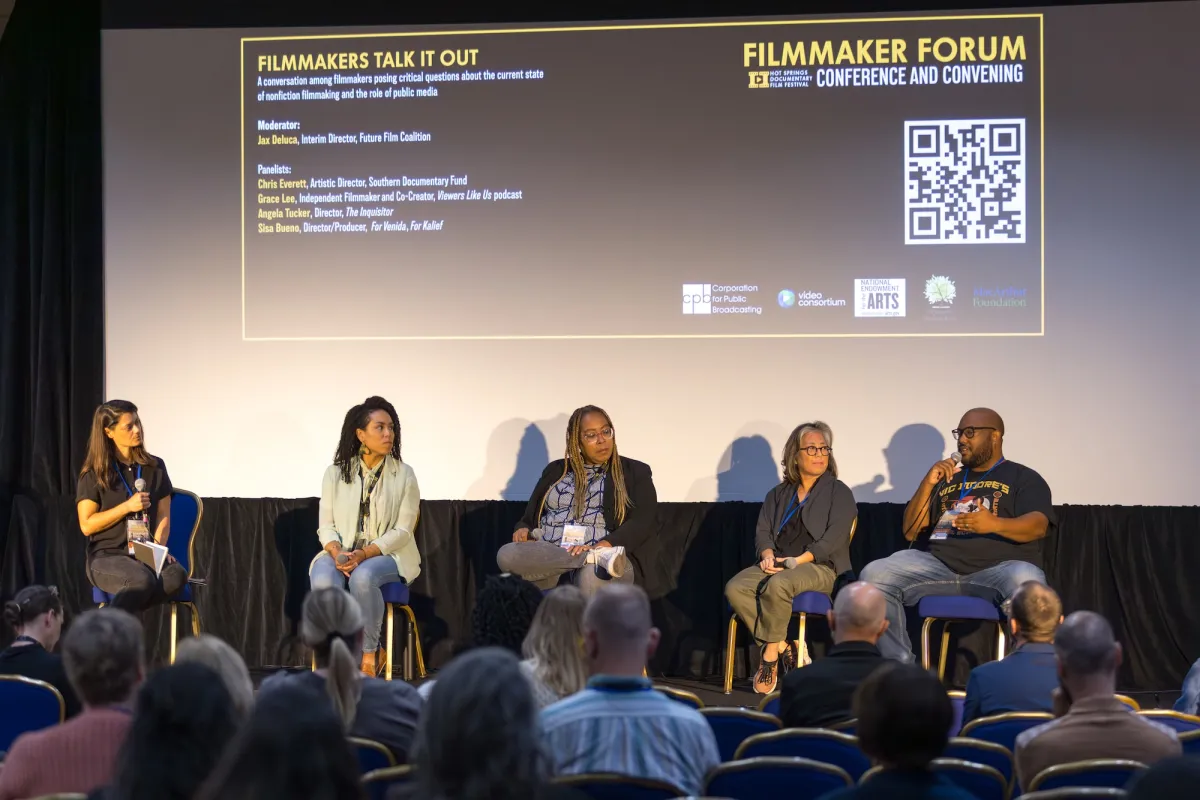
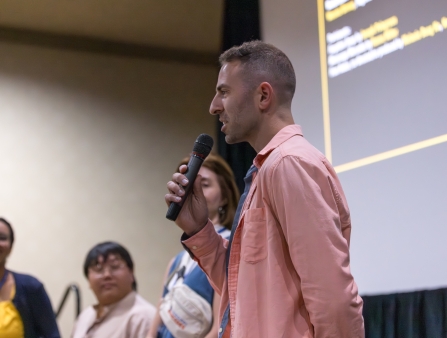
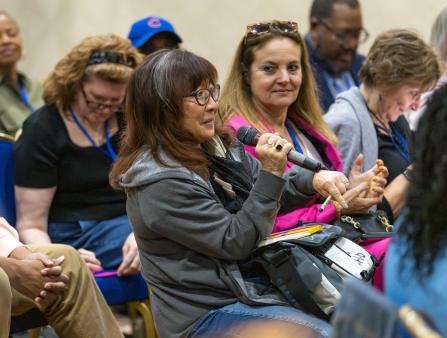
The “Filmmakers Talk It Out” panel, which featured first-time feature filmmaker, Sisa Bueno (For Venida, For Kalief, and IDA Enterprise grantee), Angela Tucker (The Inquisitor), nonfiction veteran Grace Lee (who is a current IDA board member), and Southern Documentary Fund Artistic Director, Chris Everett, proceeded in an outside the box format as well. The audience was allowed to chime in with questions as the discussion went along.
Because so many attendees this year had lost either public media jobs or public media funding, the audience questions turned out to be both random and existential. Yet the overriding message from the panel was to calmly embrace a “back to basics” approach. As an example, Everett and Lee urged a return to community-based filmmaking and engagement. Bueno rightly pointed out that it’s not just filmmakers that need to mobilize, but society at large since the dismantling of structures is happening everywhere. Tucker agreed that “this is not the moment to do anything alone.” She also asked us to ponder, “What kind of stories can I make with the resources I have access to?” And then went on to warn against “chasing the Sundance trajectory”—a path, she said, had “only existed for white men.” It was straight talk like this that made this year’s Forum feel like a breath of fresh air. Here, the speakers weren’t privileged folks wanting to lift up marginalized communities, but marginalized folks who’ve succeeded in lifting up their own communities and were game to show you how.
In addition to the diverse selection of sessions, the spa town conference likewise featured Press Play Hot Springs, a series of panels, breakouts, and networking events presented by Video Consortium. (Considering the global nonprofit touts itself as “local-first,” it was a smart partnership for a forum with an eye towards Southern storytelling.) In addition, there was also a Works in Progress Showcase, which was both illuminating and, given the time constraints, a bit frustrating. Co-presented with Indie Media Arts South, and moderated by Weenta Girmay, regional initiatives coordinator of Firelight Media, the event featured three filmmakers based in or with roots in the South/Mid-South.
Of the trio of WIP projects, each allowed to present around 10 minutes of footage, one seemed to garner a great deal of engaged feedback. Hanna Miller’s Mississippi Mercedes is an eye-catching profile of a complicated woman. A delightfully bawdy lesbian living in Mississippi, the titular Mercedes is a naturalized U.S. citizen from Colombia who illegally swam across the Rio Grande to make it to the States. She’s also an avid Trump supporter (“Build the wall!” she shouts through her ubiquitous bullhorn)—and she’s anti-trans. A small businesswoman who runs her own restaurant, she has decided to run for mayor as well. Set to a quirky soundtrack, the project certainly has a lot of potential, standing out as a Southern story we haven’t really seen before.
Unfortunately, because the time for feedback on all three films was limited, so was the chance to really dive deep and wrestle with crucial aspects of the film—most notably the storyline Miller may choose to pursue. One audience member insisted that Mercedes’s mayoral race should be the focus: this could be a small town, high stakes political drama. (And yet we hadn’t even gotten a glimpse of her opponent. If Miller is able to get emotional access, not just physical, couldn’t Mississippi Mercedes just as easily be a strong character study?) Another attendee recommended providing scenes of Mercedes’s anti-trans behavior, rather than just hearing from a nonbinary resident who described her transphobia. That seemed like a right-minded suggestion as was the push to approach that angle carefully. But how carefully? Many cisgender homosexuals of Mercedes’s generation, like their straight counterparts, harbored (and some still harbor) anti-trans beliefs. Might it make more sense to lean into those complexities instead?
Such conversations made me wish that the WIP panel, like several talks that upended predictable format, could have been centered more on questions than answers. Before giving guidance, the audience might have inquired, “What is your goal?” “Did the director want to make a film for their community or a more commercial work, marketable to as wide a demographic as possible?” “Were they solely interested in upending a system or crafting an art film?” This way, feedback could have been tailored accordingly, with less spaghetti being thrown at the screen, so to speak.
That said, the Hot Springs Filmmaker Forum—smaller and a lot more laidback and easily navigable than most forums, not to mention especially welcoming to debut and regional filmmakers—ultimately struck me as a much-needed win in these turbulent times. Nearly all of the attendees I spoke with, over the buffet lunch or at the end of the day, couldn’t wait to get back to their films with a wealth of ideas and a renewed focus. More crucially, they were eager to come back to Hot Springs in 2026. For in this era of endless distraction and funding cuts, as Chris Hastings so passionately reminded us, “the mission,” to make films that make an impact, remains the same.
Courtesy of Hot Springs
Courtesy of Hot Springs