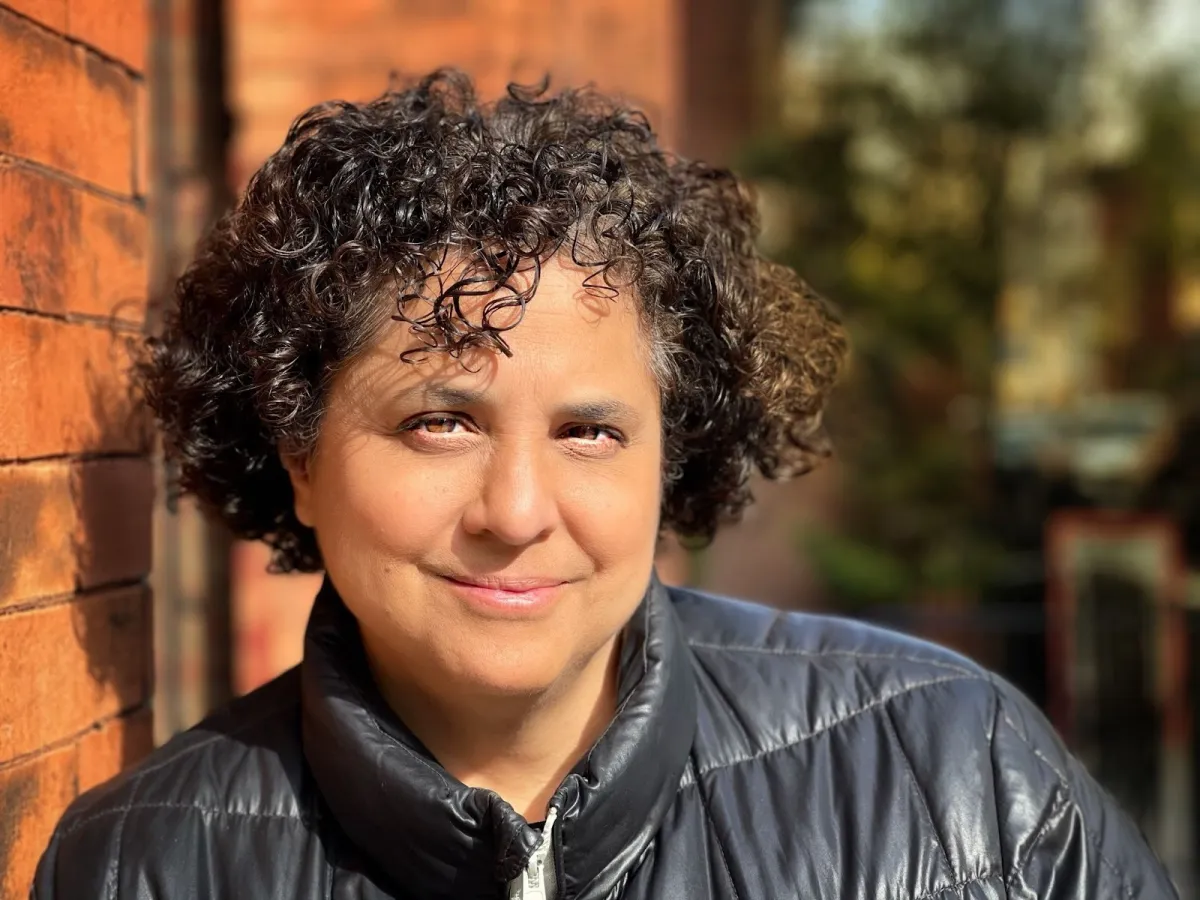
Rose Arce
Welcome to IDA Member Spotlight, a monthly interview series highlighting IDA members and showcasing the depth and diversity of our community. This month, we had the pleasure of speaking with Rose Arce.
Rose develops and produces films for Soledad O’Brien Productions, which elevates untold stories from marginalized communities. For her journalistic work, she was recognized with the Pulitzer Prize, three Emmys, the Peabody, the Cine, and other accolades. Her recent documentary work included the Oscar-nominated films The Devil is Busy (HBO, 2025) and The Perfect Neighbor (Netflix, 2025), which was also honored with 5 Critics’ Choice Documentary Awards, and The End of Affirmative Action (CBS/Paramount+). As a director, Rose was honored with Telly Awards for War on La Radio (Scripps, 2025) and Pandemic in Seattle (Hearst, PBS, 2019). Her CNN documentary work includes Her Name was Steven (2010), Rescued (2010), and parts of the Black in America (2008) and Latino in America (2009) series.
At CNN, Rose also produced breaking news, including from conflict zones and natural disaster areas such as Haiti and Chile. She was recognized by the National Academy of Television Arts and Sciences as one of the few on-air reporters live all day from Ground Zero while the 9/11 attacks unfolded, and for her war reporting in Afghanistan. Rose focused on breaking news and investigative journalism, especially education, policing, politics, and abortion at CBS, WCBS, NY Daily News, and NY Newsday, where she was a Pulitzer finalist and then winner for spot news reporting with her colleagues. Rose is the author or co-author of four books taught journalism at Columbia University Graduate School of Journalism and CUNY Graduate School of Journalism (now Craig Newmark) and worked for diversity in media through leadership roles with the National Association of Hispanic Journalists, the National Lesbian Gay Journalists Association, San Francisco State University, Unity: Journalists of Color, and the Radio Television News Directors Association. Rose graduated from Barnard College/Columbia University and lives in Brooklyn with their partner and daughter.
IDA: Could you share a bit about your background and the experiences that shaped who you are as a storyteller?
ROSE ARCE: I wanted to tell stories for as long as I can remember, jumping at the chance to work on the high school newspaper. My first assignment was to land an exclusive. I lived in the DC area, and the hostages in Iran had families in my neighborhood. I approached one of their wives and asked for an interview. She not only talked but promised I could talk to him if he were released. When he was released, she kept her promise and got me an exclusive with him! I was hooked on storytelling.
That area was very southern back then, and as I knocked on many doors interviewing people and taking pictures for new stories, I knew I was an outsider. My parents are Peruvian immigrants who spoke little English then and had few resources. My school had only a handful of kids who were not white, or were Jewish or foreigners, but did have a substantial group who carried Confederate flags. I wrote from that experience, devoted to using information to create shared experiences between people who are different and even at odds. It felt like the more people heard about each other, the more they understood each other.
My hometown is more progressive today, and my classmates are more thoughtful adults for having known one another. As an adult reporter and later documentarian, I’ve been committed to replicating that experience. I want my stories to not just recount events and show off the sparkly objects in the rooms, but to open eyes to new and different worlds, to introduce people to each other, and start conversations. I have always worked in organizations to diversify my profession because I don’t think our content is the only problem; we also need to be diverse.
IDA: When did you begin working in the documentary field, and what initially inspired you to pursue it?
RA: I was a general news reporter, then an investigative reporter for many years. I loved to write and meet people, and tell stories. I loved the different experiences that you can only have as a reporter. I’ve met almost every president in my lifetime, famous people, good and bad, like Gotti, Tupac, Gorbachev, and Nelson Mandela; been to war zones and political conventions; just seen remarkable things; and spent time with some amazing everyday people. But at some point, after I made the switch to television, I started working on these documentaries that ran on weekend local news. It was just so great to really dig into a topic and let a story play out. That was in the very late 90s, and there weren’t many opportunities to do that in journalism. I was excited to do it, but it was limited. When I went to CNN, I spent several years covering breaking news, which was thrilling but exhausting, until I was suddenly assigned to this story about a city manager who was fired for secretly planning to transition to being a woman. I remarked that it would be so great to stick with the story and see what became of his life after losing his job, his family, and his friends. They let me do a documentary, and I just fell in love with long-form visual storytelling. After so many years of being there when stories were unfolding, I liked being there to see what happened next, and months later, and sometimes years later. I moved to their documentary unit and lobbied to tell stories of more marginalized communities—coverage I had lobbied for at CNN. I started to dive into the complexity of their stories and build out story arcs and characters, and sit in the quiet of the story until I figured out the best way to play it out. I was inspired by a documentary’s ability to immerse viewers in a different world.
IDA: Congratulations on the Oscar Nomination for the deeply moving and impactful film you produced, The Devil Is Busy. Could you tell us a little about the film?
RA: For nearly 50 years in this country, every woman had the constitutional right to an abortion. But when the Supreme Court overturned Roe v. Wade, nearly 25 million women lost almost total access to abortion. 13 states banned abortion, and 4 states banned it if you’re more than 6 weeks pregnant, when most women don’t even know they are pregnant, including Georgia. The Devil is Busy takes place at an Atlanta clinic and focuses on a very religious African American security guard named Tracii who escorts women inside to find out if they qualify for abortions. You hear her praying out loud for their emotional and physical safety, contrasted to a group of protestors outside weaponizing religion against them by praying that they be punished. The majority of women who get abortions in this country are poor, unmarried, have children, and are people of color. In our film, you see what the world looks like for them as they’ve lost agency over this decision. You see doctors working in fear, women getting abortions, and women traveling great distances only to be turned away, Tracii expressing her own surprisingly complicated feelings about abortion, discovering the protesters’ dark backgrounds and strong emotions, and the women’s myriad reactions to their circumstances. It’s a raw, unflinching portrait of this new reality that gently forces viewers to think and feel and, hopefully, talk about abortion so that people don’t forget what happened.
IDA: When did you begin working on The Devil Is Busy, and what drew you to the project?
RA: I conceived of the film even before the Supreme Court ruling. Access to health care has always been divided by class and race, and gender. I assumed universal abortion rights would go away for about half of all women, mostly poor women of color, and the other half would still have access. And, as I called around, talking to women at abortion clinics, exploring what I could do, there was one conversation with a clinic employee in South Dakota that stayed with me. I asked if I could come and maybe talk to people about filming, she said, very emotionally: “You’ll film with us, then Roe v. Wade will go away. For a time, everyone will raise money and come help. Then they’ll ban abortion, and we’ll close. All the women in New York and LA, and Chicago, and wherever will stop giving money and raising hell because nothing’s going to change for them. But we will still be living here, and they’ll have forgotten all about us.” So then, Soledad O’Brien and I launched this project; Roe v. Wade did go away, and we waited to see what it would look like a year later. And, I worry that what that woman said would happen. Her words drew me to this project. They are still why I do this. If any of us did documentary work for the statues or the money, we’d be impoverished fools. 25 million women lost agency over the most fundamental thing they do in their lives, and—whatever you think about abortion—we need to be talking about what that looks like. That is why this film exists.
IDA: What has been the film’s reception, and does it resonate with the impact you hoped it would inspire?
RA: I wasn’t sure it would. Then I went to the Full Frame and River Run Festivals in North Carolina, a more conservative state, where southern audiences just loved the films. At Full Frame, where it won the Audience award, a man wept as he told me how the film reminded him of his daughter, who is a health care provider and deals with people’s mixed feelings, and how this film allowed for people’s complex emotions and empowered him to talk about abortion. At River Run, we won the Jury Prize, which qualified us to submit the film to the Academy Awards. There were people there, obviously opposed to abortion, who truly loved the film because the characters were so honest and compassionate. The film has screened at 20 festivals, and the ones that really reflect its success to me are the festivals that draw community members, people who are not only from film and film aficionados but from the town coming to see what’s up. We did a public impact campaign and brought together people from the local reproductive rights organizations and clinics wherever we could, and the conversations were really interesting. Online, we have used the film to start conversations on abortion and have people continue them. That was the whole point.
IDA: For our members who are eager to watch The Devil Is Busy and stay connected with your work, what’s the best way to see the film and follow your upcoming projects?
RA: The Devil is Busy is available on HBO. Our website is Soledadproductions.com. We are always in the business of telling stories of those whose stories have a hard time making it to the surface.
IDA: Looking ahead, what’s next for you? Are there any upcoming projects you can share with us?
RA: There are so many stories we want to tell. We are releasing a PBS series, She Was First, in March, featuring six women in the arts who were the first to break ceilings in their professions. It was reported by Soledad O’Brien and produced by the same filmmakers who directed The Devil is Busy, Geeta Gandbhir and Christalyn Hampton. It includes Ruth Carter, who just broke the record as the most-nominated African American woman in Oscar history. We are also working on a documentary with Hartford Films about the crisis caused by so many teachers leaving the profession. The rest of our projects are top secret!