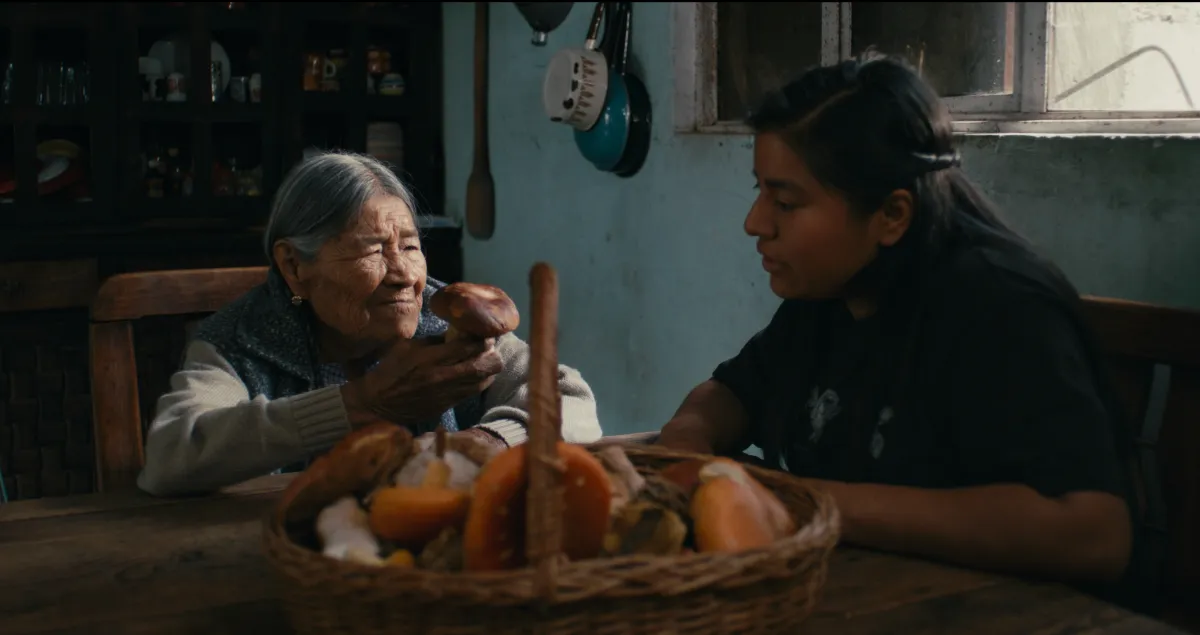


Otilia Portillo Padua’s Daughters of the Forest is crafted with artistry that simply demands the big screen. Indeed, with a kaleidoscope of eye-popping colors, and an otherworldly sound design that feels both foreign and familiar, the film is truly mesmerizing—and more than lives up to its “immersive sci-fi documentary” hype. Set in Mexico’s magical forests (for now, as the logging industry is fast-decimating what’s left of the territory), Daughters of the Forest is guided by a pair of young female mycologists, Lis and Juli, both hailing from Indigenous communities where generational knowledge, from language to the secrets of fungi, is fast-vanishing as well. “Behind every mushroom there is a story,” as one scientist puts it, and the Mexican director is determined to follow not just the two humans on a mission to restore culture to science, but engage with the cinematically stunning fungi as well (some of which seem birthed from the Alice in Wonderland underground).
Through microscopes, the women observe “the internet of the forests.” And while out in the field (in the very forests they grew up in), these daughters of the land likewise attempt to promote trust in academia itself—an oft-extractive profession long populated by non-Indigenous folks who “steal information” and contribute little to those communities they encounter. And while the stakes are existential, the paths to humanity’s progress are still palpably present. Mushrooms can teach us about life—and also death, as the two are intertwined. Life is forever giving way to death, which in turn allows for death to create life. “Ashes to ashes, dust to dust” seems to be the basic lesson the forest delivers. If only we choose to listen.
A few days before the film’s bicontinental debut at SXSW and CPH:DOX, Documentary reached out to the Mexican director (2012’s Three Voices), who studied architecture at Cambridge University, to discuss the way radical mycology and speculative fiction guided not only the film’s aesthetics, but its impact campaign as well. This interview has been edited for length and clarity.
DOCUMENTARY: Could you talk a bit about how this film originated? I know you’ve said that the mushrooms found you, but how exactly did you meet all your protagonists, human and nonhuman? How did you gain their trust?
OTILIA PORTILLO PADUA: Just before the pandemic, a mutual friend introduced me to Paula Arroio. We discussed telling stories about the relationship between humans and nature that consider nonhuman perspectives. Our thoughts were shaped by texts like Donna Haraway’s Staying with the Trouble: Making Kin in the Chthulucene, Ursula K. Le Guin’s The Carrier Bag Theory of Fiction, and Anna Tsing’s The Mushroom at the End of the World: On the Possibility of Life in Capitalist Ruins, which helped us understand that hope could still exist, even in adversity—as embodied by living beings as resilient as mushrooms. Mushrooms not only had something to offer for our own human benefit. They also had something to teach us. What we never imagined was that mushrooms would lead us to meet a group of incredibly inspiring women. I think this was always inside our carrier bag, once we dug deep to look at its contents.
In the early days of the pandemic, we used Zoom to interview several scientists from the Postgraduate College in Texcoco. The college focuses on applied sciences, including earth, forestry, plants, and mycology. It’s a tuition-free institution, where many students come from very remote areas and diverse backgrounds in Mexico. There, we encountered some of the most humane and kind people we’d ever met. They introduced us to two of their former students, Lis and Juli, in 2021. It was their generosity that opened the door for us, as they had been working with both women and their communities for years.
It was really trust built upon trust. Once we started spending time with Lis and Juli, it became clear that they had been in conversation with the mushrooms for generations. They soon became our teachers too. We had so many mentors during this process. Over time, we started visiting the women’s families in Mexico State and Oaxaca, and having long, open conversations about our project, which was constantly evolving. It was then that we had the privilege of meeting Lis’s grandmother, Doña Julia.
D: The film is cinematically stunning, so I’m curious to hear what it was like developing the visual aesthetics and sound design.
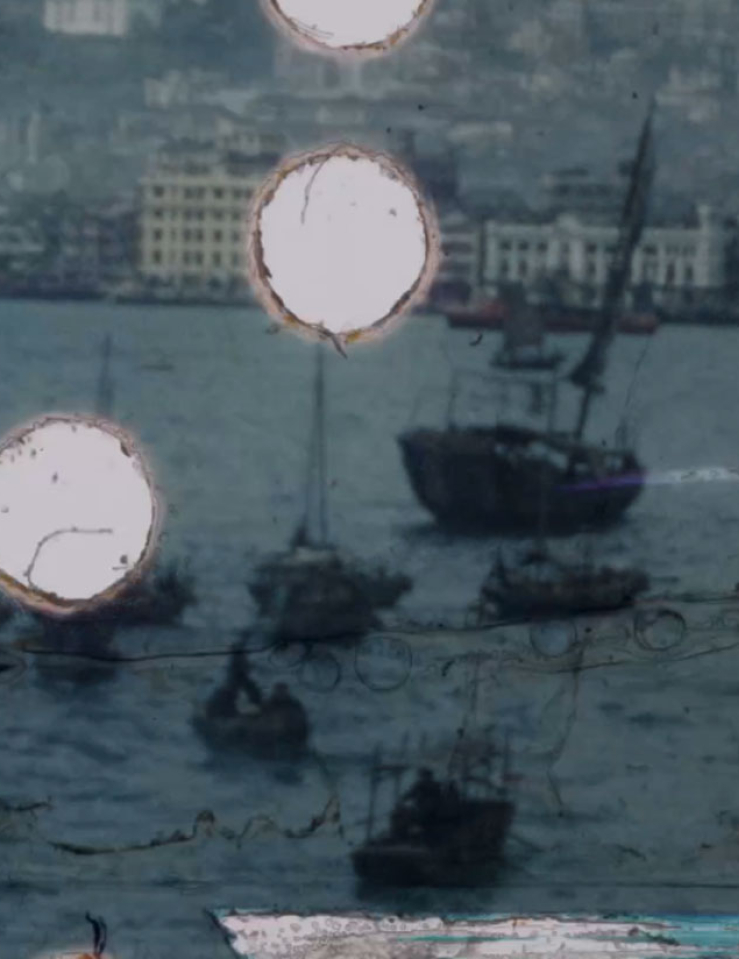
OPP: Making the film was a long process, taking almost six years to complete. We did plenty of explorations, but we always wanted to keep the film feeling tactile and artisanal, like the ground of the forest. All the material is filmed, but we did create composites with the distinct elements.
There was a lot of trial and error. In a way, we ran our own little experimentation lab, where most of the time, when we tried something, we failed. I put a lot of emphasis on the failure, because we tend to focus too much on a finished result rather than the evolving process. I feel like mushrooms have a lot to do with process and time.
In the same way that the mushroom finds you, the project found the right collaborators. We made key alliances with talented people from many different backgrounds who were all generous with their time. Martin Boege, a highly experienced photographer, tried out things for years; microphotographer Wim Van Egmond provided the time-lapse interventions; Mexico City-based Japanese artist Yupica helped with the on-site projections; photographer Miguel Labastida collaborated with the mushroom photography; and our post producer, Fernando Maganda, guided us in integrating all of these elements.
Regarding sound, we wanted to create an immersive experience and bring the audience into this precious yet fragile world. Finding the voice of the mushrooms took time. We tried many things before we decided to go with a chorus of human voices speaking Zaptec. This provided emotion but also kept it nonhuman in the way it simultaneously sounded like one voice and many. Our sound designer, Javier Umpierrez, created an incredibly layered and textured world that blended seamlessly with Hannah Peel’s beautiful score.
We ran our own little experimentation lab, where most of the time, when we tried something, we failed. I put a lot of emphasis on the failure, because we tend to focus too much on a finished result rather than the evolving process. I feel like mushrooms have a lot to do with process and time.
—Otilia Portillo Padua
D: The stories are interwoven and told from both the human and mushroom POV, which I assume is what you mean by applying the “ethos of fungi” to the film’s construction. Could you maybe delve into this a bit more?
OPP: Formally, the film is narrated and integrates both human and nonhuman perspectives. It’s not a single story. On the one hand, there are the human stories of July and Lis; and on the other, an older story, which has to do with the perpetuation of life itself and other beings. They echo each other. Are these mushrooms talking about themselves, or about humans? How different are we from “the other”—and how close?
With the ethos, I also refer to the collaborative nature of the process of making the film. Similar to the way fungi work, in making a movie as a team we had to find its voices and its form, always adapting and being open to the unexpected. I may be the one answering this question, but a single voice for this film would be incomplete.
D: I’m also hoping you could discuss reimagining the sci-fi genre with this film, including how Le Guin’s essay served as your guide.
OPP: I feel the essay has been a compass for how we navigate storytelling in this film. At every turn and every decision, we came back to the carrier bag. What’s inside? How does one scene take you from one place to another?
In her essay, Le Guin says the classic hero story did not represent her experience of life. That she preferred people over heroes, things to nourish, rather than things to bash. Her work is multi-species, emphasizing other forms of knowledge, other forms of life, and ways of life. It’s also inspired by social sciences and not just the hard sciences. It’s a tradition in tandem with sci-fi, less focused on hard technology, more on a greater consciousness.
Disruptive and radical sci-fi has existed for a long time, largely by female and Indigenous writers. Ancestral futurism re-contextualizes the past by blending traditions and culture with speculation. In this way, they reclaim sovereignty over their narratives. I find this sci-fi or speculative fiction emancipating. It allows for the possibility to experience the world in a completely different way and imagine futures in conversations with the past.
D: So what does your impact campaign, which you’ve stated is inseparable from the making of the doc, look like? You’ve also mentioned that it’s based on the principles outlined in Radical Mycology: A Treatise on Seeing & Working with Fungi by Peter McCoy.
OPP: The film deals with reciprocity in different ways: how mushrooms are collected; the principle that you can’t just take and not give back, whether it’s land or knowledge; how you use baskets to help disperse spores, creating paths of fungi. If the form of this film is fungal, the way it spreads and engages with audiences has to be fungal as well.
Peter McCoy’s book on radical mycology explores three pillars for social change: education, awareness, and resistance. For our impact campaign, we have formed alliances with scientists at the College of Postgraduates and the Tlahuica Pjiekakjoo Indigenous authorities to identify the needs of the community in relation to loss of culture and language. Two key elements are education and cultural preservation.
Of course, there’s the bigger conversation about loss of territory and devastation, which involves even larger forces. But before we think big, as Lis has taught me, we need to think small and local. As Lis mentions in the film, “Nothing can be rescued if you have no knowledge of it; you can’t love what you don’t know.” There is resistance in knowledge.