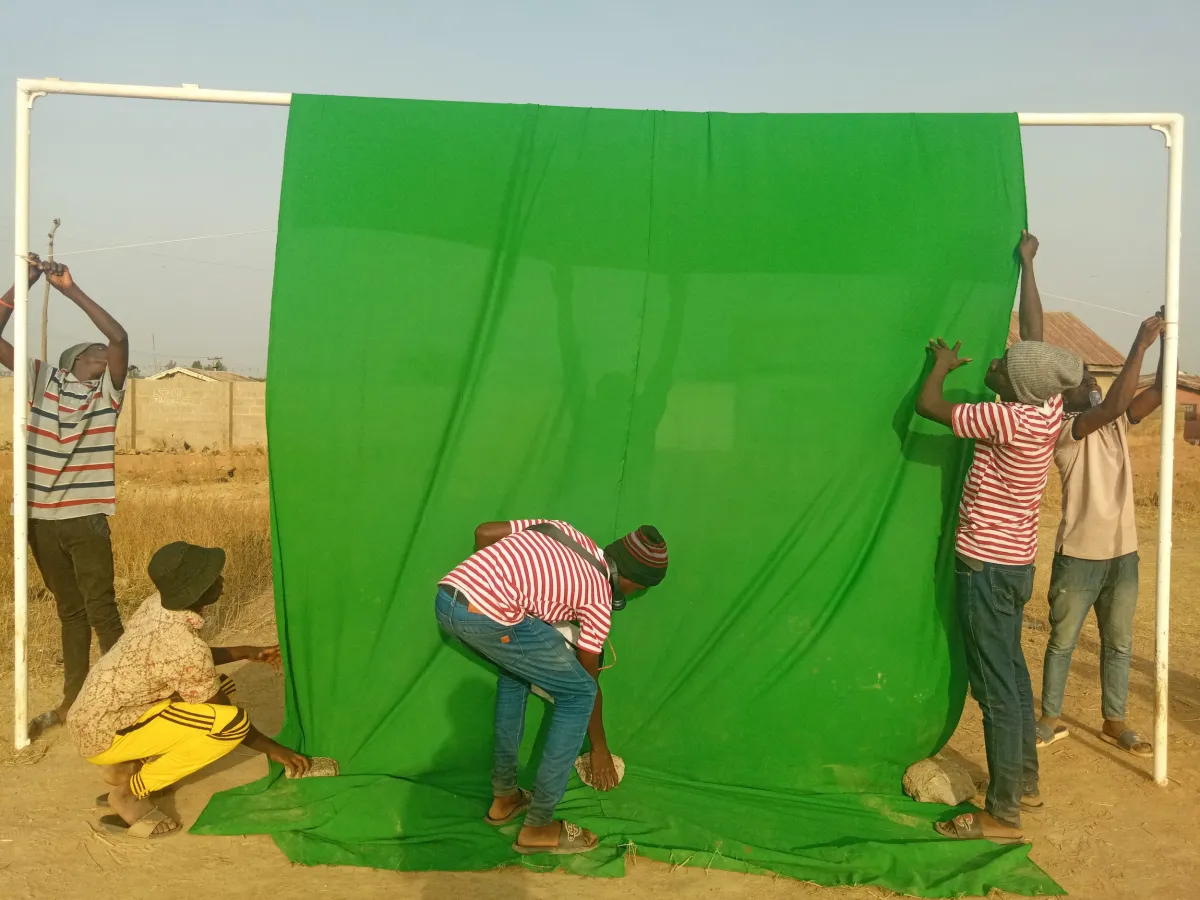

The spirit of Georges Méliès has manifested itself in the Nigerian city of Kaduna, where roughly seven years ago a group of teenagers picked up cheap digital cameras to make baroque sci-fi shorts. Labelling themselves The Critics, the film collective debuted their first work, CHASE, on YouTube in 2018 to genuine acclaim (and nearing 1.2 million views since). This somewhat shoddy yet absolutely spectacular action short brims with a playful DIY ethos and is overloaded with kinetic special effects. A dive into their YouTube channel proves how the prolific teenagers honed their craft, sculpting hyper-ambitious genre fare from the most limited of means. While myriad references to Hollywood IP (from Star Wars-coded lightsaber swashbuckling to the maniacal cackling of Joker) might suggest a hyper-commercial mindset, The Critics see their escapist fare as an urgent artistic outlet, allowing them to transcend the daily grind in what they call “Crocodile City”.
Nollywood may be globally recognised as the dominant creative output from Nigeria, but The Critics are situated on the periphery of a cinematic periphery: a lesser-known city that’s not on the map of the Nigerian film industry. With the fittingly punky documentary Crocodile, New Zealand-based director Pietra Brettkelly captured how these adolescents had to carve out a radical film practice of their own, in a city where film initially found no footing. Instead of commanding the seven-year shoot herself, Brettkelly simply handed over the reins of her documentary to the collective. As the cinematographers and co-directors of Crocodile, the result finds the fiction film auteurs becoming documentarians of their own lives. This collaborative effort shows how the hyper-ambitious teens fully grasped the democratic potential of cheap digital technology, allowing them to build a cinematic legacy from scratch.
Following the world premiere of Crocodile at Berlinale, I spoke with Raymond Yusuff and Godwin Josiah, two founding members of The Critics, alongside Brettkelly, about a film that frantically traverses the previous seven years, while looking ahead to a possible bright future for these self-taught filmmakers. This interview has been edited for length and clarity.
DOCUMENTARY: Starting seven years ago on YouTube with humble DIY sci-fi shorts, you now find yourselves at Berlinale with the world premiere of Crocodile. What is it like to mark that era on such a grand scale?
RAYMOND YUSUFF: The word “surprising” sums it up best. We’re still trying to understand why Pietra woke up one morning and decided to come to Nigeria and work on this project with us. It was a shock for us. Now we’re just grateful to have this story out there, because I think our lives and work make for a good story.
GODWIN JOSIAH: It’s a full-circle moment for us. We started The Critics out of love for the art of filmmaking. We simply did everything as it came to us. So when Pietra came up with the idea to make a documentary (and even while shooting Crocodile), it didn’t feel like we were doing a documentary. Presenting this film about our lives at a prestigious festival like the Berlinale shows that our work can be a source of inspiration for others. Instead of it being a recap, it rather feels like the beginning of something new, like a door that has opened up to us. We’re very excited to see what the future holds for this film and for our careers as filmmakers.
D: Godwin, you mentioned your shared love for cinema, which makes me curious: where did this love for film come from? What inspired The Critics to come together, collectivize, and pick up the camera?
GJ: We were all long-distance cousins who had never met in real life before. We knew of each other’s existence, but for most of our childhoods, we never actually met. When we did meet for the first time, we bonded over online mobile video games—we were teenage boys after all. That was our icebreaker. Over time, we started visiting each other and learned that we watched similar films growing up. We all had what we call a “decoder,” which basically gives you a list of channels that you could watch on TV. For us, it meant access to all kinds of films that inspired us. And that led us to pick up the camera ourselves. We shared an interest, we were family, and we suddenly found more fertile soil to become even more familiar with each other. That grew into what it is now.
D: Pietra, with A Flickering Truth (2015), you made a documentary about the endangered film heritage of Afghanistan. Meanwhile, films such as Maori Boy Genius (2011) underline the importance of preserving cultural heritage and language. Was this interest in the fragility of cultural production the impetus to travel to Nigeria and meet with The Critics?
PIETRA BRETTKELLY: I’d say that a throughline of my work revolves around creative processes in isolation, which is a reflection of my life here in Aotearoa, New Zealand. I’m active here in the regeneration of our indigenous language, Māori, which I’ve studied for a long time. It’s an investigation thatwhich raises a huge question: what are the mechanisms of culture? I explore that question through other people’s creativity—be it film, art, fashion, or music—while still having this strangely autobiographical connection to their work.
I’m just fascinated by how other creatives express themselves, how they live, and how we all friggin’ survive in this world. As I was reading about the difference between Afrofuturism and African futurism, I stumbled upon an article about The Critics. I hadn’t seen any of their films, but I’m not the type of person to overanalyze. I would rather hop on a plane and go to wherever a person is and start from there. I research in front of the camera. That’s how I went to Nigeria, not knowing that it would take seven years to finish this film.
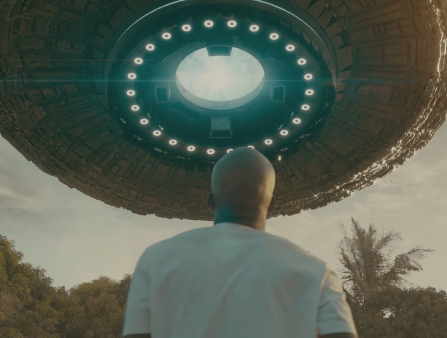
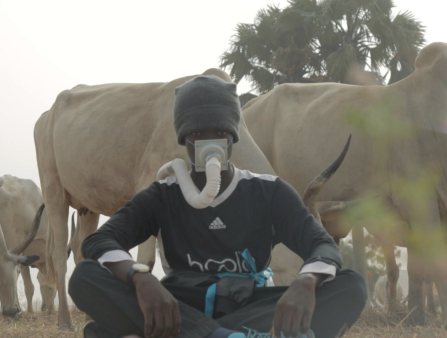
D: Given the fact that The Critics have always published videos that reveal your making-of-processes, you could say that documenting your life’s work was already there from the beginning. How did that dynamic get enhanced when Pietra arrived?
GJ: Unlike Pietra, there was a lot of overthinking on our part when we learned she wanted to make a film about us. You’re right that we were already familiar with revealing our creative processes. We were, however, less familiar with opening up about our private lives in front of the camera. So, we experimented a lot with finding the right setup for capturing the actual documentary footage.
Initially, we hired an extra cameraperson outside of our crew. We tried that for a while, but at some point it didn’t feel like the right approach. Then COVID happened, and Pietra could no longer be physically present to film us, so we had to work out a new method. It led to the agreement that we would become the cinematographers and co-directors of our own documentary. That was not so easy at first, and I think everyone had their own distinct way of filming themselves. To me, that was particularly valuable, as it gave me more insight into the personalities of our collective. Even though I know these people and I grew up with them, it made me understand my brothers even more. It also taught us about a different way of filmmaking. I remember, for instance, how Pietra urged us to hold the shot for way longer. Prior to Crocodile, we always had to shoot quickly because we would run out of storage on our cameras, meaning we had to delete a lot of material. This data anxiety still sat in us when we were filming ourselves for this documentary.
D: I appreciate that Crocodile takes a non-conventional approach in its portrait of The Critics. You’re just in the flow of their images, their emotional headspace, and the vibe of their lives in the city. It’s a fittingly non-linear approach that does more justice to the material than a more boxed-in portrait would do. How did you find this laissez-faire structure?
PB: I’m not a traditional filmmaker by any means. I simply like to empower the subjects of my films and let them tell their own stories. What I was seeing in their material could be called “imperfect footage” for a traditional documentary, but to me it turned out to be perfect. The word that describes the film best is “restlessness.” Restlessness from growing up, for wanting to conquer the world, for wanting to be known internationally. It’s essentially a coming-of-age kind of restlessness that comes with being a teenager and wanting more from life.
GJ: That’s also the exact right word to describe the feeling of finally watching the documentary on a big screen. There was a sort of innocence you could see in our youth, an honest reflection of our lives. When you’re busy living, you tend to forget the things that inspire you to become the person that you are. For me, it was a privilege to look back on our humble beginnings. I felt truthful precisely because it wasn’t a traditional documentary. It’s a collection of nonfiction, fiction, drama, our lives, our parents, our city—all of it. Against the backdrop of our daily personal dramas, film was our release valve, making even our fictional genre films a reflection of our real lives. I think the film does justice to that.
RY: I just want to add that over the course of these seven years, Pietra’s filmmaking style and ours have kind of cross-pollinated each other. I was thinking how a lot of our sci-fi films used to be non-linear, and sometimes people would deem them as confusing. And then this documentary is also non-linear and even somewhat experimental. It’s a genuine reflection of all our work as artists.
I’m not a traditional filmmaker by any means. I simply like to empower the subjects of my films and let them tell their own stories. What I was seeing in their material could be called ‘imperfect footage’ for a traditional documentary, but to me it turned out to be perfect.
—Co-director Pietra Brettkelly
D: Crocodile also explores your role as educators in film, not only through your making-of-videos, but also through the ways you physically teach filmmaking to other young people in the city. Additionally, your work challenges many dominant notions of what Nigerian cinema—still so often associated with Nollywood—can be. How do you now see your role as educators?
RY: To quote David Lynch: “Why do you want me to talk, when the film is already doing the talking?” In that quote, I see the inherent value of filmmaking as a form of education. Now more than ever, we understand the power of what film can be. How we, as artists, can contribute to a more nuanced image of where we are from. Within the Nigerian film space, there’s a lot of talk about a certain image of Africa that is being broadcast to the world. As artists, we have to find a balance between what is honest to us and what the world thinks we are. This is a difficult dynamic, and I’m grateful to be amongst people who are trying to contribute to a more nuanced understanding of it.
PB: By the way, their sharing of knowledge with other young people in Kaduna is also a necessity. They’re making a feature drama at the moment, and they didn’t have the crew to fully realise that project. They basically had to train their friends and other young people in town, as those are the people who ended up making the film with them!
D: I am wondering how the world premiere of Crocodile at Berlinale feeds into your upcoming feature film. What’s the status of this project? How can you channel this crazy momentum of Crocodile and put it back into your artistic practice to move on to the next film?
RY: We are currently trying to lock the cut of our first feature, titled Who Are We Against Fate. It’s almost done, and we can’t wait to show it. We consider this particular project as a companion film to the documentary. After you’ve seen the documentary, this film will show where we are as filmmakers now. In that sense, we are trying to keep the momentum going and make the most of it. We are happy to have started the journey of this film at the Berlinale, and we are ready to ride this wave and see where the next film takes us.