

The dizzying onslaught of assaults on journalistic freedom and funding for socially conscious art under the second Trump administration has, for many, devastated the material reality of documentary filmmaking in the United States. At the same time, the government’s concerted effort to dismantle the infrastructure that supports the production and distribution of issue-driven documentaries demonstrates an acknowledgment of documentary’s presumed political power. However, with the existing infrastructure straining to serve nonfiction filmmaking as a vehicle for social change, the documentary community must now invent new practices and ethos, and redefine for themselves what it means to harness the medium’s socially transformative elements in this increasingly authoritarian climate.
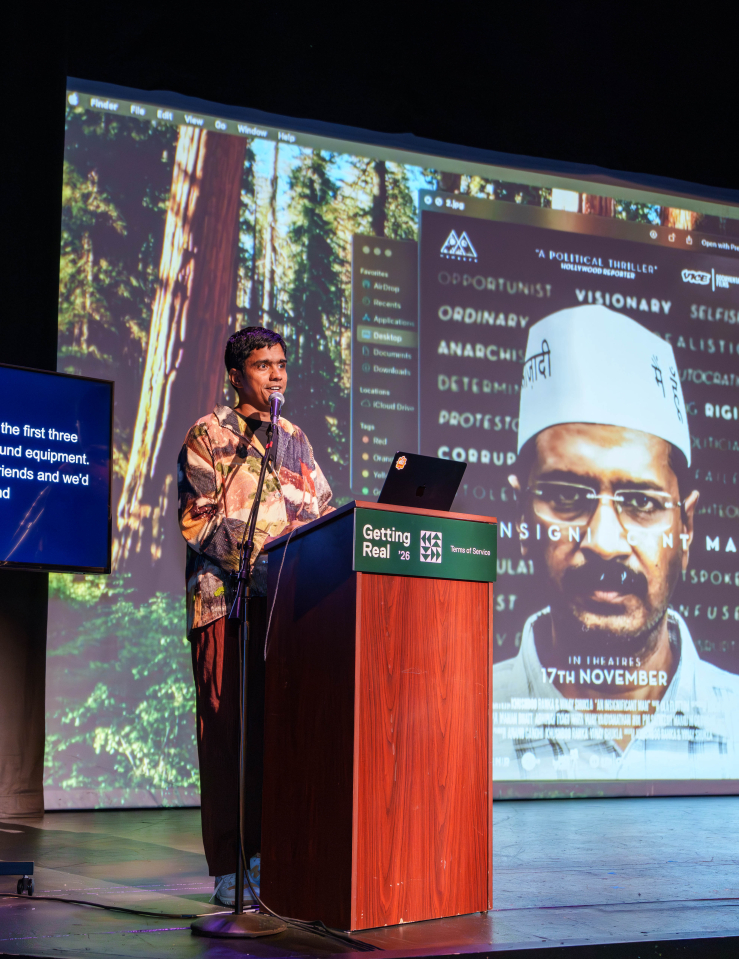
The questions concerning documentary’s putative capacity to produce impact and its future in the age of widespread censorship were at the center of Getting Real ’26, IDA’s biennial documentary conference in the Little Tokyo neighborhood of Los Angeles this past August. From its opening night performance by Vinay Shukla (who made a case for using these contracting times to reflect on what the documentary community can offer one another), to panels with timely titles like “What We can Learn from Palestinian Documentary Today,” as well as workshops like “Budgeting in Troubled Times—Maximize Your Resources and Finish Your Film,” GR ’26 was focused on recalibrating our expectations and strategies for nonfiction filmmaking and impact producing for troubled times like these.
The opening remarks from Abby Sun, then IDA’s director of programs (and editor of Documentary), served as useful guidance for this year’s conference: “What are the myths we tell ourselves?” she asked the crowd of gathered doc filmmakers, “What are the things we need to build together to make this work for us? And who are we also in service to?”
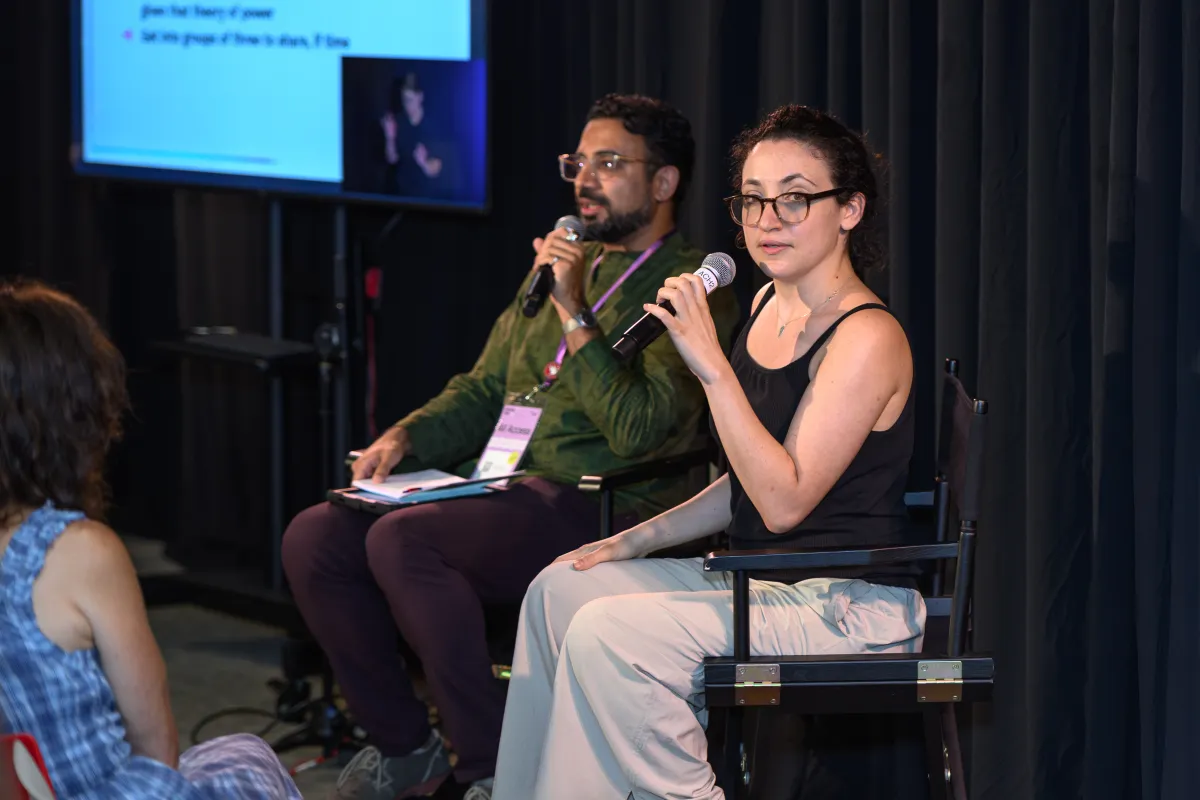
There was one event that singularly exemplified the way the Getting Real programmers wanted attendees to rethink how this community speaks of and about itself: “Loading Your Trojan Horse.” The thought-provoking workshop, led by Sarah Stein Lubrano, a social theorist and author of Don’t Talk About Politics: How to Change 21st-Century Minds (2025), and filmmaker and producer Pulkit Datta from Tikkun Olam Productions, confronted the question of documentary’s efficacy as a catalyst for social change. During her introductory remarks, Lubrano shared a key statistical finding from her research that must have horrified the filmmakers in attendance: “People are pretty good at watching a film, coming in with their own views, and leaving with those views intact—for better or for worse.” What tends to actually shift their perspectives, she argued, are changes in their relationships and firsthand experiences that challenge their initial beliefs.
While Lubrano is skeptical (with data to back up said skepticism) of cinema’s ability to change people’s minds, she does not deny that nonfiction films and other artistic media can still serve social movements. She insisted that filmmakers need to be very intentional about the individual theories of power embedded in their work and to strategize accordingly, rather than resorting to the vague notion that “art can change the world.” At a time when impact producing demands documentary filmmakers think in terms of reach and presumably tangible impact, Lubrano egged on attendees to examine the kind of theories of power they and their work subscribe to before devising plans for how said projects will go on to affect the world.
At one point, Datta chimed in with the acute observation that, relatedly, some filmmakers tend to “see their films as the center of everything,” expecting all elements of social activism to revolve around their project, and thus believing that the mere experience of watching their film will change minds. But being one of many parts of an existing political movement—thinking of a film as an instrument rather than a lone agent of social change—does not diminish a film’s value. Perhaps the most important lesson to be taken from “Loading Your Trojan Horse” was that the most effective way to unlock nonfiction filmmaking’s potential to the fullest is to make a film in service of a broader social movement that can benefit from it.
Lubrano insisted that filmmakers need to be very intentional about the individual theories of power embedded in their work and to strategize accordingly
During the workshop, I was seated next to a middle-aged filmmaker who shared his skepticism about Lubrano’s position with me: “I get that we have to be very intentional and strategic about how we produce and distribute, but I remain convinced that documentary can indeed change the world.” While it was unclear if he meant documentary could change the world by specifically changing people’s minds (despite Lubrano’s persuasive argument to the contrary), the rest of the conference illustrated various ways documentary could and has been instrumental in precipitating tangible change. The best defense of his optimism at GR ’26 came in the form of panel discussions titled “By Our Reckoning: Transitional Justice” and “The Filmmakers United: How We Resist.”
Moderated by curator and impact producer Leonard Cortana, “By Our Reckoning” presented concrete case studies in which documentary filmmaking, in the grand pursuit of building robust democratic institutions and cultures, was an active participant in acknowledging past atrocities and repairing the harms they unleashed. The three filmmaker panelists, Almudena Carracedo (The Silence of Others, 2018), Kumjana Novakova (Silence of Reason, 2023), and Lissette Orozco (Adriana’s Pact, 2017), took turns sharing their experiences of using the camera to grapple with, respectively, Francoist brutalities, war rapes during the Yugoslav War, and pervasive human rights violations committed under Pinochet’s dictatorship. In each case, filmmaking was much more than an act of documentation. Their films created avenues to hold perpetrators accountable and break the oppressive silence often demanded of survivors.
Throughout their discussion, the panelists emphasized the shared approach they take to their filmmaking, best summed up by Orozco’s declaration that “aesthetic decisions are also ethical decisions.” Their approaches to documenting testimonials—whether in person or sourced from archival materials—prioritized the victims’ well-being and agency, and the aesthetic choices were made in service of their effort to reclaim dignity and pursue justice. Carracedo’s remark that “we are not giving [the survivors] a voice. They have a voice, and we’re just giving them a platform,” beautifully encapsulated the three filmmakers’ shared commitment to ethical documentarian practices. By setting remarkable examples of nonfiction filmmaking in which cinematic form and praxis coalesce into an inseparable whole, they demonstrated how documentary filmmaking can help transform the world—in these cases, by establishing counter-historical narratives that place the voices of their marginalized subjects front and center.
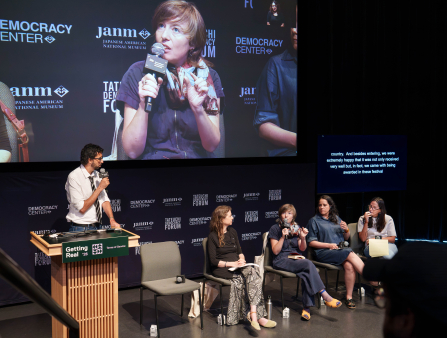
(L to R) Moderator Leonard Cortana, alongside Almudena Carracedo, Kumjana Novakova, Lissette Orozco, and her translator, Annabella Tidona, during the “By Our Reckoning: Transitional Justice” panel.
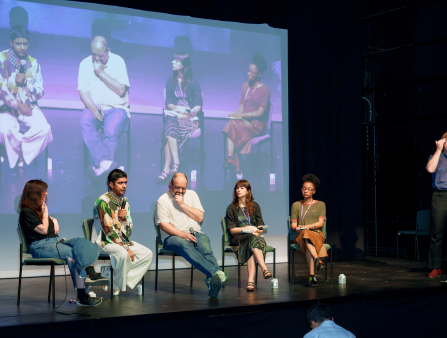
(L to R) Alina Simone, Vinay Shukla, Orwa Nyrabia, Lucía Requejo, Ingrid Raphaël, and ASL interpreter Justin Maurer during the “How We Resist: The Filmmakers United” panel.
As authoritarian governments around the world persist with their actions against journalists and documentarians alike, the impetus to chronicle the plight of the marginalized runs counter to political systems that enshrine power in the hands of the few. Media censorship and resistance strategies were at the heart of “The Filmmakers United: How We Resist” panel. Syrian filmmaker, co-founder of the International Coalition for Filmmakers at Risk (ICFR), and IDA Board Member Orwa Nyrabia, who moderated the panel, began the discussion by framing the question of censorship as grappling with “different ways of controlling what film is and through that, what society is.” Lucía Requejo (a member of the Argentinian political film collective Fuera de Campo), Vinay Shukla (While We Watched, 2022), Alina Simone (Black Snow, 2024), and Ingrid Raphaël (founder of the nomadic microcinema No Evil Eye Cinema) each offered their insights into the current climate of film censorship that has intensified with the recent right-wing turn in global electoral politics. From India and Argentina to occupied Palestine and the United States, state institutions and their partners in media and finance employ a wide range of tactics and policies to disrupt the circulation of dissenting voices and truths, and perpetuate the regimes built on corruption: austerity measures that specifically target grants and funding opportunities, the mobilization of police forces to detain filmmakers and exhibitors, and in the worst cases, the execution of documentarians. As Nyrabia somberly reminded the audience, for filmmakers in Palestine, “their censorship is the censorship of life, not of a shot [they] want to film.” Nyrabia’s words emphasized—as Datta noted when talking to Lubrano—the sense that documentary filmmaking cannot be a myopic endeavor that ignores the very circumstances it both chronicles and aims to change.
Many attendees at the panel raised their hands to share their own run-ins with censorship in diverse corners of the world and their growing concerns about the calamitous decimation of free expression in the United States. In the past two and a half years, many U.S.-based filmmakers have encountered forms of control to which they were not previously accustomed. It’s not that the censorship of films never existed in this country, but those with relative privilege who never had to resist it now see their grants rescinded, struggle to secure distribution, and fear legal and material repercussions. Recounting the violent mass arrests by UCPD in riot gear of UCLA students who gathered on campus to watch The Encampments (dirs. Kei Pritsker and Michael Workman, 2025) in May last year, one attendee bluntly asked, “What the fuck do we do?”
Raphaël, who has been organizing workshops for film practitioners to collectively strategize against censorship, proposed that it has become more necessary than ever to adopt intercommunal and global perspectives. They shared an illuminating observation from their conversations with filmmakers at the most recent edition of Prismatic Ground, a New York City film festival that highlights experimental documentaries and avant-garde cinema: “In the U.S., the biggest threats are funding. Internationally, exhibition is the problem.” In light of the UCLA police crackdown, the documentary community in the United States can establish solidarity and resource-sharing networks with film workers in countries such as China and Egypt, where they have devised resistance initiatives to combat exhibition-based censorship. In response to an audience member who stressed the importance of reaching out to like-minded institutional partners for help, Raphaël emphasized that “it’s imperative for us to divest from the illusion that our institutions [will] protect us.” Instead, they proposed, we should look to third-wave filmmakers as the north star and establish self-sustainable grassroots coalitions that can withstand and resist state interference.
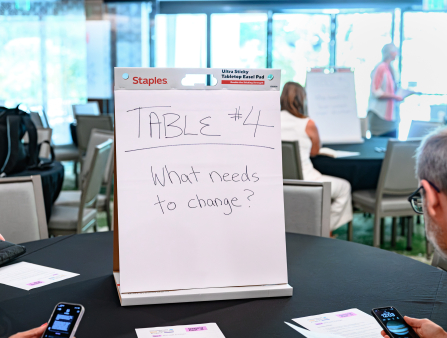
The “Blueprinting for Filmmaker Co-ops” open breakout session had attendees discuss key issues around new compensation models.
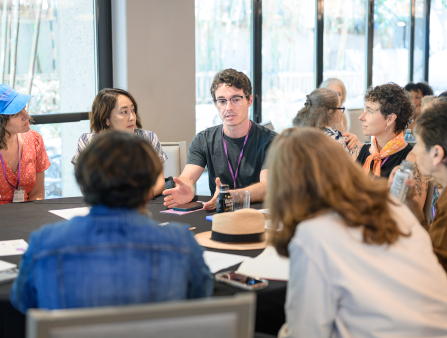
Those who shared Raphaël’s admiration for the pioneering postcolonial filmmakers had the opportunity to further explore their legacy of collectivism on practical terms at the open breakout session “Blueprinting for Filmmaker Co-ops.” Filmmaker Yael Bridge (The Big Scary “S” Word, 2020) and Jay Arthur Sterrenberg, co-founder of the filmmaker cooperative Meerkat Media Collective, made a compelling case for the co-op model as a blueprint for endurance and sustainability. According to the two speakers, the worker cooperative model places decision-making power in the hands of all employees. As such, it brings us closer to true workplace democracy, allowing us to navigate the contemporary threats to documentary filmmaking with greater flexibility and be less reliant on the typical austerity measures expected of organizations founded on a top-down structure. While it may take more time and arduous effort to arrive at a consensus, as each worker holds the same amount of power, the risk in the collective’s every endeavor is that much more diffused, and the surplus is distributed equally in the sense that most of it gets reinvested to fund the business’s immediate and long-term goals, thereby ensuring the continued existence of the collective.
In the second half of the event, participants broke into small groups to brainstorm what their hypothetical co-op would look like: the mission statement, the scale of operation, the governance structure, and the kinds of positions needed to be filled. Many were particularly engaged by the thought exercise. From what I witnessed, they found practical inspiration and encouragement in knowing there are alternatives to production companies with vertical hierarchies, which may be more streamlined and profitable in the short run, but fall especially vulnerable to state actors and capitalist allies who are at odds with issue-driven documentaries. Nevertheless, some still walked out of the breakout session either unconvinced or with more questions than before. “I don’t quite see why I would gravitate toward the co-op model when it looks like a regular business structure can accomplish the same things and probably more efficiently,” one freelance producer commented. But he conceded that our present moment calls for approaches diverging from the status quo.
If “Loading Your Trojan Horse” encouraged those in attendance at this year’s conference to interrogate the possibilities and limitations of nonfiction filmmaking as a vehicle for social movements, “Blueprinting for Filmmaker Co-ops” was an invitation to reconsider whether the existing labor infrastructure is best suited for pursuing documentary as a means of social change. These weren’t, in the eyes of the programmers, diametrically opposed visions for how to grapple with today’s challenges. The purpose of these workshops and panel discussions was to reject ready-made answers and solutions and instead open an avenue for participants to strengthen their conviction in the medium’s role in social movements, precisely by having us all reconsider how documentaries ought to be produced and distributed in the face of our contemporary obstacles. Throughout the conference, attendees were unafraid to have their beliefs contested and to exchange opposing perspectives. As Lubrano stated in her panel, “The reality of social movements is that people often disagree” on strategies and priorities. The wonderful cacophony of differing opinions heard at GR ’26 signals not a crisis of contemporary documentary filmmaking in the United States, but rather the documentary community’s courage to change itself to meet the ever-shifting challenges of our time.
This piece was first published in Documentary’s Fall 2026 issue.