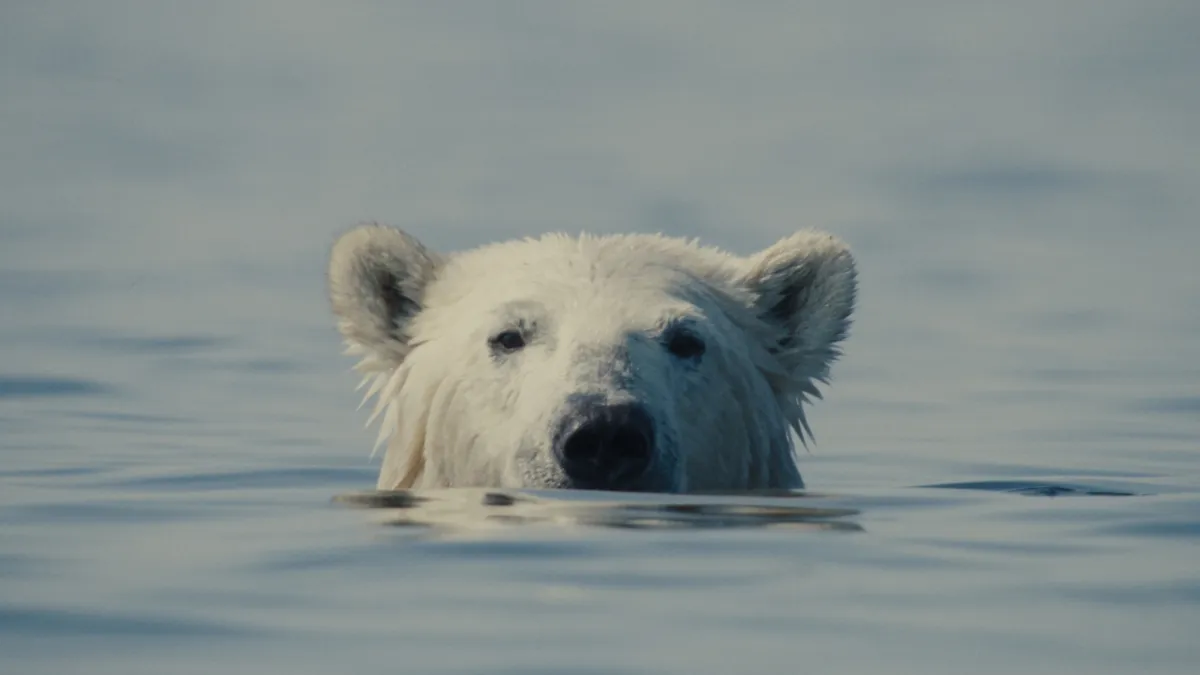

Jack Weisman and Gabriela Osio Vanden’s debut short, the IDA Award–nominated Nuisance Bear (2021), was a deserved breakthrough hit. In 14 unpredictable minutes, the cinematographer duo simulate the illusion of simply getting up close to polar bears roaming near Churchill; the title comes from those ursines who venture inside the far-north Canadian town and must be removed mid-trash-dump raid or while otherwise disturbing the peace. The short ends with the surreal, broad daylight relocation of one such animal, tranquilized and airlifted from the town to be dropped down further from people.
The result of a ten-year production process, the 90-minute feature expanded from Weisman and Vanden’s debut is a more elaborate production shot by six cinematographers, still including the directors themselves. Additions include a score (from The White Lotus’s Cristóbal Tapia de Veer) and narration from the late Mike Tunalaaq Gibbons, who lived in Arviat, the (relatively) nearby other town swarming with stray bears, who reveals late in the narration that his own son died in an attack by one.
The feature-length Nuisance Bear peels away from Churchill at the moment the short climaxes, following the bear (a composite of animals shot over two years) through its airlifted relocation to Arviat. I spoke to Weisman and Vanden the morning they flew to the Sundance Film Festival for the world premiere of their gorgeously shot film.
DOCUMENTARY: People obviously make sizzle reels, but it’s a bit different to expand a documentary short into a feature film. At what point did it conceptually click that one thing could become the other? Was that always something you wanted to be the case?
GABRIELA OSIO VANDEN: We were shooting the short just to shoot [footage] for the feature, but we had no money, no one backing us, and no one really understanding what we were trying to do. So, we shot some stuff, made an assembly, showed it to a trusted filmmaker we look up to because they’re a prolific documentarian, and they were like, “This is a film.” That emboldened us to think of it as a short.
JACK WEISMAN: We were just trying to make this feature and spending all our own money to go up there. It’s so expensive. Then we were watching The Hunt on BBC and they had the most sophisticated polar bear shots I’d ever seen. I was like, “What are they doing?” They have BTS episodes, so we watched that, and they had taken a helicopter camera rig and put it on a boat, a car, and an elephant. That equipment was well beyond our reach, but we were able to do a version of that in 2020 during lockdown, basically bubbled in our car in Churchill. All of the footage from the short is from that one shoot. Then we edited that, not knowing it was a short—didn’t have interviews, didn’t have music licensing because we couldn’t afford it, but [that] became this really important creative limitation that I think gave it a singular feeling. But it was also deliberate to withhold all the context, especially what’s happening in Arviat and with the Gibbons family.
GOV: Having the short do well introduced us to other filmmakers and producers we would want to work with [and] put us into rooms where we could talk to other people about it.
JW: The first question was always, “How are you going to expand this 14-minute, no-talking short into 90 minutes? No one’s going to watch that.” And we were like, “You’re right, but we know there’s enough of a story here.” The Oscars shortlist stuff was really focusing: you keep getting into these rooms, and the rooms get smaller and more concentrated, so you start to develop a bond with people going through this experience. That’s how we met [producer] Teddy [Leifer]. I was telling myself, “If we do get nominated, maybe we shouldn’t make a feature, because we’ll have exposed it too much,” which was silly. But we didn’t, and there was still momentum and interest. So, we basically dove right into developing the feature as a pitch in order to stomach the disappointment of not being nominated, and it was the best thing because we carried that energy for the next three years.
D: When people said, “There’s not a story here,” and you said, “Yes, there is,” what was the story you had conceived?
JW: To juxtapose two communities through the bears they share. We were looking for a central narrator as well, but hadn’t figured that out.
The first question was always, ‘How are you going to expand this 14-minute, no-talking short into 90 minutes? No one’s going to watch that.’ And we were like, ‘You’re right, but we know there’s enough of a story here.’
— Jack Weisman
D: Conceptually, I’m sure it must have come up sooner rather than later: is this a quote-unquote “nature documentary”?
GOV: When we were pitching, we always pitched it as, “It’s not your traditional nature documentary.” What was the word we used a lot?
JW: “Subverts.”
GOV: Yeah! “We’re trying to subvert the nature documentary.” And reversing the gaze—we must have been thinking about the gaze without realizing, because we’re cinematographers by trade. Starting out in documentary, shooting for other directors, you can’t help but think, Where’s the right placement of the camera for the story, but what does it mean as far as your relationship with your subject matter? Historically, with a lot of nature documentaries, you’re excluding your inclusion as a filmmaker, as people in the landscape. This is a very colonial thing. We had discussions with one of our other producers, Michael Code, who grew up in Churchill and Arviat, and he’s Diné. He helped us realize that for a lot of this stuff, you have an Indigenous person showing the filmmakers where to go to find the animals, and they don’t get recognized. Also, [presenting] the land as unpopulated by human beings is very common. But we are part of those ecosystems, and you’re leaving out a massive chunk when you don’t include human beings. In terms of the history of treatment of Indigenous peoples, at least in North America, that was a form of Manifest Destiny—like, you remove the people from certain areas so that we can take over this unpopulated area.
JW: And conservation practices have a lot of colonial roots as well. We had no idea about any of this stuff when we first started.
D: I see six credited cinematographers, including the two of you. Presumably, at least one of those people is a nature cinematographer—or is it all people learning how to assimilate that skill set?
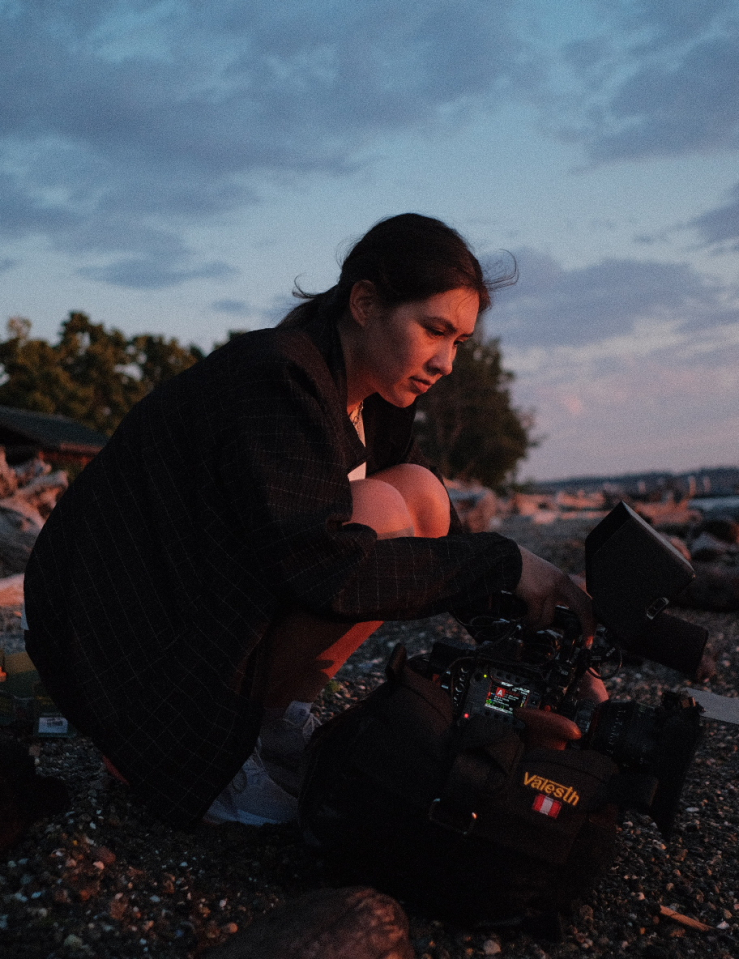
JW: Gabby and myself were the directors of photography, so we had the vision for where we wanted to place the camera, how we wanted to tell the story. We worked with a team of cinematographers—Michael Code, Jack Gawthrop, and Ian Kerr—who all specialized in wildlife photography. We trained with a wildlife specialist production company called River Road Films. Jeff Turner is the founder; he’s a co-executive producer on our film, and he trained us and gave us incredible discounts during the strikes when a lot of the equipment wasn’t moving. It wouldn’t have been possible without his generosity. So, we learned how to use the equipment, then started bringing people with us who could operate it. We were shooting in two towns simultaneously for eight-week periods. We were stretched really thin, even with the six individuals that we had. In total, I think I spent about 250 days shooting over the last five years.
GOV: In terms of structure, I had Ian Kerr with me in Churchill. He was there the shortest amount of time because he’s the most professional and expensive, so we would send him out to get bear stuff, knowing what kinds of shots we wanted. When we had bigger scenes that we could control, we had a second vehicle so that we could cross-shoot coverage. Sometimes the car is rolling, so whoever’s driving is like a camera operator as well. We have monitors inside so they can be watching the frame with us. It’s very stressful, and you yell at each other a lot. You have full access to the camera system from a panel inside that sits on your lap. You’ll be going along following a bear or fox or whatever, then land in front of a bush, and it hides everything, so how you move is really important.
Historically, with a lot of nature documentaries, you’re excluding your inclusion as a filmmaker, as people in the landscape. This is a very colonial thing.
— Gabriela Osio Vanden
D: I don’t know if there’s a minimum distance that you’re required to keep from the bear.
JW: When you’re outside of the vehicle, you’re supposed to be 100 meters away.
GVO: In terms of vehicles, if you’re parked, your engine’s off, and a bear comes up, what are you gonna do? But if you’re moving, you have to keep a certain distance.
JW: In a car, the rules are different. Outside of a car, it’s very strict, but it’s self-enforced.
GVO: You basically can’t be out of a certain area out of your vehicle without a gun—
JW:—or a bear guide.
D: So did you also get a gun and get trained on how to use it?
JW: For sure. [DP/producer] Mike [Code] is a hunter, so he has his PAL [the possession and acquisition license for adults to obtain weapons in Canada].
GVO: A few of our teammates have their PAL then you link up. One person has a PAL, one doesn’t.
D: Obviously, the lenses are very long—they would have to be—so I was curious how long they got and if they freeze up when you’re trying to adjust them.
GOV: The lens that we had, the focal distance was 50 to 1000 [mm], then we have a doubler on that, so we can go to 1500, which is very helpful.
JW: It’s like the longest professional lens, at least one of them, and it’s specially outfitted in this Cineflix—
GOV: —which is a six-axis gimbal as opposed to a three-axis. We didn’t have to worry about it getting frozen, because it stays heated from its own exhaust.
D: But it doesn’t fog up?
JW: It can fog up, but we have a hair dryer, so we remove the front element, the lens cover, and then it freezes [because it’s been removed from the Cineflix]. That would sometimes be an issue but not really. It’s an incredible device.
GOV: And it’s more comfortable because you could just be in the car, which is nice, but it’s also for safety. You rarely have to go out to, like, swap batteries.
JW: When we first went up in 2015, we were getting out of the car with a tripod. No one’s watching your back; it was just dangerous. The long lenses and not getting out of the vehicle felt like a step towards trying to maintain as much respect for the animal as we could. And, of course, you can have quite a bit of distance. I mean, you could film from across a football field. You’re not going to get a close-up, but you can get the image. A lot of times, there would be some sort of foreground layer of people, because we’re behind the tourists, looking at the circus, so to speak. If you’re zoomed all the way in, you can almost film through a person’s shoulder, and it will completely disappear. It would maybe darken the image just a hair. So, it was both ethical and practical.
D: What’s the maximum or general resolution on this? It looks like it’s really high-res.
JW: We filmed on a bunch of different cameras: the Sony cameras do nighttime stuff really well, for skin tones in mixed lighting environments, [we used] the Alexa, then the wildlife cameras are the RED. They have a high resolution with the gimbal system if you need to punch in. It ranged from 4K up to 7.5K.
GOV: 6K and 8K are standard now for wildlife because it gives you the ability to punch in if you need to.
JW: We were handling enormous amounts of data. We lived in a shack with a really expensive camera—
GOV: —in this cat-pee-filled laundry room.
JW: We had all of these old-school hard drives plugged into this toaster, then we were pulling them out and swapping them as we churned out 700 hours of footage. It was a 14-month edit.
When we first went up in 2015, we were getting out of the car with a tripod. No one’s watching your back; it was just dangerous. The long lenses and not getting out of the vehicle felt like a step towards trying to maintain as much respect for the animal as we could.
— Jack Weisman
D: The polar bear airlift is your big, spectacular set piece. Is it a nightmare to keep the lens trained on the bear from the helicopter following it?
GVO: I shot all the close-ups of the bear, and I’m really glad I had Ian for the helicopter-to-helicopter stuff. It is so difficult because not only do you have panning and tilting, but you’re on this vehicle that can go in any direction while following another one. You can never plan stuff with bears, but unfortunately, because it’s incapacitated, we could discuss with the wildlife officers how it was gonna go. It’s my favorite scene. The beginning of the day was so overcast, and I was so sad, but when we landed, the sun peeked out, and it looked backlit, just gorgeous. These people are putting a lot of effort into helping out this bear, but then they’re bringing it a bit closer to the next community, so it’s a complicated thing.
D: What was your approach to recording location sound?
JW: We brought a sound recordist with us at least three times, and when we weren’t shooting things, which was sometimes a lot of time, they would go out and gather sounds of the communities—
GOV: —mostly like when we’re doing more traditional shooting with human beings. When we’re shooting from vehicle rigs, they’re so loud you would just be getting the sound of your engine. And you can’t put a microphone up to a bear breathing, you know?
JW: Gathering the sound was more difficult than capturing visuals and took a lot of time, basically putting microphones in places where there is lots of activity, and then the bear will walk by or sniff it—from 12 hours of recording, you get a second. We also partnered with a polar bear sanctuary in Ontario that has a couple of nuisance bears in captivity. We sent the zookeepers a couple of recorders, and they would place them in the enclosures or when they were feeding the bears.
D: The whole movie is structured around your narrator, including the fact that it’s dedicated to him.
JW: Mike is such an integral part of this film. In 2017, when I first went to Arviat, [the residents were] willing to talk about polar bears. They’re curious about outsiders being curious, and there was just a friendliness. After [the death of Mike’s son], I returned, and the tone in the town completely changed. Everyone was really traumatized by the event. They were fearful that it might upset the family. That was a really crucial point for us where we recognized that now is not the time. Maybe never—let’s pack it up and focus on Churchill. We showed the short to the community, about 200 people, and faced a bit of our own apprehension: Should we continue making this? Is this helpful? And when we put ourselves out there, we were welcomed.
GOV: Historically, [Arviat’s] side of the conversation has been left out, so I think that’s a big reason why we were embraced. We weren’t necessarily going to include [Mike]; we just wanted to make sure they were okay with us.
JW: Once he understood what we were doing, he came over to the church we were staying at and went off on this long rant. We were blown away by his poetry and anger and the power of his words, and were like, “Do you want to narrate this film?” He said yes, and we couldn’t believe it, because I think he had said that he didn’t want to speak to non-Inuit people about this anymore. That began a multi-year process of interviewing, recording with him, workshopping a script with him, watching the material with the voiceover. We recorded lots and lots of hours with Mike to distill the narration to the point that you see in the film.
GOV: He passed away very recently, before we fully locked the film.
JW: That interview that you see in the film, that’s the final interview we did together. He passed away only a few weeks after that. It’s tragic, but because of his passing while we’re wrapping this up, it became a spiritual experience. His family has really embraced the film. Before, it was very much focused on Mike: he really wanted to do it, and there was some tension within the family about whether or not he should. Now that the film is done and they’ve seen it, they’re grateful that he’s part of this.
GOV: And he was really happy to be a part of it because it felt cathartic to be able to talk about his trauma.
JW: He was a trauma specialist as well as a priest, so he was always taking on other people’s burdens or stories, and I think he didn’t really have an outlet. So, this was a really cool way to have that outlet in an artistic form. I’m going to get emotional, but I’m so grateful he was part of it.