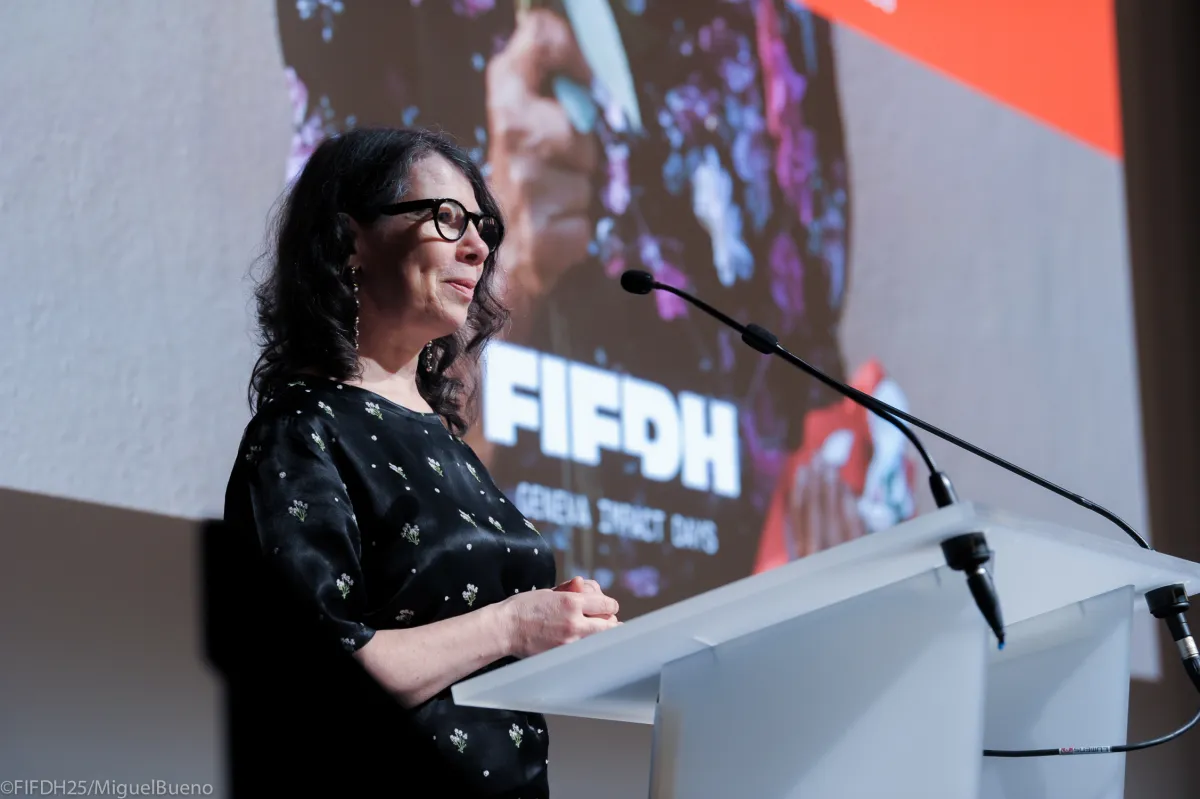

Editor’s note: On March 10, 2025, Jenni Wolfson delivered a keynote address at the International Film Festival and Forum (FIFDH) in Geneva on Human Rights titled “Storytelling for Social Change: The Bridge Between Art and Advocacy.” Drawing on her journey from UN human rights investigator to nonprofit leader and storytelling advocate, the CEO of Chicken & Egg Films offered a roadmap for how documentary can reflect an authentic commitment to ethical storytelling.
This text has been edited for publication in Documentary.
I invite you to take one deep breath right now.
We need to breathe. Not just we as people, but we as activists, advocates, and artists. In this daunting political time, we need to breathe together. Because the challenges in front of us are weighty, and they demand a collective response.
As Toni Morrison wrote, times like these are “precisely the time when artists go to work. There is no time for despair, no place for self-pity, no need for silence, no room for fear. We speak, we write, we do language.” I’ll add that this is also the time when activists and advocates go to work, too. As we recommit to our work in this new reality, we must also commit to storytelling as one of our greatest strengths.
Having been given the opportunity to deliver this keynote, I want to start with my own story to share what I’ve learned about wielding the power of narrative change.
My Own Story
I grew up in a tight-knit community of Scottish Jews. There were only about 15,000 in the entire country of 5 million. Most Scottish people had never met a Jewish person. On my first day of high school, I walk across the school yard and spot this cute boy looking at me. He takes a step forward, throws a half-penny coin in front of me, and says, “Pick that up, Jew.” Experiencing anti-semitism first-hand, for years, had a deep impact on me. There was a lot of hatred at my school: Protestants fighting Catholics, violence against South Asians and other minorities, and if you were queer, you were in hiding.
Bullying, exclusion, hatred—everyone in this room has experienced these first-hand, in some form or another, maybe as a victim, a witness, or even a perpetrator. The divisions in our world are long-running and widespread. Experiencing them played a role in the path I chose, leading me to commit my career to social justice and human rights. I’m also lucky to have grown up in a family of artists, and to have been born in Scotland, a country full of imagination, storytelling, myths, and folklore.
So that’s who I am: On one side, galvanized by experiencing and witnessing prejudice. On the other hand, believing in unicorns. I’m sure this is true for so many of us here, because these are the things we need to work on in human rights. We need to see the truth clearly. We also need imagination, stories, and hope to envision a different future, because so much of what we see in the present is so hard. As I grew up, I kept these two sides with me. I was a teenage activist (and a real pain in the ass to my parents); I collected a CV of volunteering, backpacking, and development work, then earned my Master’s in Human Rights; and later I came here to Geneva as a fresh-faced intern for the UN Committee on the Rights of the Child. It was an exciting and deeply informative time. After soaking in the ivory tower of graduate school, I received a crash course in the huge chasm between theory and practice.
During all those years, again and again, I saw three key challenges appear that blocked the power of storytelling:
- I saw stories depersonalized.
- I saw stories told at a distance, to audiences who were both physically and emotionally far from the stakes.
- And I saw stories packaged in ways that closed off pathways to action, removing agency from both the storyteller and the audience.
These three challenges, together, helped me arrive at the insights I want to share with you today about how storytelling creates change. But it took me a long time to reach these insights.
Learning the Necessity of Storytelling
My first UN field assignment was in Rwanda, where I worked for 3 years as a human rights investigator after the 1994 genocide. I took survivor testimonies all day long. I listened to stories of abuse, witnessing, survival, and resilience—and I documented.
During this time, I learned how to truly listen. I experienced how the power of a story can foster a deeper understanding of complex issues, nurturing connection and empathy between people.
Still, the years I spent as a human rights investigator sucked the artist out of me. Writing reports that were triple-checked and squeezed into submission by the bureaucracy disconnected me from the emotional necessity and vitality of the stories I had heard. It took me years to find my way to my current vocation at the intersection of storytelling and social justice.
Part of what helped me get there was learning to tell my own story in my one-person play, RASH (2007), about my experiences at the UN. I had nightmares whilst developing this play. But each night as I stood alone on stage and could hear a pin drop, I recognized the power of the arts to draw people in and remind us of our shared humanity.
This belief has become the foundation of the nearly two decades I’ve spent working at the intersection of media, art, and justice. First, during the seven years I worked at WITNESS, the human rights video advocacy organization co-founded by musician Peter Gabriel, where we helped human rights activists and citizen journalists to document abuses and injustice with video. And now at Chicken & Egg Films, where we support women and gender expansive documentary filmmakers whose storytelling drives understanding and action.
My vocation has often revolved around this question: When people at the frontlines of injustice tell their stories—often at great risk—how do we make sure they’re heard? How do we make sure they are listened to?
When people at the frontlines of injustice tell their stories—often at great risk—how do we make sure they’re heard? How do we make sure they are listened to?
The Principles of Social Justice Storytelling
The answer lies in three core principles: Intimacy, Proximity, and Agency.
Films are just one piece of the larger fight for justice, but they are uniquely well-suited to moving the needle on urgent and complex issues because they touch our emotions in deep, visceral ways. That’s why we see so many journalists, activists, artists, writers, teachers, organizers, and others reach for the camera.
Docs are also uniquely suited to this moment. As traditional investigative journalism has declined, documentary films are often stepping in and doing the long-term, deeply embedded work of exposing corruption with an international spotlight. Filmmakers can follow complex stories for months or years, gathering extensive evidence, often at the frontlines. Docs are a vital complement to journalism, especially in this age of conspiracy theories and misinformation, and the emerging complications from AI. Just as importantly, documentary films are beautiful, sometimes fun, and artistically exciting, and they are pushing boundaries in brand-new ways.
Films that move us emotionally move us to act through intimacy, proximity, and agency. And when films create impact campaigns grounded in these same principles, they can help channel individual action into real, collective movements.
Principle 1: Intimacy
Black Box Diaries (2024), a beautifully personal film we supported (and an IDA Enterprise grantee), is as gripping as a political thriller. The film follows director Shiori Ito’s courageous investigation of her own rape, in an improbable attempt to prosecute her high-profile offender.
For Shiori, the act of telling this story is an achievement. Especially in the context of Japan, where—like so many places—conversations about sexual assault are deeply taboo, and where powerful actors use that taboo as one of many levers to silence victims. Shiori’s film turns the shame that is too often pushed onto survivors back on the perpetrators themselves. In sharing her own story, she gains tremendous power while also empowering other survivors who identify with it.
Shiori and her team of impact producers went on a global tour, including screenings of the film at international halls of power such as the UN and the European Parliament. Through this impact campaign, Shiori grew as an advocate, leading groundbreaking conversations on how gender-based violence and corruption are deeply interconnected and should be treated as such in policy and legal frameworks. In advocating for these policy changes, her authority is grounded in the compelling emotional power of the intimacy of the film and its impact campaign. While Black Box Diaries is a first-person narrative, I want to clarify that intimacy doesn’t mean a filmmaker is necessarily telling their own story; it just means the issues are explored through individual experiences.
Another film we supported, Black Snow (2024) (an IDA Enterprise grantee), is a good example. It’s an Erin Brockovich-type story about citizen journalist Natalia, who is reporting on the devastating health effects of open coal pit mining in her town in Siberia. Her own daughter develops serious kidney problems. The intersection of human rights and environmental issues is one of the existential human rights challenges the world faces today. And yet Black Snow brings it to a personal level through the intimacy of Natalia’s individual story.
The film also shows the power of my second principle—proximity.
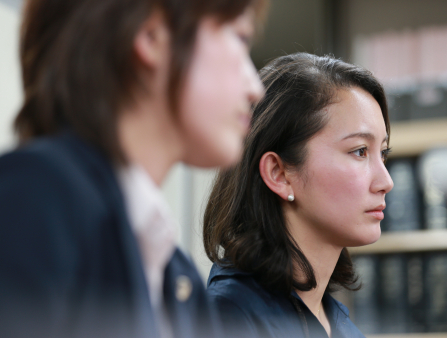
Black Box Diaries. Courtesy of Chicken & Egg Films.
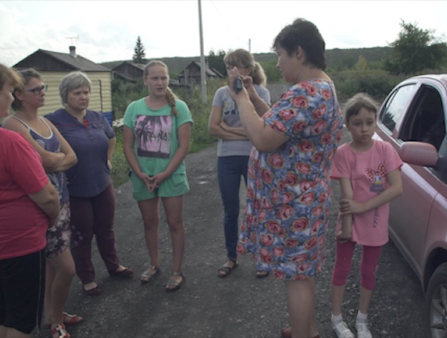
Black Snow. Courtesy of Chicken & Egg Films.
Principle 2: Proximity
Black Snow’s director, Alina Simone, was born in Ukraine and has family in Russia; she had previously worked in international development, including with grassroots organizations in Siberia, and later as a journalist. With these personal ties to the region, Alina was deeply embedded alongside Natalia while filming.
The filmmaking team is running an international campaign to highlight the human cost of coal and reframe the perception that this is a “cheap” source of energy, given the immense toll on human health and the environment. Erin Brockovich herself signed on as an executive producer. The filmmakers have worked with coal scientists and NGOs to create multiple, shorter versions of the film—such as 15 minutes or an hour—to play in venues where a full screening won’t work.
One scientist is taking these around the world, to geology conventions and meetings with governments. Another has identified a small town in Texas with a high rate of kidney problems because of coal runoff—the same kidney problems we see in the film. The story of a mother in a remote town in Siberia is resonating with communities and governments worldwide grappling with these issues.
In other words, the film creates proximity, even across great distances. In a world where extractive forces gain power by distancing us from each other, films can bring us back into proximity with one another.
Principle 3: Agency
To illustrate how agency is key to films that create social change, we have a powerful example in Pay or Die (2023), which follows three American families living with the physical, emotional, and financial struggles of Type 1 Diabetes. It traces the heart-wrenching decisions of people who are trying desperately to afford life-saving insulin while the price keeps going up.
Filmmakers Racheal Dyer and Scott Alexander Ruderman are longtime creative collaborators and partners, and their film embodies the principle of proximity in part because Scott lives with type one diabetes. Rachael, a former journalist, had previously reported on “medical refugees,” or Americans with chronic disease who travel to other countries for treatments that are too expensive in the US. Together, the two traveled to Canada to buy insulin from a local pharmacy, a trip that anchored the film’s urgency. The two-week supply that would normally have cost Scott well over US$300 in the U.S. was just US$19 in Canada at the time—so accessible and affordable, Scott broke down in tears. He had never felt so isolated in his own country and so welcome somewhere else.
Scott’s story is not part of the film, but the filmmakers’ deep proximity to the issue, one living it and one having reported on it, helped create a film that left audiences with a sense of agency. One of the women in the film is Nicole Smith-Holt, who lost her son, Alec, in 2017, when he was just 26. She successfully led a grassroots campaign to pass the Alec Smith Insulin Affordability Act, which established an emergency and long-term safety net for access to insulin in Minnesota for residents who can’t afford it, and which is central to the principle of agency in Pay or Die’s impact campaign.
At screenings, Pay or Die provides materials and guidance for audiences to follow Nicole’s model of local, personal advocacy. There are options for short-term, medium and long-term actions. There are ways to share personal stories with legislators. Or guidance for joining local grassroots movements, with the goal of passing state-level bills, just like the Alec Smith Insulin Affordability Act. In the long run, the filmmakers are working to create state-level momentum for a federal law to be passed.
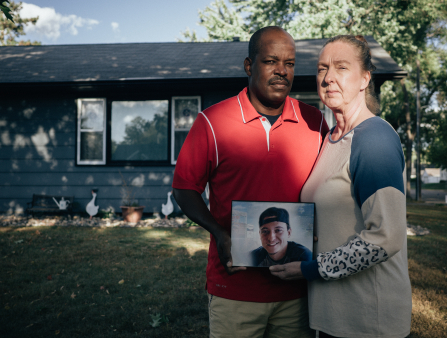
Pay or Die. Courtesy of Chicken & Egg Films.
Songs From the Hole. Courtesy of Chicken & Egg Films.
Bonus Principle: Measure—With Discernment
My previous examples show the raw power of film for our social movements. Film, storytelling, and narrative change play a critical role in bringing complex issues to light and showing the true impact on the people most affected. Films put the “human” into “human rights” like no other medium. They help us envision a better future. And they can help us see the pathways of action we can take to get there.
Films have impact. But it is difficult to measure.
In today’s world, things that are difficult to measure are often unfairly devalued. One of the tasks our movement faces is to better communicate the real, yet often intangible, value of documentary films and their impact campaigns. When I interact with other funders, who still value metrics and logic models over trust for the artists they fund, I’m sometimes reminded of my early work with the UN, compressing human stories into bureaucratic reports.
To that end, I want to share an inspiring example of another film that has generated the kinds of metrics that bureaucracies like, but which has, even more importantly, generated a kind of resonant change through personal interactions.
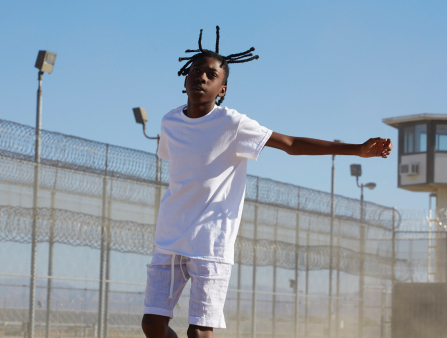
Songs from the Hole (2024), an IDA Enterprise grantee, is an innovative hybrid documentary and visual album, featuring music composed by protagonist JJ’88, who wrote it while in solitary confinement and recorded it while in prison. JJ’88 was serving a 40-year-to-life sentence for a murder he committed when he was 15. Three days after the murder, his own brother’s life was taken. The film is a moving chronicle of forgiveness and the transformative power of art. Filmmaker Contessa Gayles worked in a deeply collaborative, creative process with JJ’88, as well as producer and music producer richie reseda, who had been incarcerated alongside the musician. Through 15-minute phone calls—a limitation of prison—and handwritten, snail-mail treatments, the three worked back and forth to co-write and produce the film.
Alongside the film’s festival run in 2024, richie and JJ’88 took the lead, running an extraordinary impact campaign screening the film in prisons and community centers, for audiences who have been impacted by gun violence and mass incarceration. After each screening, they brought communities together with a healing plan, designed to break cycles of violence and build a new culture of community strength. They also partnered with Healing Through Creative Practice to make the film available in prisons via tablets. The same partnership has also helped create one of the film’s most tangible impacts: It is part of the Milestone Program in California, where incarcerated people can watch the film, participate in the curriculum created by the filmmakers, and earn a week’s reduction in their prison sentence. At one prison visit, richie noted that 285 people had signed up for the program in a week.
While these successes can be counted, there are so many intangible impacts from this film that are difficult to measure, but hard to deny. richie told me the story of a screening in a children’s prison in Oakland, where a kid who was no more than 15 years old came up to JJ’88 afterward to say that he had been planning on getting out and enacting revenge on the person who had killed his cousin. Yet the film gave him the strength to forgive this person. When thinking about how films create social change, we have to think hard about how we measure that change.
In other words, we have to change ourselves. It can be tempting to hear a story like the one I just told about the Oakland prison, sit back, and feel good that someone else has changed their mind. Instead, we have to look at ourselves, our work, and how we’re showing up in the world. When I spoke with richie, I asked him, what can NGOs, UN organizations, and funders do? He told me, “Practice the world you want to build.”
So I want to close by sharing a few thoughts on how the principles of intimacy, proximity, and agency apply to our work and lives—and how they vary depending on what documentary filmmakers call our “positionality.” I want to offer a way forward for each of the three main communities here at the festival: filmmakers, experts and advocates, and funders.
In today’s world, things that are difficult to measure are often unfairly devalued. One of the tasks our movement faces is to better communicate the real, yet often intangible, value of documentary films and their impact campaigns.
Where We Go From Here: Filmmakers
For filmmakers and artists who want to practice the world we want to build, I have to start by acknowledging that this work is already so hard. Today’s landscape poses unprecedented challenges; filmmakers are expected to be not just storytellers but fundraisers, public speakers, impact strategists, and distribution experts—all while often lacking basic financial security. It costs time and money to show works-in-progress at pitch forums, to screen films at festivals, and to go on the awards campaign trail. Our new reality is that filmmakers are struggling to get their films seen in a severely consolidated distribution model. I wish it weren’t so hard, and I always admire filmmakers’ tenacity and grit.
But bringing the principles of intimacy, proximity, and agency from the screen to the real-world is a vital place to start. The core principles that make films so powerful also make partnerships effective and sustainable. This means starting partnerships as early as possible, identifying and building relationships with others who have dedicated their talents to the same issues explored in a film.
Partners can provide subject matter expertise. They can open access to decision-makers, institutions, and communities who can be part of the film and deepen the story. NGOs and others may even be able to help address security issues affecting the protagonists of a film, or even you as filmmakers. I heard an extremely practical example of this from Aline Simone, who, while filming Black Snow, supported the main protagonist to go into hiding with her younger daughter. After two months, thanks to the support of the Committee to Protect Journalists and three other NGOs, Natalia and her daughter were able to flee to Germany. Collaboration with organizations has practical benefits.
Of course, collaborators have to be sensitive and mindful, especially in the current political climate, where nobody has time or resources to spare. Both filmmakers and organizations need to balance what they’re asking for and what they’re offering.
Where We Go From Here: Experts and Advocates
Partnerships are also vital for the experts and advocates in the room who want to better practice the world we’re working to build—and whose work is also so hard and so important. I always encourage folks working at nonprofits and advocacy organizations to remember that filmmakers are powerful potential allies in advancing your efforts. Filmmakers can help bring tough issues to life and reach broader, diverse audiences worldwide. They amplify the voices of communities on the frontlines. As U.S. representative for Massachusetts, Ayanna Pressley has put it, “The people closest to the pain should be closest to the power.” Documentary film can lift those people up so that their stories are heard widely and listened to.
Anyone at a nonprofit knows what it means to feel strapped for resources—but many of the things filmmakers need, nonprofits often have in abundance. Sharing email lists, organizing screenings, running social media campaigns… the list of valuable resources is endless, especially as filmmakers work without traditional salaries and have to be scrappy at times. But the flip side is that they are incredibly creative and resourceful. When filmmakers, activists, and advocates pool their power, they can move audiences from emotion to action.
The more funders can show up to support filmmakers at every stage of the process—including the all-important long haul that starts after a film’s premiere—the more films can help us shape the world we’re all working so hard to achieve.
Where We Go From Here: Funders
For the funders in the room, I’ve already explained how important it is to fund documentary films. I hope you’re also convinced about the need to fund impact campaigns and independent distribution strategies. These are incredibly difficult to fundraise for, yet they’re vital to fully realizing a film’s potential. This is all essential because we are facing a distribution crisis. Major streamers are cutting back and shifting the content they showcase to even more commercial tastes, or “the 4C’s”—celebrities, crime, cults, and competition. In the gap, filmmakers are having to explore alternative distribution pathways to reach their audiences. New platforms and innovations are arising.
If funders help support this crucial piece, they can help filmmakers find an enormous audience of documentary film fans who currently don’t know where to find the films they want to see. That’s what Harvard Shorenstein fellow Keri Putnam explained in a 2024 study. Putnam estimates about 77 million people—in the United States alone—want more independent and documentary films, but only about 37 million of those actually watched one last year. The other 40 million is an untapped audience facing a fragmented marketplace that makes these films hard to find.
The more funders can show up to support filmmakers at every stage of the process—including the all-important long haul that starts after a film’s premiere—the more films can help us shape the world we’re all working so hard to achieve.
A Final Note on Hope
When I worked for the UN, my colleagues nicknamed me “Mafalda,” a six-year-old cartoon character from Argentina who asks hard questions, wants to save the world, and is sometimes quite pessimistic. I do identify with her quite a bit. One of the things she says is that we should “have the heart in the head and the brain in the chest. So we would think with love, and love with wisdom.”
We can think with love, and love with wisdom, by creating and acting from a place of intimacy, proximity, and agency. By grounding ourselves in our own humanity and in empathy for others. By collaborating with respect and humility. Because we don’t have time for despair, no place for self-pity, no need for silence—as Toni Morrison said. Times like these call on us all, as artists, activists, and advocates. Let’s go to work.