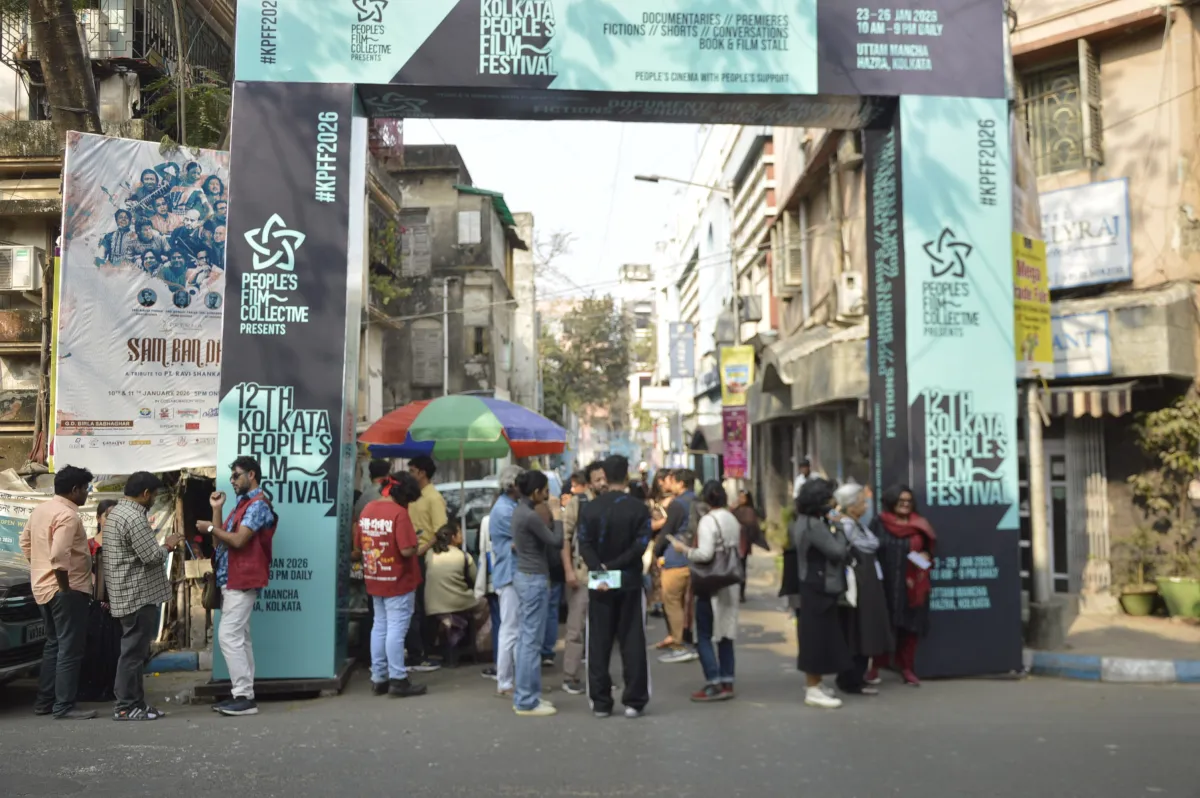


In the days of the Raj, Calcutta was the second city of the British Empire, superseded only by London in size and commercial importance. For better or worse, Kolkata, as it is called today, is still often seen as India’s cultural capital. In an annual calendar populated by iconic events—including historic music conferences, glittering cultural festivals, and the most attended book fair in the world—a small indie film festival might be the least glitzy but the most important of them all.
Like its previous iterations, the 12th Kolkata People’s Film Festival (January 23–26, 2026) was organized on a shoestring budget, raised entirely through voluntary subscription. “It is not easy [for filmmakers] to trust a festival which is not tagged with big names or big title sponsors, which is not giving out an award,” Kasturi Basu—a co-founder of the People’s Film Collective (PFC), which organizes the festival—said in her closing speech. “The only award is a very energetic audience and a good screening. And this gives us the assurance that we are all a community together.”
The close-knit DIY aesthetic was emphasized when Basu went on to sweetly thank an audience member for lending a backup laptop and projector, as well as all the school students who had volunteered at the four-day event. “And the biggest thanks are due to you,” Basu pointed at the packed hall, “You are not just the audience…you are the funders of this festival, you are the ones running it.”
With no designated artistic director and no specified programmers, KPFF is the fruit of genuinely collective labor. There were dozens of volunteers this year: researchers, college students, and community activists. The school kids working the event were from Rokeya Shiksha Kendra. Named after the pioneering early-20th-century Bengali feminist writer and educator Rokeya Sakhawat Hossain, this is a free daycare and learning center for marginalized children, run by many of the same people responsible for KPFF. In the foyer, the school had a bake sale going. Friends and fellow travelers had contributed artwork: handmade lamps, a beautiful nakshi kantha (a centuries-old Bengali art form of embroidering quilts), and enormous installations linking Israel’s genocide in Gaza to the Indian state’s anti-immigrant violence on the Bangladeshi border. These were displayed in the foyer, on the landing, and along the steps of Uttam Manch, the auditorium in southern Kolkata that hosts the event every year. Between screenings, the speakers piped out Victor Jara, the Chilean singer murdered by the army after it overthrew Salvador Allende on September 11, 1973. Along the walls, a makeshift bookstall sold antifascist literature.
One of the predominant themes of this year’s festival—addressed in a number of intense short docs—was labor and migration against the backdrop of a changing climate. Emblematic of many of these films, Atish Dipankar’s 25-minute Against the Tide (2024) captures a sinking Ghoramara Island, which saw some of the first Indians to be displaced because of the state’s overenthusiastic embrace of dam building. This lopsided development has combined with rapidly rising sea levels to reduce Ghoramara’s land mass by three-quarters. As the river devours this fragile island 60 miles south of Kolkata, three families on the edge of climate migration fight to stay rooted in shifting soil. A young fisherman rebuilds his home, destroyed by landslides, for the third time; an older man is forced to abandon ancestral lands for distant labor; and Revati and her son Biltu cling to their home even as the sand shifts under them. Scored to the mournful tangoes of Astor Piazzolla and set against the shimmering lights of the big city on the northern horizon, the five thousand residents of Ghoramara are fighting a losing battle against land erosion. “If I have to leave Ghoramara,” says Biltu, “It’ll hurt very badly.”
Under similar threat of erasure, the Mirs are a community of musicians who live in the Thar Desert near the border between India and Pakistan, where they are the custodians of a music that transcends both religion and nation. Once a vibrant blend of Islamic Sufi music and Hindu Bhakti poetry, their songs have faded to a whisper as the land gets drier and the borders harder. Music in a Village Named 1PB (dir. Surabhi Sharma, 2025) stitches together these fleeting melodies to paint a picture of the Mirs—some of whom are age 100 or older—and their struggle to preserve their heritage in an increasingly divisive subcontinent.

Outside the festival auditorium, audience and filmmakers catch up for tea and adda.
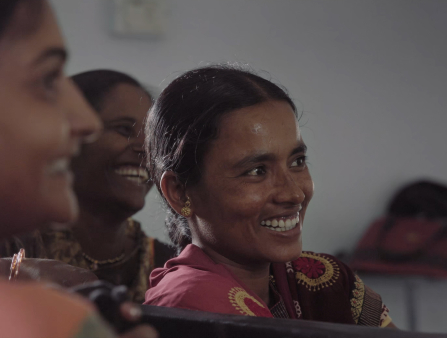
Marching in the Dark.

Queues at the bookstall.
In today’s India, the specter of censorship looms like a hungry elephant in the room. The media ecosystem is almost entirely controlled by oligarchic corporatists hand in glove with a protofascist political establishment, so it is a minor miracle that KPFF manages to screen political and alternative cinema that is frequently banned, censored, or unofficially ignored in most other spaces. Last year, both the International Film Festival of India in Goa and the International Film Festival of Kerala refused to screen films that were already invited.
Smaller independent festivals have also faced the ire of the Ministry of Information and Broadcasting. The inaugural India Doc Fest in Delhi did not receive clearances to publicly screen three films, one of which played to rapturous applause on the second day here: Marching in the Dark (dir. Kinshuk Surjan, 2024), which follows a young widow in Maharashtra—one of more than 400,000 women farmers who have lost their husbands to suicide in the last 20 years—as she navigates her grief and finds joy in community with other women like her.
In India, a film requires official certification only if it is released commercially or broadcast on television. Most state-sponsored festivals, and many independent ones, however, continue to submit lists of screenings to the ministry. More often than not, this is out of fear of extrajudicial reprisal—hoodlums breaking up a venue, for example—which often happens with tacit state approval. Many documentarians are rumoured to have stopped bothering to even apply for certification anymore.
So, perhaps understandably, the last day of the festival saw a packed house for a special screening of the UK documentary To Kill A War Machine (dir. Rainbow Collective, 2025). Last year, the UK Home Office proscribed Palestine Action as a terrorist organization, leaving To Kill a War Machine in legal limbo as the Terrorism Act now extends to Palestine Action’s civil resistance against Israeli arms manufacturers in the UK—and, potentially, anyone who distributes, screens, or views the film.
Frenetic and immediate, the film consists of footage pulled from social media and activist networks, with voiceovers from the founders of the direct-action group Palestine Action. Many of the activists film their own acts of sabotage, holding cameras as they shatter factory glass, climb onto roofs, scale fences, and daub machinery with red paint. These acts of property damage are framed as profoundly moral choices rooted in solidarity with Gazans under perpetual siege, a refusal among ordinary Britons to accept complicity in an ongoing genocide.
The media ecosystem [in India] is almost entirely controlled by oligarchic corporatists hand in glove with a protofascist political establishment, so it is a minor miracle that KPFF manages to screen political and alternative cinema that is frequently banned, censored, or unofficially ignored in most other spaces.
The film does not eschew the conventional documentary tactic of talking heads. These include academics, Black Lives Matter activists, the rapper Lowkey, and the mother of Fatema Zainab Rajwani, a 20-year-old jailed for smashing up a factory owned by a subsidiary of Elbit Systems, Israel’s largest weapons manufacturer. (On February 4 this year, some months after the film was released online, Fatema and her comrades—the “Filton 6”—were acquitted of charges).
“To screen a film about the Palestine massacre is no longer kosher in India,” Dwaipayan Banerjee, another PFC co-founder, said as he introduced the film. “We support the just cause of Palestinian equality. This film is tied directly to our conscience.” At present, the film has been taken down from its website. “This is for the safety and well-being of the communities wishing to organise events or screen the film,” reads a statement on the landing page, “as we have been advised that it is they who would face the greatest legal exposure.”
Telegraphing years of urban ecological transformation into a 29-minute palimpsest, Friends of Jilipibala (dir. Debalina Majumder, 2025) is less world-historical and more local than To Kill A War Machine, but just as immediate. On the surface, it is about the bond between a little child, the eponymous Jilipibala, and an enormous old tamarind tree in her neighborhood. But this is no ordinary tree: it was planted eight decades ago by a famous revolutionary in Vidyasagar Colony—a former refugee colony for persons displaced by the upheavals of Partition.
Majumder shot the film in a 250-meter radius of this colony over many years, with multiple cameras and phones, to document how the tree came to be a bustling sanctuary for humans and nonhumans alike, an ecosystem that has become an organic locus for community. Little children play under it, local women gather tamarind pods, and cats laze on its branches. The closing credits include about 50 different species: birds, monkeys, squirrels, dogs, and lizards.
As the narrative unfolds, the film shifts from a celebration of life in the tentultola (“under the tamarind tree”) to a stark warning about the encroaching threat of urban development. But it is always anchored by its two delightful protagonists—the preternaturally cute Jilipibala and her capacious tamarind tree. Through sharp editing and a masterful sound design, the tree’s vibrant daily rhythms are juxtaposed with the jarring, off-screen sounds of saws felling nearby timber. In the post-screening Q&A, Majumder drew a symbolic connection between the national BJP government’s systematic dilution of environmental laws to this tree. Arguing that ecological degradation in the name of development can also be a profound psychic and sociocultural unraveling, Jilipibala may well be the most charming—and bittersweet—film you watch this year.

To Kill a War Machine.
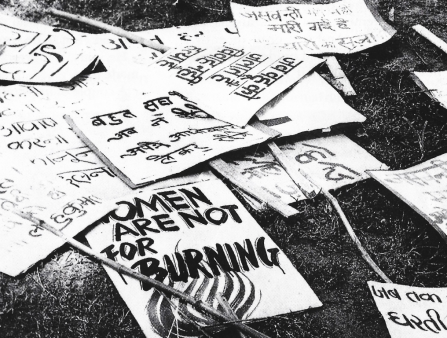
That Dawn That We Will Bring.
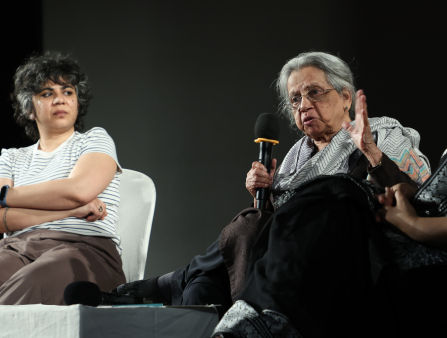
Post-screening Q&A, That Dawn That We Will Bring.
The festival closed with a rousing tribute to Indian feminist filmmaking, the latest doc by the pioneering feminist historian Uma Chakravarthi. Produced by Pension Pictures, the company Chakravarthi set up after retiring from her professorship at Delhi University, That Dawn That We Will Bring (2025) is an attempt to represent her notion that “movements have long roots.”
A lively montage of clips from about 40 documentaries on the women’s movement in India over the last 50 years, the film functions almost like an audiovisual primer on what Chakravarthi prefers to call “the women’s studies movement.” From obscure arthouse features like Chhatrabhang (dir. Nina Shivdasani, 1976) and famous docs like Jai Bhim Comrade (dir. Anand Patwardhan, 2011), to All About Our Famila (dir. Chalam Bennurakar, 2012) and the short Bilkis Bano: Justice Overruled (dir. Bebaak Collective, 2023), Chakravarthi and editor Priyanka Chhabra take us on a whirlwind tour of the solidarity of Indian women—queer, trans, Dalit, Kashmiri, and many other marginalized communities. The resulting film is equally a survey of the filmmakers who have documented them. There are even scenes from an anonymous film that is under legal injunction.
“I was born in a time of hope,” Chakravarthi, who was born during the last gasp of the British Raj, informed the audience wryly, “and I’ll die in a time of despair.” A commentary on feminist movements, feminist publishing and historiography, and, ultimately, the cinematic archive, the energy of the first half of the film gives way to a certain grimness by the end. “But for movements,” she added with a gleam in her eye, “it’s not the end of hope.”
A few days after the festival, I made a pilgrimage to Jilipabala’s tentultola. The tamarind tree spread its branches majestically over neighboring houses. Birds chirped, children played hopscotch, and their mothers lounged under the winter sun. In the shadow of evergreen tamarind leaves, a calico cat nursed her kittens.
This piece was first published in Documentary’s Spring 2026 issue.