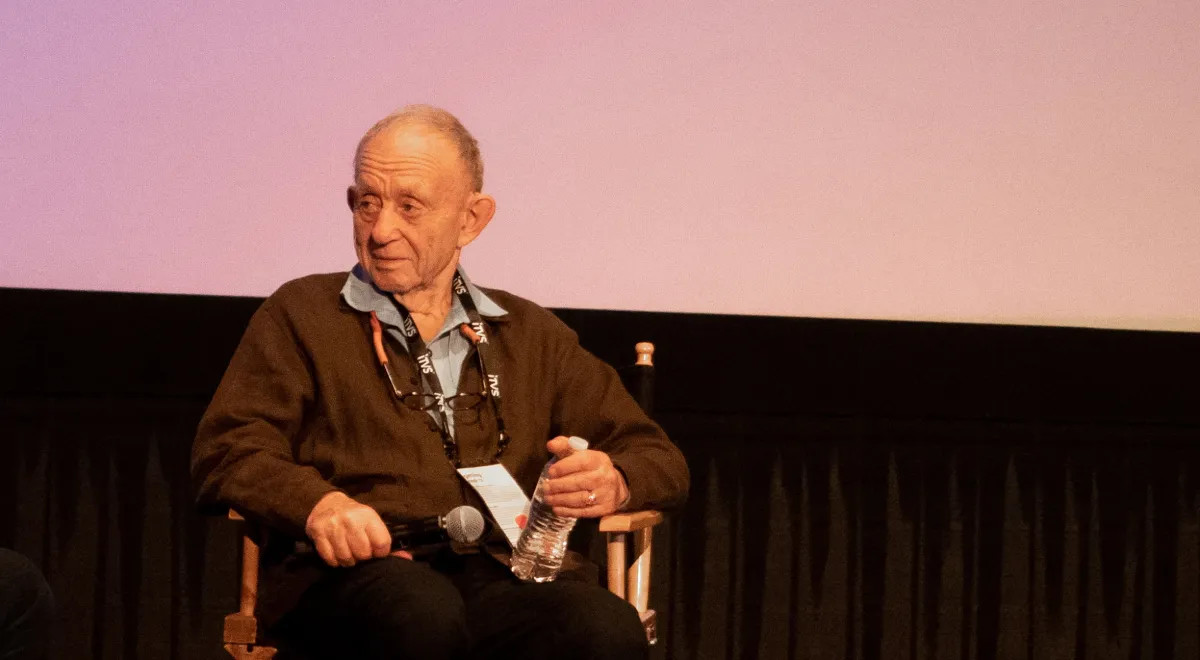


A week ago, Frederick Wiseman passed away. As a filmmaker, his work is indelible. In its breadth and depth, few filmographies, if any, match. He was driven both by personal artistic interest and by a deep humanity. He documented social systems, the law, healthcare, animal rights, governments, arts institutions, and more, and he returned time and time again to explore more. He made long epics: nearly six hours for Near Death (1989), over four hours for Belfast, Maine (1999), and At Berkeley (2013). He also made shorter features that were no less affecting for their more taut runtimes: 75 minutes for High School (1968), 80 minutes for Basic Training (1971), and a few anthologized fiction shorts. As his own editor, he leaned on some recurring visual tropes (funerals and cleaning workers), but also demonstrated a love of and grasp for performance, novelistic scale, and the absurd (I will never forget the vomiting in Hospital [1970]).
But in these reminiscences, I want to highlight some of the business-related things about his filmmaking that are prescient for today: Wiseman’s self-distribution of his films.
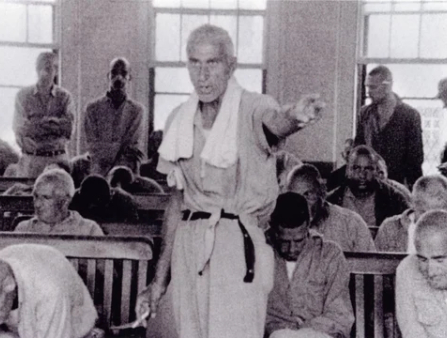
Titicut Follies (1967), Wiseman’s first film, documented deplorable conditions at the Massachusetts Correctional Institution at Bridgewater, a prison-hospital for the criminally insane. When teaching a class on legal medicine—he had practiced law before picking up a camera—Wiseman regularly brought students on field trips to observe courtrooms, hospitals, and prisons. Bridgewater became the subject of his devastating debut. Though he obtained permission from state officials to shoot for 29 days and secured releases from subjects, the Commonwealth of Massachusetts sued to ban the film ahead of its scheduled premiere at the 1967 NYFF. State officials claimed the documentary invaded patients’ privacy, though Wiseman countered that the state was more interested in protecting its reputation than guarding the privacy of the men it incarcerated.
A federal judge in New York found Wiseman’s First Amendment argument convincing and allowed the festival screening. But after a contentious legislative hearing, Massachusetts Superior Court Judge Harry Kalus banned Titicut Follies, calling it “a crass piece of commercialism...excessively preoccupied with nudity.” On appeal in 1969, the Massachusetts Supreme Court issued a compromise: only specialized audiences—medical, legal, and educational professionals—could see the documentary. For over two decades, Titicut Follies was the only American film burdened with court-imposed restrictions for reasons other than obscenity or threat to national security. The restrictions weren’t lifted until 1991, with an updated ruling from the same court.
During this period, Grove Press—where the Films division specialized in controversial and avant-garde cinema—picked up Titicut Follies and Wiseman’s subsequent film, High School. But Wiseman wasn’t happy with the returns he saw from the films’ theatrical and non-theatrical screenings. In 1970, he founded his own distribution company, naming it Zipporah Films after his wife and business partner, Zipporah Batshaw Wiseman, who passed away in 2021. They are survived by their sons, Eric Wiseman and David Wiseman, and their families. Even now, Zipporah Films owns the U.S. rights to every film he directed, contracts bookers for theatrical releases, produces and sells its own home video and DVD box sets, negotiated licenses with public libraries and universities around the world for educational copies, and fundraised for the restoration and digitization of his first 33 features, which were shot on 16mm.
This total dedication to self-distribution might seem unusual, but many pioneering direct cinema documentarians self-distributed to great success at the onset of the American independent film movement in the 1970s. Wiseman’s path to filmmaking began with Shirley Clarke’s The Connection (1961), then as producer of her The Cool World (1963). In 1962, future M*A*S*H writer Allan Katz described Wiseman’s early forays:
[Wiseman’s] first association with film-making was as an investor in The Connection. Miss Clarke’s first film was financed, as Broadway plays are, by a limited partnership arrangement; over two hundred investors put up sums ranging from fifty dollars to twenty-three thousand dollars. The principal advantage of this method of financing low-budget films is that it enables the producer to find investors who are interested in his particular project and who are willing to leave artistic control in the hands of the director.
This investment model—prioritizing artistic control over maximizing returns—shaped Wiseman’s entire career. His films were funded by WNET and other individual PBS stations and sometimes by ITVS, Ford Foundation, and other entities, but he retained both editorial control and rights. He persisted even when the going got tough by the 2010s. To explore other funding avenues, Wiseman pitched In Jackson Heights at the 2015 Hot Docs Forum, where a European broadcast commissioner asked him if he would consider a cut-down to broadcast hour (Wiseman said no).
Titicut Follies. All stills courtesy of Zipporah Films
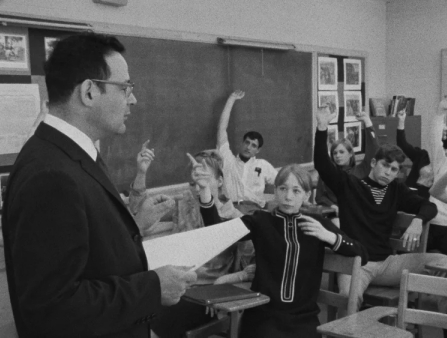
High School.
Over nearly four decades, Documentary has extensively covered Wiseman’s work. In 1991, an early monograph on Wiseman’s filmography by Thomas W. Benson and Carolyn Anderson was reviewed by documentarian and educator Mark Harris, and Wiseman was interviewed by filmmaker John Gianvito on the occasion of his Lifetime Achievement Award from IDA. Several well-known documentary filmmakers selected one of his films for a “Playback” column desert-island pick: Bobby Houston and Laura Poitras on Titicut Follies, and Thomas Lennon on Hospital.
Since the 2010s, several almost-complete or complete retrospectives of his work have traveled the world, many precipitated by the restoration and digital remastering of his first 33 features or by various lifetime honors from the American Society of Cinematographers (ASC), the now-shuttered Human Rights Watch Film Festival, and the Academy. He even made a stop at Getting Real ’18 to deliver a masterclass. The pace of Documentary interviews picked up. But despite all the critical accolades and recent revivals, the amount of writing that we’ve committed to his work still doesn’t feel like enough to convey the seismic scale of his oeuvre.
What Wiseman understood was that documentary filmmaking required infrastructure independent of the institutions it scrutinized. He could spend four hours examining the bureaucracy of a city government or six hours inside a care facility for the dying precisely because he didn’t answer to broadcast executives concerned with ratings or advertisers worried about controversy. Wiseman did not offer Zipporah Films as a model, and often said in interviews that he did not presume how other filmmakers should finance or distribute our films. But his life’s work reminds us that the question of who controls documentaries—who profits from it, who can suppress it—has always been inseparable from what documentary work can accomplish.
In a special preview for the upcoming results of Documentary’s 25 Greatest Documentaries of the 21st Century poll, we asked the IDA members and Documentary contributors who voted for one of Wiseman’s films to note the reasoning behind their picks. Their writing below reflects on the influence of Wiseman’s observational commitment on their own filmmaking and understanding of humanity. They insightfully and movingly describe the films and its observations of the world. Together, they make a strong case for the endurance of Wiseman’s work in an era when documentary faces pressures Wiseman spent his career resisting.
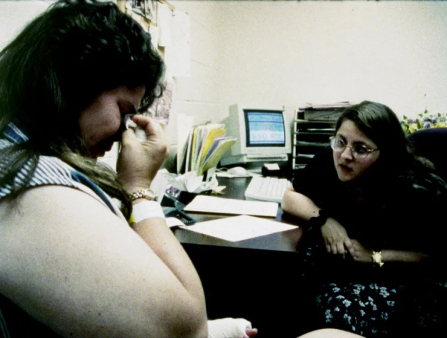
Domestic Violence.
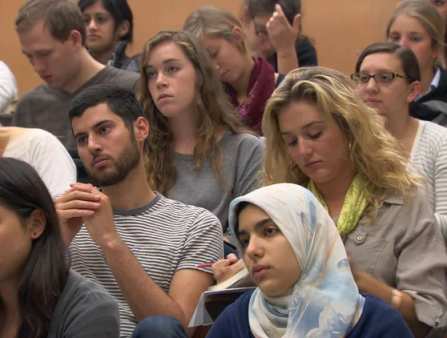
At Berkeley.
Domestic Violence (2001)
In a body of work whose “masterpieces” could reasonably be said to number in the dozens, Domestic Violence might be Frederick Wiseman’s crowning achievement. All of his films are in dialogue with one another, but Domestic Violence could be the skeleton key that unlocks the knotty pain evident throughout his various institutional portraits. By revealing the unending cycles of routine private abuse, Wiseman offers one potential motor on the ceaseless treadmill of American social dereliction, as the hurt originating at home is inevitably internalized and manifests in the public sphere.
Across 44 documentaries, Wiseman demonstrated that institutions aren’t separate from people, but are reflections of them. Such institutions would then naturally fail to break the cycles from which they stem, instead reifying and accelerating them as the years pass, and here we are. And yet among the subjects presented across 56 years of essential documentaries, Tampa, Florida’s The Spring is perhaps the most evident of the director’s frequent assertion that the people he finds operating within undeniably under-resourced institutions are generally “good people trying their best.” I think we can safely make the same claim about this filmmaker who has given us all so much.
—Arlin Golden, co-host of Wiseman Podcast
At Berkeley (2013)
When I was a student at Ohio State, I found out about a documentary called At Berkeley that was going to be showing on campus. I didn’t know anything about it or the filmmaker behind it. But I heard it was good, and that was good enough for me. I bought a ticket and went (unknowingly) on a four-hour tour of one of the country’s foremost educational institutions.
That lumbering but light-on-its-feet behemoth of film hit me like a bolt of lightning. I had never seen anything like it. I didn’t know documentaries could be like that. At the time, I felt it was the most objective documentary I had ever seen—a fly-on-the-wall observing classes, custodians, administrators, and clubs. But At Berkeley was just my first peek into the work of the peerless Frederick Wiseman, whose work feels objective at first blush but is actually so humane, so curious, and so empathetic that it proves subjective in the most optimistic ways imaginable.
So much of Wiseman’s work is about communities attempting to do work, usually good work, and that is at the core of At Berkeley, which feels like an exhaustive tour of the storied campus, though I’m sure it only scratches the surface. It feels like a gift to spend time in these spaces, to hear from students who might someday shape the world, and to witness the infrastructure that allows them to grow and shine. In many ways, At Berkeley feels like a legacy sequel to Wiseman’s High School, one of his early works that I also hold dear. How lucky are we that the world’s foremost documentarian found his way into the classrooms of the world and made other spaces into areas of cinematic exploration and education for us? I’ll miss him so much.
—Clayton Walter, film critic
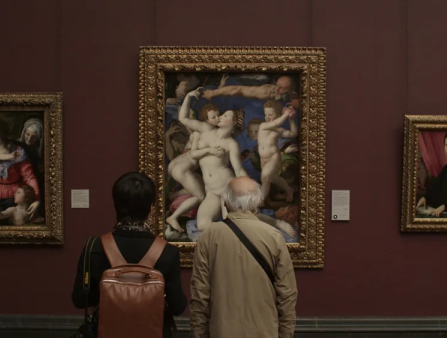
National Gallery.
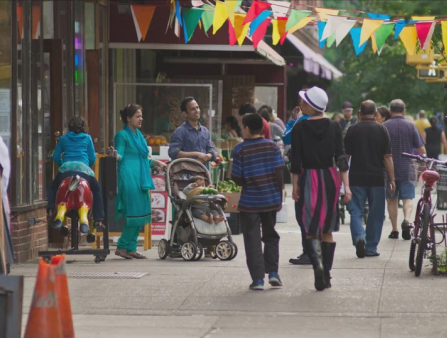
In Jackson Heights.
National Gallery (2014)
I had planned to re-watch National Gallery in full for this remembrance, but had to stop. Every time I interviewed Frederick Wiseman, I would typically mention a newly discovered detail or insight from one of his films, whether or not it was related to the particular title at hand. As the first 15 minutes of his report on the London art museum sent synapses firing anew, it was simply too sad that I could not tell him again what he had helped me to see in—and through—his films.
That’s maybe a long-winded way of saying that Wiseman’s films reward re-watching, as does the work of all great artists. But even those first 15 or 10 or even 5 minutes of a Wiseman can be like hearing the beginning of a symphony or, more to the point, seeing a painter sketching out and daubing in the first layers and conditions of a painting. Or like watching the prologue of a theater, which Wiseman suggests here by showing the light coming up in a museum hall. Echoing the medley of location shots that typically opens one of his films, there follows a montage of paintings—Jan Van Eyck’s Arnolfini Portrait, Van Gogh’s crabs, a Saint Sebastian, too many to process at first—and then an array of museum visitors, whose thoughtful poses echo the head-and-shoulders of previous portraits. And between the paintings and visitors: a man cleaning the floors, something of a Wiseman signature, but also signaling his cinema’s moves between the literal and metaphorical that he often spoke of, between surfaces and depth, art and life, work and play, seeing something and understanding more.
When a guide says of a Camille Pissarro picture, “He’s unlike many of his colleagues in that he does show all strata of society,” it’s possible to see Wiseman’s nod to what he attempted across his oeuvre. National Gallery suggests a self-portrait for this filmmaker, but then so does his entire work feel like an analytic mirror for all of us.
—Nicolas Rapold, host of the podcast The Last Thing I Saw, and currently at work on a book of interviews with Frederick Wiseman
In Jackson Heights (2015)
Frederick Wiseman’s 40th feature, In Jackson Heights, is the first I truly connected with. While attending CUNY’s Graduate School of Journalism, I was assigned to patrol Corona, Queens, for local scoops. Aimless wandering often brought me to nearby Jackson Heights, famously lauded as one of the world’s most diverse neighborhoods. But its authentic texture was a mere kaleidoscopic impression to me. That is, until I experienced the locale through Wiseman’s purview. In just over three hours, the vast goings on In Jackson Heights are filtered through his meandering yet meticulous eye: LGBTQ+ marches, immigrant rights workshops, taxi driver trainings, belly dancing classes, mariachi street performances, and Hindu temple services are just some of the daily priorities for residents.
More than simply documenting one of the country’s most successful “melting pots,” Wiseman deftly displays the dazzling potential inherent to all communities when diversity is embraced rather than discouraged—a message worth championing now more than ever.
—Natalia Keogan, critic and journalist
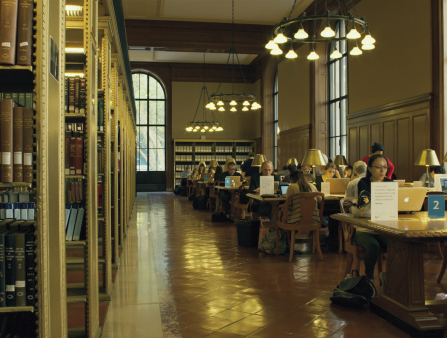
Ex Libris: The New York Public Library.
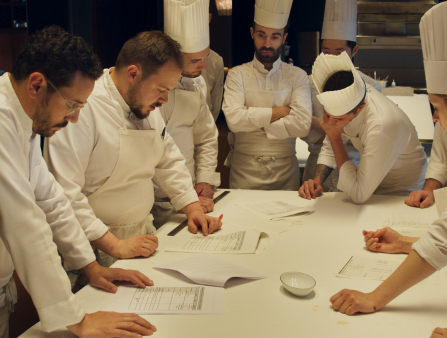
Menus-Plaisirs – Les Troisgros.
Ex Libris: The New York Public Library (2017)
Frederick Wiseman. The name evokes so many descriptors: Patience. Humanist. Uncompromising. Master. But I am blessed to use another word for him, Friend. To be in the presence of someone whose work was a vital part of my life, I devoured his gifts of cinema. Such monumental portraits, but then to work for him as a publicist on some of his films, it was more than work; he gave me respect, he gave me friendship. I will miss no more films, but most of all, I’ll miss my pal. Rest easy, Fred, you’ve earned it.
—Ry Levey, director/producer and owner of Ry Levey Film PR, Distribution & Marketing
Menus-Plaisirs – Les Troisgros (2023)
I was lucky to have known many of the key documentary filmmakers who emerged in the 50s and became prominent in the 60s: Jean Rouch, Joris Ivens, D.A. Pennbaker, and Ricky Leacock. I crewed with the Maysles. Most of these directors worked in both strict observational style of “Direct Cinema” and crossed the line into “cinema vérité,” allowing themselves to interact with the subject to provoke happenings.
Not Frederick Wiseman. He eschewed cinema vérité. He staged nothing, interviewed no-one, intertitled nothing, simply observed from various camera angles and formed his always compelling narrative through his empathetic, oft ironic edit. Facing his compendious images is strangely empowering, an invitation for you to make your own connections, to luxuriate, to research, and edit your own narrative. Wiseman’s films, sometimes four to six hours long, reward multiple viewings. His grounded, legally trained mind created interconnected, holistic portraits of the Institutions he portrayed. Keeping costs down, he filmed an average of one film a year, turning out over 43 documentaries. Each is a lesson in humanism. I watched his enchanting last documentary, Menus-Plaisirs – Les Troisgros, twice. Invited to dine at France’s legendary Michelin spot, he returned to film it. I eagerly sat down to consume his filmic meal twice (it was the best show in town).
Wiseman once said, “People basically go about their business. And the presence of the camera doesn’t have much, if any, effect on their behavior...Generally speaking, people are often unaware of the implications of their behavior or choice of words.” Over decades, his films illuminated that behavior, sometimes to the shame of his subjects, always for our pleasure and edification. A towering figure, the purest of documentarians, no one will be more sadly missed.
—Robin Menken, screenwriter, producer, film historian & film critic