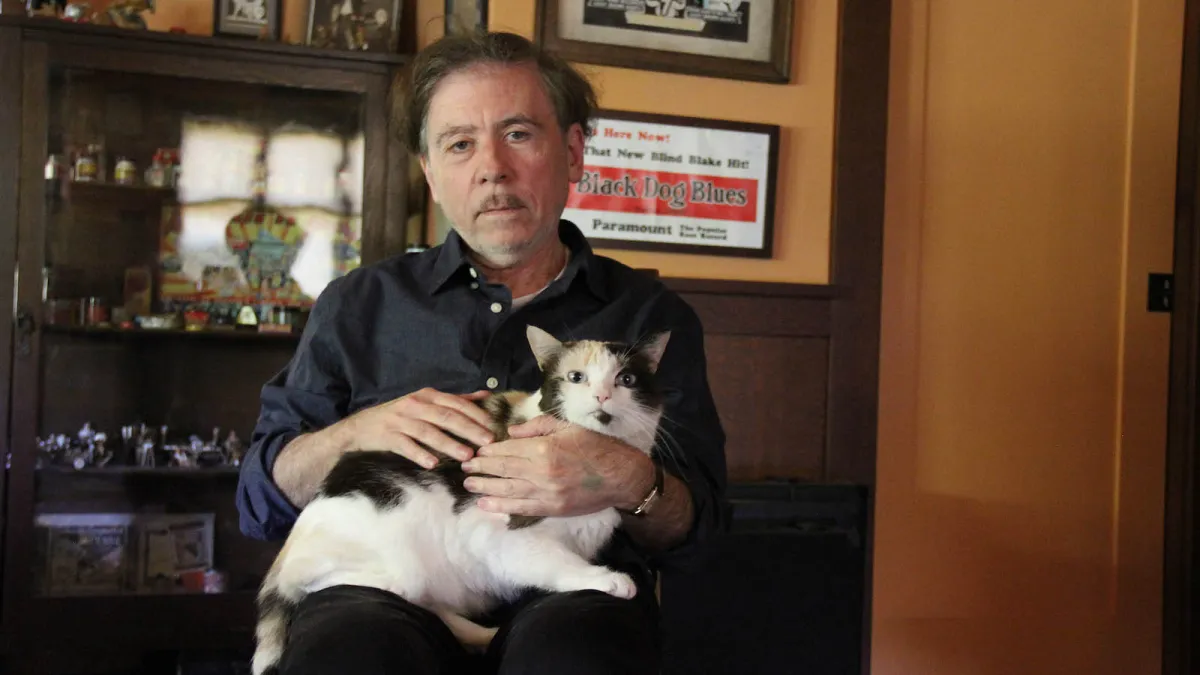


Terry Zwigoff followed an unlikely path to filmmaking. His involvement in the San Francisco underground comix scene of the 1970s led to a friendship with one of the movement’s leading cartoonists, Robert Crumb, with whom he shared a passion for blues music and related genres. That interest compelled him to make a documentary about country bluesman Howard Armstrong despite being a complete filmmaking neophyte.
The result, 1985’s Louie Bluie, received good notices and paved the way for Zwigoff to film Crumb and his family for more than six years. Crumb (1994) proved to be one of the unlikely hits of the ’90s documentary scene, memorable for its lead subject’s singular irascibility, as well as demonstrating how, thanks to his art, Robert still seems to have handled his childhood traumas better than his brothers Maxon and Charles. It remains one of the most important films about American comics and the form’s artists.
This month, Zwigoff is receiving a full-career tribute at Film Forum, with Louie Bluie and Crumb featured along with cult hit fiction features he went on to direct, including Ghost World (2001) and Bad Santa (2003). Ahead of the series, we talked with Zwigoff over email about the myriad obstacles he faced making his documentaries, how they taught him to be a director on the fly, and what’s happened with some of the Crumbs in the years since. The conversation has been lightly edited for clarity.
DOCUMENTARY: You originally planned to write an article about Howard Armstrong before deciding to make Louie Bluie about him. Did you imagine going into it that filmmaking would be a one-and-done deal, just another of the many different artistic endeavors you were engaged with at the time? What made it click that this was something you wanted to spend more of your life doing?
TERRY ZWIGOFF: I had no aspirations to be a filmmaker at the time I did Louie Bluie. I slowly got obsessed with the idea of a film after tracking down Howard Armstrong, talking to him about his life, and getting to know him. He was always a larger-than-life figure to me, if only based on his few recordings from back in the ’20s and ’30s. He was really one of the best that ever did it. I thought he would make a great film, but I couldn’t convince any other documentary filmmakers I knew to take it on, so the responsibility fell to me.
After the film was finished, we showed it around the country at different theaters and film festivals, and it was well received, but I still had no plans to do another film until I got to know Robert Crumb better and met his family. Again, it was more like a compulsion rather than a career plan. After Crumb became financially successful, I was approached by agents and was being sent screenplays to consider directing. I wasn’t being sent any very good scripts—the writing seemed pretty lame-brained and contrived, so I thought, I could write better than this. And then, once it became more personal, for the first time, I started thinking about working as a filmmaker.
D: You’ve spoken about having little filmmaking knowledge before starting Louie Bluie. What was the learning curve like?
TZ: There was a lot of trial and error and a lot of film wasted. But after you start seeing your own life savings rapidly burn through the camera, you start to pick it up. I’m sure you keep learning with every subsequent film you’re lucky enough to get to make. I did. I originally planned to just follow Armstrong around with a camera, cinéma vérité-style, but those plans were thrown out the window early on, when the housing project he lived in decided we weren’t allowed to film there. (This was after they had given me permission months ahead of time.) Howard told me he didn’t want me filming him at his girlfriend’s house in Detroit, because then his girlfriend in Chicago would find out about her. So I had no real places left to film him and had to go in a different direction, but I always strived to capture the truth behind the artifice I had to employ.
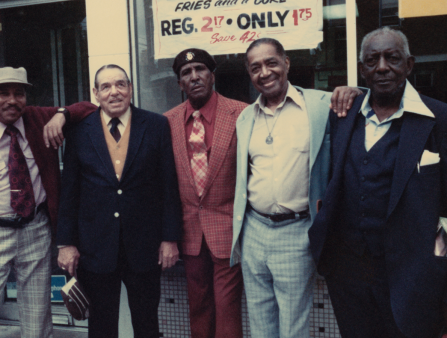
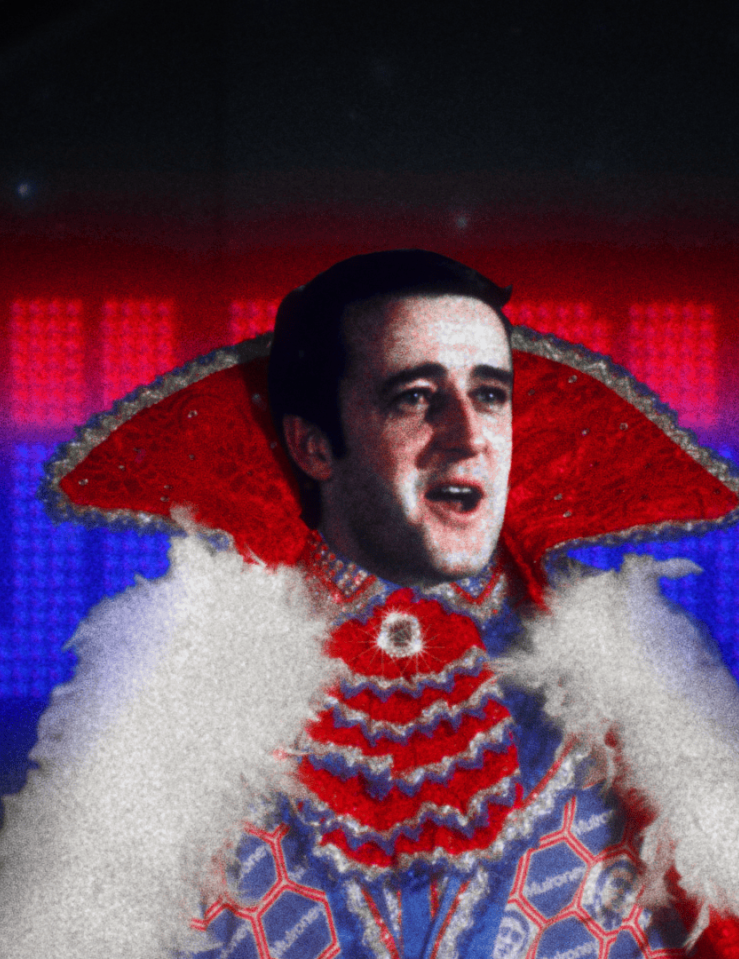
Louie Bluie.
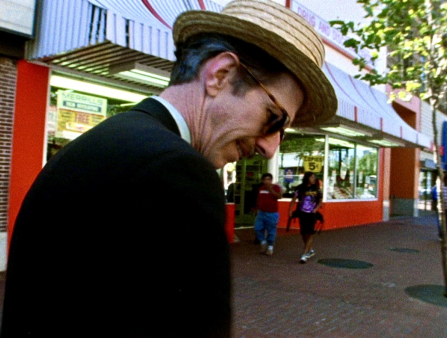
Crumb.
D: Crumb starts with Robert Crumb, in quick succession, talking about the three things he was most famous for at that point—Fritz the Cat, “Keep on Truckin’,” and the cover for Cheap Thrills—and dismissing all of them. It’s a strong statement that the film won’t operate the way one would expect a biographical documentary to.
TZ: That slideshow was something he was doing in Philadelphia, not too far from where his mother and Charles lived. I filmed at their house on the same trip. I always planned to use a more chronological structure.
D: You told Roger Ebert that your cinematographer, Maryse Alberti, took the lead on getting the Crumbs’ mother, Beatrice, to agree to an interview. Did you find your collaborators helpful in other ways in shepherding this project?
TZ: I’m grateful to Maryse and Scott [Breindel, sound]. I couldn’t have done it half as well with anyone else. Collaborators are usually helpful. Scott would often help with the lighting (and he was also the set photographer), and Maryse, of course, would suggest shots or framing. But by far the most helpful thing was that I liked them and felt comfortable with them, as did Robert. They’re smart, easygoing, sensitive, artistic people, fun to be around, whose opinions I valued and trusted.
With Beatrice, Maryse was telling me we should film her after we finished filming Charles. I had always planned to do that, but when we came downstairs, Beatrice got very upset for some reason and said, “No more filming, you have to leave!” I didn’t want to be pushy and upset her even further, but Maryse had gone ahead and quickly thrown up a light and started filming. For a few seconds, his mother really freaked out and started screaming at us, but then suddenly she relaxed and said, “Oh well, too late now,” and then she really seemed to enjoy it.
D: You’ve spoken of issues with your back that made you feel suicidal during the shooting of Crumb. Could you expand more on that?
TZ: I was in almost constant pain with it throughout the film. It felt like a blowtorch on my lower back. The only thing that relieved it was collapsing on the floor to lie down here and there whenever I could. I only took a break during shooting when Maryse and Scott were reloading film or setting lights. It wasn’t fun some days, but there was just no time. I’d had this for years before, but filming was stressful, which aggravated the pain.
I eventually heard Howard Stern talk about his own back pain, which described my symptoms to a T. He had gone to see Dr. John Sarno in New York, so I did the same, and he completely cured me, too. A brilliant doctor—he saved many, many people over the years.
D: For the six years you were shooting, how much of that time was spent with Crumb? Were you regularly accompanying or checking in with him and his family?
TZ: Most of the time was spent waiting for money to be raised so I could buy a few more rolls of film here and there. I’d regularly check in with Robert a couple of times a week, just like I had before I started the film, because we were good friends. Then, the family decided to move to France about halfway through filming. As he’d be the first to tell you, it was his wife’s idea. In retrospect, they were really smart to see what was shaping up in this country.
There was a lot of trial and error and a lot of film wasted. But after you start seeing your own life savings rapidly burn through the camera, you start to pick it up.
—Terry Zwigoff on filming Louie Bluie
D: For the three years of postproduction, how much of the time it took to finish the film came from difficulties with the edit as opposed to difficulties with funding?
TZ: Mostly, we were waiting for finishing funds, although the editing took us a long time—maybe a year. It was a surprisingly difficult film to structure. It was easy to structure each scene, but the overall structure was tricky. I had a great editor, Victor Livingston. He and I got very close to cracking the puzzle, but eventually my producer, Lynn O’Donnell, came up with the idea of moving a few scenes around, and everything finally clicked.
D: The latest news I could find on Maxon Crumb is an SFGate article from 2006 about how he was still living much like how we saw in the film, though he was selling his art and had found some companionship. Can you speak to what he’s been up to, how he’s doing?
TZ: I last saw him a very long time ago. It was after the film had been out for a few years. He’d occasionally walk over to my house and visit. The last time, I was home alone and leaving just as he arrived. I told him I’d be back in an hour or so and that he could hang out. I later learned he had just “passed the cloth” through his body [slowly eaten and then extruded a long cloth string for self-purification purposes] and boiled some water in our saucepan to cleanse it in. It was bubbling up a stink that permeated the entire house when my wife came home and found him there. She ordered him out of the house. We had to open all the windows for days after that to air the place out. We didn’t really encourage visits after that. Funny, when I first met him, he was a rather average guy who’d watch baseball and have a beer after he came home from his auto mechanic job.
D: In recent years, Crumb has focused a lot on compiling and republishing his old work, along with projects like his Book of Genesis, or posting contemporary political commentary in new prints. Looking at the arc of his career, how would you describe the ways his artistic sensibility has evolved?
TZ: He’s become an even better artist visually. Unfortunately, he’s become rather obsessed with conspiracy theories about viruses, and his last comic was mostly about that.