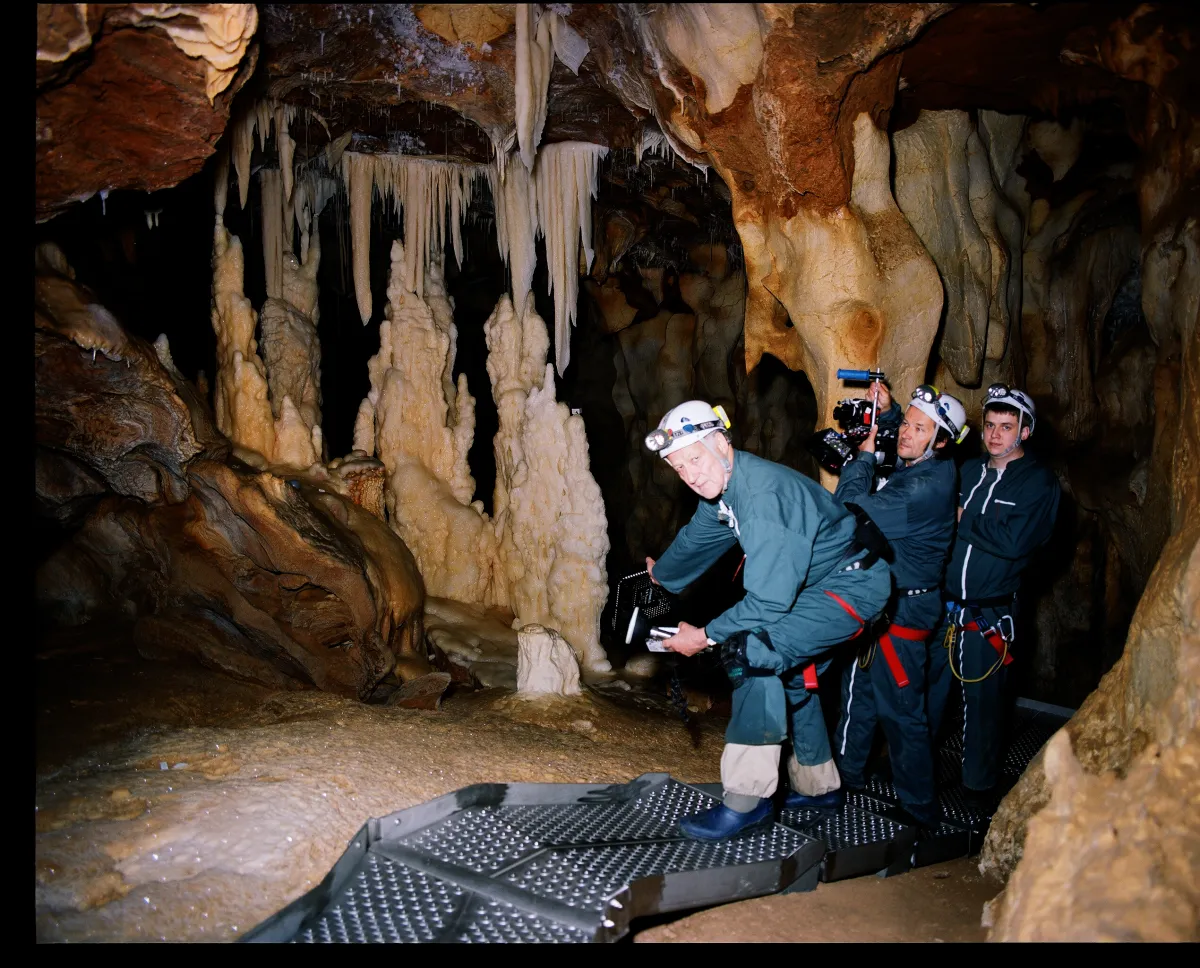


In 1994, speleologists in southern France discovered what would become known as the Chauvet Cave, whose entrance had been naturally sealed for more than 20,000 years. What they found inside was incredible: humanity’s oldest known cave paintings, perfectly preserved. Two decades later, Werner Herzog led a skeleton crew to explore the cave, shooting over a handful of days under strict conditions to avoid disturbing the delicate ecosystem. The result was Cave of Forgotten Dreams (2010), a thought-provoking and immersive meditation on art and history. Winning multiple critics’ prizes, the documentary remains this master filmmaker’s only 3D offering.
Cave of Forgotten Dreams now returns to U.S. theaters in a 6K restoration, screening exclusively in IMAX for the first time on April 15 and 19. (A traditional theatrical run starts April 24.) Viewed in the large-screen format in 3D, the documentary, which features Herzog’s typically musing voiceover and interviews with archeologists and curators, is even more enrapturing, as his camera glides across evocative renderings of horses, lions, and bears—some of which date back approximately 32,000 years. The director’s passion for the natural world and curiosity about the mysteries of the human soul have rarely been served by such fertile subject matter.
I spoke to Herzog about his lifelong obsession with cave paintings, his transporting experience inside Chauvet Cave, and why he still loves his film’s quirky “albino mutant” ending. This interview has been edited for clarity.
DOCUMENTARY: It’s been 16 years since you filmed Chauvet Cave. Have you been back?
WERNER HERZOG: No, you’re not allowed. There were too many visitors in other Paleolithic and Neolithic caves. This created mold, and the caves have become degraded, so a few of the most famous ones are categorically locked down. To avoid the same effect, Chauvet only allows a handful of scientists for a very specific, short period of time to enter.
D: There were many restrictions put on you in terms of filming. What requests did you make to shoot the movie you wanted?
WH: Something that was important for me was saying, “Please let me have a look into the cave before I’m shooting. I have to see what kind of light [I need].” We were not allowed to have hardly any equipment. Only tiny little light panels. [They told me,] “You can only shoot five days, but only four hours each day.” When I was finally allowed to see the cave, it immediately struck me: This has to be in 3D. The film was planned in regular 2D.
D: Because this documentary was such a technical and logistical challenge, did you ever think during filming, Maybe I should scrap this 3D idea?
WH: No, that thought was not allowed. We were committed. At that time, 3D cameras were very large. There was a very narrow passage at the entrance [of the cave] we had to slide through, and we were allowed only to bring in what we could carry. We had to build our own 3D cameras—tiny, the two cameras as large as matchboxes. We had to create our own data collection and management. And apparently, there’s so much additional data in what we recorded that it could now be expanded to IMAX.
I personally do not see movies in IMAX theaters. I see them in a regular theater. But in this case, the film itself set its rules.
—Werner Herzog
D: Did you and your longtime cinematographer, Peter Zeitlinger, strategize how best to capture these paintings in a short period of time?
WH: With Peter, I don’t need to strategize much. The people with whom I work are very, very good—I know they can adapt to the moment and be ready. We went in and filmed everything that makes you awestruck. The only thing I remember is that Peter has a different sensory organ for timing, for speed. I had to tell him, “Linger on it. Linger, linger, linger.”
D: You’ve said that you’d never make another 3D movie. Do you still feel that way?
WH: Unless it became as mandatory as this one. I can tell you what I would do in 3D: I have always wanted to be on a space mission. We shoot it in 3D—on Mars or the moon.
D: What about IMAX? Are you intrigued by that format?
WH: I personally do not see movies in IMAX theaters. I see them in a regular theater. But in this case, the film itself set its rules.
D: You’ve made several documentaries about the natural world, which might look incredible in IMAX.
WH: Ghost Elephants [2025], I don’t see it as an IMAX film. No, I think it’s better where it is [in theaters and now streaming]. And films like Encounters at the End of the World [2007] shouldn’t be in an IMAX theater, because it’s very much a human experience. It’s interaction with very intense human beings—a separate species of what we are. [Laughs]
D: When people vacation, they spend so much time taking photos on their phone that those images can become their only memory of the place. With Cave of Forgotten Dreams, how much is the movie now your own memories?
WH: The experience is the thing that lingers. The film is a natural concomitant, but there are things you cannot have in the film. When we had to leave the cave, I was always lingering behind, so that I found myself all alone for a few minutes. And I got the feeling that I was being watched. Eyes were on me—eyes from 30,000 years back.
D: Was it the eyes of the animals on the walls?
WH: The artists. The humans.
D: Interesting. Do you believe in ghosts?
WH: No, of course not. But it’s a strange feeling. You can’t avoid it. And it’s not a coincidence that some of the scientists who were working in the cave told me exactly of the same experience.
D: Was that feeling of eyes on you frightening?
WH: I had the feeling I’m in good company: “Speak to me. Sing to me.”
Cave of Forgotten Dreams is not gonna age. If you revisit the film 150 years from now, it still will be alive and vibrant and fascinating.
—Werner Herzog
D: The film examines how art has the power to endure. Do you think about whether your work will last?
WH: No, but my films don’t seem to age. Just a few minutes ago, I saw on the internet someone imploring users to watch Aguirre, the Wrath of God [1972], a film that was made 55 years ago—it’s as if it were done yesterday. It doesn’t age. And Cave of Forgotten Dreams is not gonna age. If you revisit the film 150 years from now, it still will be alive and vibrant and fascinating.
I’m not working for eternity. Partially, I work to make a living. [Laughs] I’m a storyteller, and I know if something is really big. Cave of Forgotten Dreams—man, this is so big. And if it’s so big, it has some staying power.
D: You’ve been fascinated by cave paintings since childhood. What is the hold they have on you?
WH: I don’t know. It was just my own intellectual awakening. When I walked by a bookstore when I was like 12, there was a book on cave paintings with a cover of a horse from Lascaux Cave. I was completely stunned by it. I wanted this book. It took me two months to earn the money. I was afraid it would be sold before I could buy it. It didn’t dawn on me that there were many copies of a book.
D: Do you still have the book?
WH: Yes. It’s not a really good book—it’s a Popular Science sort of thing. Still, it was something that shook me to the core. It’s the first thing that I discovered—beyond family education, beyond school—that was mine. My soul awakened. It sounds very lofty, but I can say it’s really what happened.
D: Was that the moment you knew you wanted to be an artist?
WH: No, but fairly soon it became clear that I was a poet, that I was going to make films. Very early on—because I was so young, 15 or 16—there was no way to find a producer. I was thrown out of every office because I was still a child. I started to work a night shift in a steel factory as a welder. During the day, I was in school. But I earned money to make my films.
D: You’ve kept the documentary’s original ending—a postscript involving you discussing “albino mutant crocodiles,” which has nothing to do with anything that came before. It’s such a peculiar ending, partly because you made up the reason how the “mutants” got that way.
WH: Everyone who saw the film speaks about the albino mutant radioactive crocodiles. [Laughs] It’s so outrageous that it’s obvious I’m taking an audience into this realm of sheer poetry. It’s some of the best [footage] I’ve ever filmed, although it was done in 10 minutes flat. I was not prepared—after shooting [Chauvet Cave]—I would run into albino crocodiles. Nearby was a biosphere with hundreds of big crocodiles, and the climate was created through the steam of a cooling system of a nuclear plant on the Rhône River.
D: Few filmmakers could get away with that ending. Did your producers try talking you out of it?
WH: I have this wonderful producer, Erik Nelson, who did Grizzly Man [2005] and also Encounters at the End of the World. I had packed and driven away. I called him, and I said, “I’m filming radioactive mutant albino crocodiles for the movie.” I think he believed I was pulling his leg. When he saw it, he was fascinated as well. But it’s so outrageous! You can only put it as a postscript in a film.
D: This time when I saw the film, I thought about how it celebrates art, which feels increasingly denigrated in Trump’s America.
WH: Art is always thriving under pressure. You can see that, for example, in Brazil’s Cinema Novo in the ‘60s and ’70s, Brazilian cinema was at its most vibrant during the military dictatorship. It happens quite often that way. The moment the pressure was gone, Brazilian cinema—of course, it’s still strong—but the real force dwindled away.
D: Do you feel more inspired now because of that pressure?
WH: Yes. There’s a challenge out there: you better do something, and you better be at your best to create a counterculture. I’m not the one who would go into exile on a lonesome island where it’s all peaceful and quiet and serene. I want to be in the middle of things.